


Government statistics show inflation has declined for three consecutive months. According to the Bangladesh Bureau of Statistics (BBS), overall inflation fell to 8.32 per cent in July, the first month of the 2026-27 fiscal year, marking the lowest level in eight months.
However, consumers shopping at Dhaka’s kitchen markets say the figures do not reflect the reality they face. With the prices of rice, lentils, fish, meat and other essentials remaining high, they question how inflation could have fallen so sharply.
On Wednesday, Finance and Planning Minister Amir Khosru Mahmud Chowdhury told journalists after an event at the China-Bangladesh Friendship Conference Centre in Sher-e-Bangla Nagar that lower rice and meat prices had helped bring July’s inflation to its lowest level in eight months. He said the BBS had presented the figures “accurately”.
The market situation, however, remained difficult throughout July. Towards the end of the month, prolonged rainfall and waterlogging in several districts caused volatility in kitchen markets. The impact of the fuel price hike in June also pushed up the prices of other essentials. Citing supply shortages, traders raised the prices of almost all vegetables by Tk20-40 per kilogram.
According to BBS data, food inflation fell to 7.16 per cent in July, from 8.60 per cent in June. Overall inflation stood at 9.16 per cent in June and 9.42 per cent in May, the highest in 16 months since February 2025.

Little relief in markets
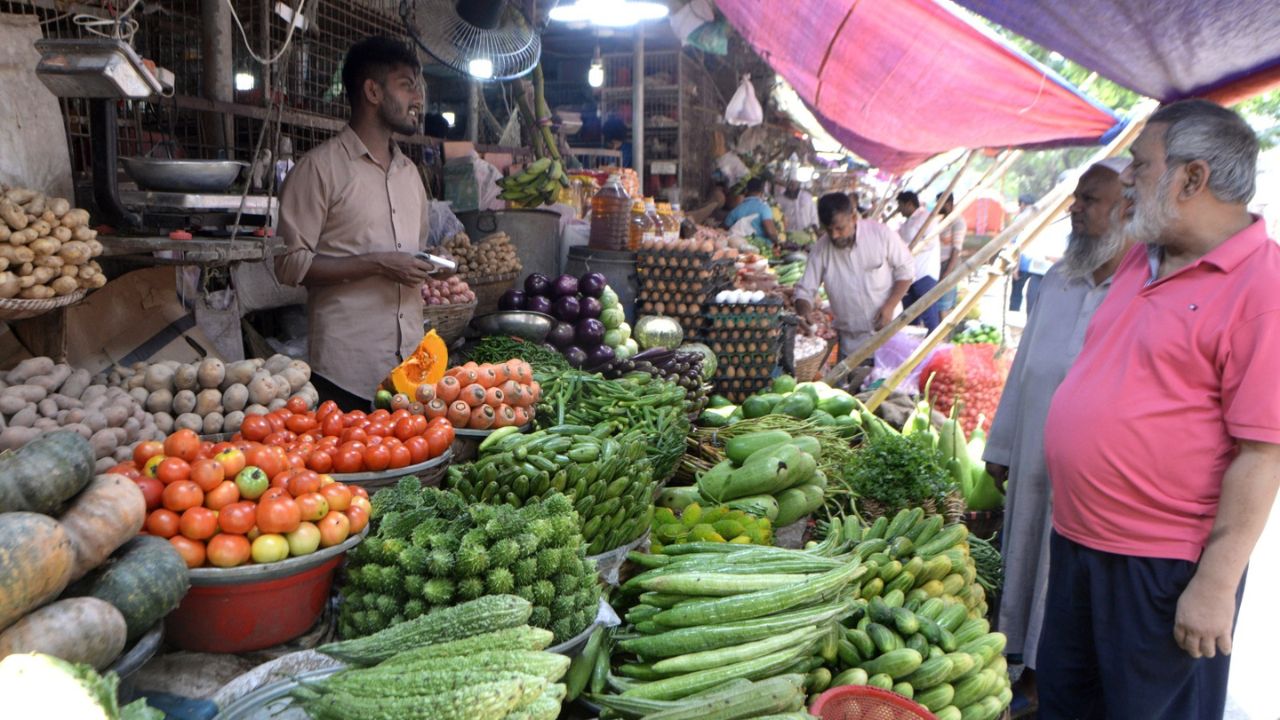
A visit to several markets in the capital, including Merul Badda, Rampura, Malibagh, Karwan Bazar and North Badda, on Friday found little sign of relief. Fish and meat were still being sold at high prices.
Private-sector employee Nazim Islam was shopping at Merul Badda kitchen market. He said, “Two weeks ago, we had to buy fish and meat at exorbitant prices, with sellers citing floods and supply shortages. Today, I had to pay almost the same prices. I bought two chickens for Tk480. That is Tk20 less than last week, but for us, it makes little difference.”
At North Badda market, private-sector employee Rozina Begum was shopping with her seven-year-old son. She said rising prices had made it difficult to ensure nutritious food for her children.




“When my son was younger, I could regularly buy nutritious vegetables, meat and milk. Now, with prices rising at this rate, I can no longer afford nutritious food. Where I used to buy two kilograms of meat, I now buy one. Sometimes, we do not buy meat at all for an entire month. The same is true of fish,” she said.
She added that she had paid Tk2,500 for hilsa on Pahela Baishakh.
Vegetable prices ease slightly
On Friday, pointed gourd was selling for Tk70 per kilogram, cucumber Tk60, bitter gourd Tk80, yardlong beans Tk80, sponge gourd Tk60, ridge gourd Tk80, snake gourd Tk60, round eggplant Tk80, teasel gourd Tk80, carrot Tk120, papaya Tk40, okra Tk60, green chillies Tk120, tomatoes Tk120, taro Tk80, pumpkin Tk60, radish Tk80, bananas Tk40 per four, bottle gourd Tk60 per piece and taro stems Tk80.
Karwan Bazar vegetable seller Saif Islam said, “The vegetable market is relatively cheaper today. Two or three weeks ago, prices had risen so much that customers were buying vegetables by half a kilogram or even a quarter kilogram. Compared to then, prices have now come down to Tk60-80. If crops are not damaged by continuous rain and supplies remain steady, prices should stay within this range.”
Fish, meat remain costly
Broiler chicken was selling at Tk190 per kilogram on Friday, down slightly from Tk200 last week. Karwan Bazar chicken seller Suman Ahmed said prices had fallen by Tk5-10 per kilogram compared with last week, but had risen slightly again on Friday.
Sonali chicken remained unchanged at Tk320-334 per kilogram, hybrid chicken at Tk290-300 and layer chicken at Tk350. Beef was selling for Tk800 per kilogram.
Egg prices fell by Tk10 per dozen to Tk140, compared with Tk150-155 last week.
Fish prices, meanwhile, remained high. Rifa Tasnim, who was looking to buy a kilogram of pangas, said, “I used to buy pangas for Tk180, but now it is impossible to find it for less than Tk200. Tilapia, which was around Tk200 just a few months ago, now costs Tk260. We are having to bear additional expenses every day.”
Rimon Chowdhury, a fish trader at Merul Badda market, said prices remained unpredictable. “I bought fish from the Karwan Bazar wholesale market at around Tk20 lower two or three days ago, but today I had to buy it at the same high prices again. We have to add our profit when selling at retail. There is no relief at all,” he said.
On Friday, pond-raised pangas was selling for Tk230 per kilogram, tilapia Tk260, shrimp Tk800-900 depending on quality, pabda Tk350-400, rui Tk300-500 depending on weight, tengra Tk700, bhetki Tk400-550, mrigel Tk250-300, baim Tk600-800, local koi Tk700-800, farmed koi Tk300, poa Tk260, shol Tk700 and farmed shing Tk300-450.
Pomfret, river sole and large shol were selling for more than Tk1,000 per kilogram.