
Every additional 1 kilowatt (kW) of installed solar capacity could reduce fuel oil imports by around Tk30,000 a year.
A nationwide shift towards renewable energy could create one million green jobs, cut Bangladesh’s dependence on imported fossil fuels and ease pressure on foreign exchange reserves, the Bangladesh Working Group on Ecology and Development (BWGED) said on Wednesday as it unveiled a seven-point policy roadmap to accelerate the country’s clean energy transition.
The civil society coalition urged the government to back the transition with a Tk25,000 crore renewable energy financing facility under Bangladesh Bank, low-cost green loans and direct subsidies for small-scale rooftop and agricultural solar systems.
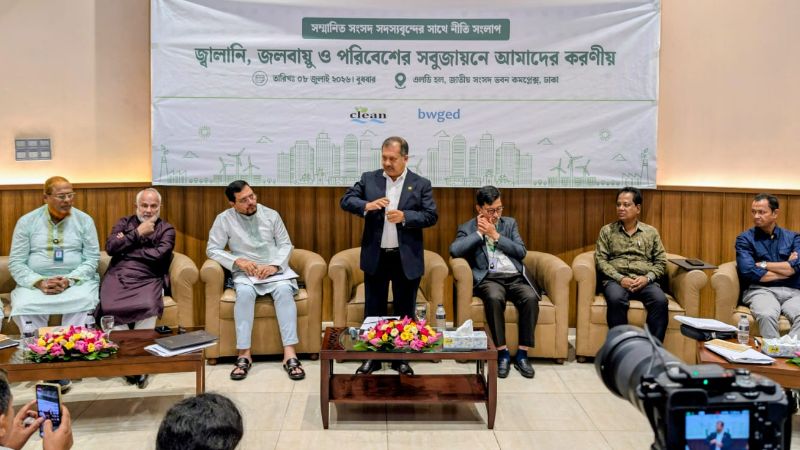
Presenting its proposals at a policy dialogue at Jatiya Sangsad Bhaban, BWGED said Bangladesh’s renewable energy expansion should be driven by households, farmers, local governments and small businesses rather than relying primarily on utility-scale projects.
The group argued that every additional 1 kilowatt (kW) of installed solar capacity could reduce fuel oil imports by around Tk30,000 a year, generating cumulative savings of about Tk5.5 lakh over a 20-year operating life.

“Supporting rooftop solar is not a government expense. It is a strategic investment that reduces fuel import costs, empowers citizens and strengthens national energy independence,” said Hasan Mehedi, chief executive of CLEAN and a BWGED representative.
Among its key recommendations, BWGED proposed establishing a Tk25,000 crore renewable energy financing facility through Bangladesh Bank to provide loans via commercial banks at interest rates capped at 5 per cent.
It also called for a Tk25,000 per kW subsidy for household and agricultural solar systems with capacities of up to 3kW, arguing that upfront financial support would accelerate adoption of distributed renewable energy.




According to BWGED, achieving Bangladesh’s target of 10,000 megawatts (MW) of renewable energy capacity by 2030 would require annual investment of around Tk21,750 crore, including about Tk6,750 crore in direct government support.
The coalition also proposed an additional 10% incentive for renewable energy projects led by women, Indigenous peoples and marginalised communities.
BWGED urged the government to withdraw what it described as a discriminatory National Board of Revenue order that limits tax incentives mainly to utility-scale renewable energy projects operating under long-term power purchase agreements.
Instead, it said, the same tax benefits should be extended to rooftop solar, solar irrigation, solar-powered water supply and other distributed renewable energy systems.
The group also proposed using 14,166 acres of unused land acquired for coal-fired power projects to develop around 6,000MW of solar and wind capacity, eliminating the need for additional land acquisition.
Other recommendations included introducing battery energy storage systems for all newly approved utility-scale solar projects, launching pilot “Green District” programmes and expanding renewable energy skills training nationwide.
BWGED said Bangladesh currently has about 1,679MW of installed renewable energy capacity, far short of the government’s 10,000MW target by 2030.
Speaking at the dialogue, Information and Broadcasting Minister Zahir Uddin Swapon said energy security had become inseparable from Bangladesh’s economic sovereignty.
“Energy security is not merely about ensuring electricity supply. It is about protecting Bangladesh’s economic independence and development aspirations,” he said, calling for faster adoption of renewable energy to strengthen long-term energy security.
The dialogue was attended by lawmakers, energy experts and policymakers, including Khulna City Corporation Administrator Nazrul Islam Manju and Members of Parliament ABM Mosharraf Hossain, Dipen Dewan, Kamruzzaman Kamrul, Mohammad Abu Sufian, Mohammad Shafiqul Haque Milon, Mahbubur Rahman Belal and Sultana Jesmin Jui.