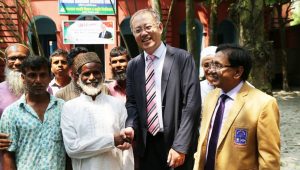
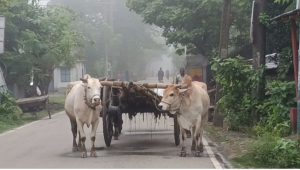
Civil society organisations on Sunday formed a human chain in Dhaka to mark the 50th anniversary of the historic Farakka Long March, presenting a 10-point demand to ensure fair water rights and protect transboundary rivers.
The program was organised on the morning of May 23, with speakers highlighting how the Farakka Barrage has devastated Bangladesh’s southern region through increased salinity, drying rivers, and disrupted agriculture and public life.
Executive Director of ALRD Shamsul Huda read out the written statement on behalf of civil society. “The historic Farakka Long March of 1976 taught us that saving rivers means saving the country,” he said.
Senior journalist Abu Sayeed Khan said the Farakka Barrage has not benefited either Bangladesh or India, but has rather brought disaster to both countries. He demanded the renewal of the Ganges Water Treaty, the swift implementation of the Teesta Treaty, and a fair share of other transboundary rivers, while emphasising the need for regional cooperation and a comprehensive water treaty under UN mediation.

President of Riverine People Anwar Hossain said river treaties should not be bilateral but rather basin-based regional agreements involving Bhutan and Nepal. He called for building water diplomacy on a rational and scientific basis.
Kajal Debnath of the Hindu Buddhist Christian Unity Council said that just as a fair share of rivers is Bangladesh’s right, the people of upstream countries India, Nepal, and Bhutan also have rights. “The state must negotiate with a strong spine and ensure fair water distribution under international law,” he emphasised.




Zakir Hossain of Citizen’s Initiative recalled that Maulana Bhasani understood long ago that dams destroy river ecosystems. He noted that while Bangladesh has signed international protocols, neighbouring countries have not, urging increased diplomatic efforts.
Mosammat Sultana Begum of the Green Bangladesh Garment Workers’ Federation said the Farakka Barrage has repeatedly caused water scarcity and floods in Bangladesh, demanding a fair share of water in the India-Bangladesh treaty.
Writer and researcher Pavel Partha said the Farakka Long March was not just an anti-dam movement but a question of the existence of transboundary rivers, livelihoods, and development philosophy.
“Rivers cannot be divided by cusec numbers. A river is a living entity with its own life and flow,” he said, calling for adopting Maulana Bhasani’s water philosophy as state policy.
Among the key demands, civil society called for: Declaring 16 May, the historic Long March Day, as National Water Rights Day; ensuring a fair share of all transboundary rivers including the Ganges and Teesta under international law; renewing the Ganges Water Sharing Treaty with a guarantee clause; and ensuring public consultation and participatory decision-making before adopting large projects such as the Teesta Master Plan and Padma Barrage
Others expressing solidarity included Professor Anu Muhammad, Nijera Kori, BELA, BLAST, CCDB, INCIDIN Bangladesh, BARCIK, Badabon, Green Voice, Bangladesh Indigenous Forum, Banalata Women’s Development Organisation, Keraniganj Human Resources Development Society, and others.