


Leaders of the Chittagong Hill Tracts (CHT) Accord Implementation Movement have called upon the newly formed government to prioritise the full implementation of the 1997 Peace Accord within its 180-day programme, while also demanding the removal of the “non-hill” state minister from the Ministry of Chittagong Hill Tracts Affairs.
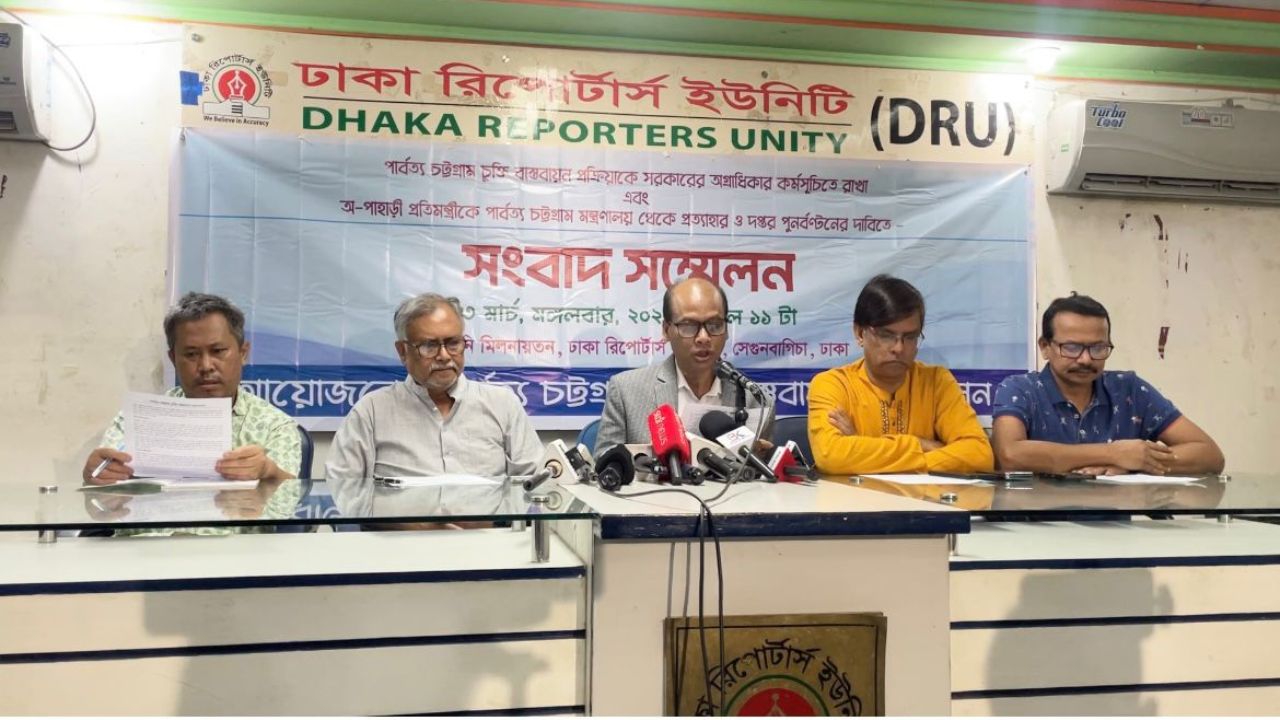
At a press conference held on Tuesday at the Dhaka Reporters Unity, the platform placed a five-point demand, emphasising the need to resolve long-standing issues faced by the indigenous communities in the hill districts.
Professor Dr Khairul Islam Chowdhury, joint coordinator of the movement and a Dhaka University teacher, presented the keynote address. He noted that despite 28 years having passed since the historic accord was signed on 2 December 1997, its fundamental provisions remain unimplemented, leaving the future of the hill people uncertain.

“The newly formed government under Prime Minister Tarique Rahman has announced a 180-day programme covering various sectors. We welcome this initiative and extend our congratulations to the government,” he said. “However, we urge the authorities to include the implementation of the CHT Accord in the priority list to resolve the problems of the region, which covers one-tenth of Bangladesh’s land area.”
Referring to BNP’s electoral pledge of building a “Rainbow Nation” encompassing all ethnic communities, Professor Chowdhury stressed that the government should strengthen this foundation by ensuring consistency with the CHT Accord. He recalled how former prime minister Khaleda Zia played a statesman-like role in advancing the implementation process in 2001 and expressed hope that Prime Minister Tarique Rahman would follow suit.




Khan Asaduzzaman Masum, president of Bangladesh Youth Union, pointed out that appointing a non-hill state minister alongside a full minister in the CHT Affairs Ministry contradicts Clause 19 of Section ‘D’ of the accord, which explicitly states that a minister shall be appointed from among the tribal people. “This conflicting appointment must be reconsidered to avoid creating further tension between hill people and settler Bengalis,” he asserted.
Human rights activist Dipayan Khisa elaborated on the accord’s provisions, noting that during the 2001 BNP government, maximum departments were transferred to the Hill District Councils. “The BNP’s 31-point programme speaks of establishing a Rainbow Nation. We hope to see this reflected in government actions,” he said.
Alamgir Kabir, general secretary of Bangladesh Poribesh Andolon (BAPA), highlighted his long-standing involvement in both environmental and indigenous rights movements. “After the bloody conflict, the CHT Accord brought new hope to hill people. Twenty-eight years later, its full implementation remains incomplete. We expect this government to make it a priority,” he added.
The five demands placed before the government include adopting a time-bound action plan for accord implementation, reconstituting the implementation and monitoring committee, making the land dispute settlement commission functional, arranging dialogue with the CHT Regional Council at policy-making level, and withdrawing the “non-hill” State Minister from the ministry.
The press conference was moderated by Zakir Hossain, joint coordinator of the movement, and attended by its leaders and activists.