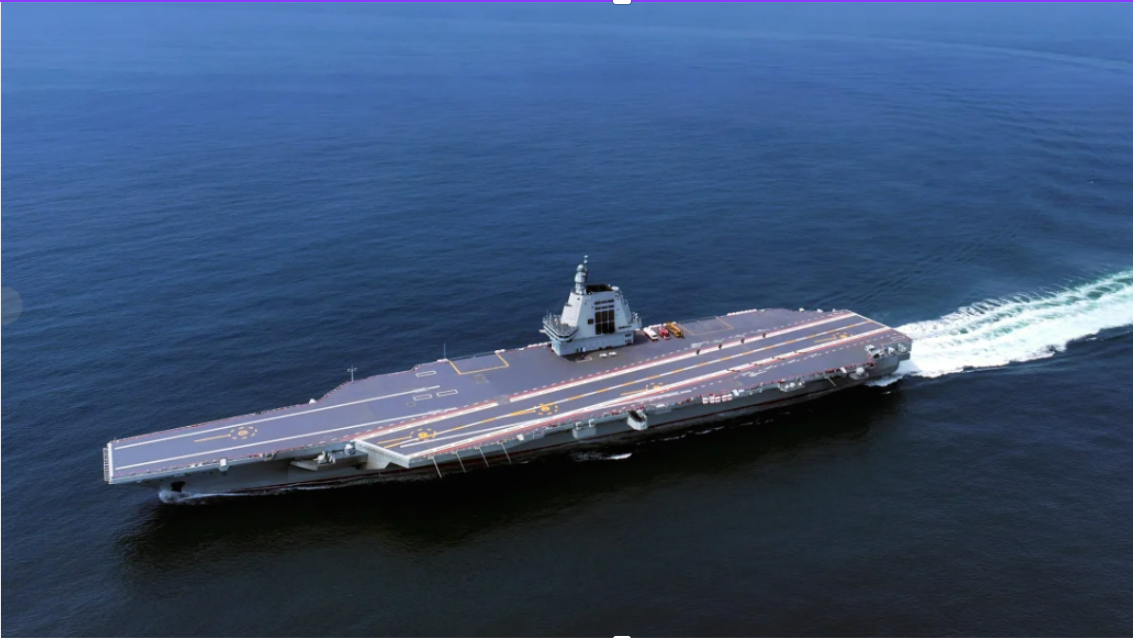

China has officially commissioned its latest aircraft carrier, the Fujian, after extensive sea trials, marking a significant milestone in the country’s growing military capabilities. The Fujian is China’s third aircraft carrier and the first to be both designed and built entirely within the country. The historic commissioning ceremony took place at a naval base on Hainan Island, with top Chinese leader Xi Jinping presiding over the event, underscoring the importance of this naval development to China’s long-term strategic goals.
The Fujian is a clear demonstration of China’s ambition to modernize its military forces by 2035, with the aim of achieving a “world-class” status by mid-century. This new carrier will bolster China’s naval power, enabling it to project force much farther from its shores and improve its ability to compete with the US navy. As China works toward closing the technological gap with the United States, the Fujian represents a critical step forward in terms of both its design and operational capabilities, reports AP/UNB.
The Fujian is a particularly significant achievement as it departs from the older Soviet-inspired designs of China’s previous carriers. Unlike the Liaoning, which was a Soviet-made vessel, and the Shandong, which was based on a Soviet model but built in China, the Fujian uses a more advanced electromagnetic launch system, similar to the technology used on the US navy’s Ford-class carriers. This system offers significant advantages over the older steam catapult systems, including the ability to launch heavier aircraft with full fuel loads, such as China’s KJ-600 early warning and control plane, and its stealthy J-35 fighter.

In addition to the advanced electromagnetic catapult system, the Fujian is capable of carrying and deploying a range of aircraft with increased efficiency. During its sea trials, the carrier successfully launched its latest J-35 stealth fighters, as well as the J-15T heavy fighters and the KJ-600 surveillance aircraft. These aircraft provide the Fujian with enhanced capabilities, allowing it to conduct operations far beyond the reach of land-based support, and giving China a more formidable presence in distant waters like the Second Island Chain, which stretches from Japan to Guam.
One of the major strategic objectives behind the development of the Fujian and other Chinese aircraft carriers is to expand China’s reach into the broader Indo-Pacific region, particularly beyond the South China Sea, East China Sea, and Yellow Sea. China’s naval strategy aims to establish control over the waters of the so-called First Island Chain, which includes key areas like the Taiwan Strait, the East China Sea, and the South China Sea. With the Fujian, China is better positioned to challenge the US navy’s dominance in the Pacific and to contest control of the Second Island Chain, which includes critical US military facilities like those on Guam.


The Fujian is also seen as part of China’s broader vision of becoming a global naval power, capable of operating far from its shores. Military analysts emphasize that, while the carrier gives China the ability to project power more effectively across the region, it also serves to extend the country’s strategic perimeter. With its ability to deploy aircraft far from home, the Fujian will play a critical role in China’s efforts to monitor activities in the air, on the sea, and below the surface, expanding its domain awareness and surveillance capabilities. This development is also seen as a response to concerns about China’s ambitions toward Taiwan, with the Fujian potentially playing a role in any conflict scenario in the Taiwan Strait.
However, despite its impressive advancements, the Fujian is not without its limitations. Unlike the US navy’s fleet of nuclear-powered carriers, which can operate virtually indefinitely without needing to refuel, China’s carriers are conventionally powered, limiting their operational range. Additionally, while the Fujian represents a leap forward in terms of aircraft launch technology and air operations, China still lags behind the US in several critical areas. For example, the US navy possesses a much larger fleet of carriers (11 to China’s three) and has a superior network of overseas bases, which are vital for resupplying and maintaining carrier operations.
China’s naval modernization also faces challenges in other areas, such as missile-launch systems, nuclear-powered submarines, and guided missile cruisers and destroyers, which are key to air and submarine defense. While China is making significant strides in these areas, analysts caution that there remains a gap in operational readiness. While China’s military has showcased its growing arsenal of advanced systems, including hypersonic glide vehicles and advanced drones, experts warn that these capabilities may be overstated, as China has not engaged in a major war since 1979.
Despite these challenges, China’s rapid modernization efforts are closing the technological gap with the US at an impressive pace. The commissioning of the Fujian is just one example of China’s broader military buildup, which includes the development of more aircraft carriers, nuclear-powered submarines, and advanced destroyers and missile systems. Chinese shipyards are capable of building multiple vessels simultaneously, and the country’s naval construction rate far outpaces that of the US, signaling China’s determination to become a dominant naval power in the coming decades.
Experts suggest that while the Fujian may not yet be on par with the US navy’s most advanced carriers, it represents a significant step forward for China’s military capabilities and its ability to project power far beyond its immediate neighborhood. As China continues to modernize its military forces, it is clear that the Fujian is just one of many new assets that will shape the future of China’s naval and global strategic posture.