



The number of registered motorcycles in the country has surged past 41 lakh in just a few years, transforming urban mobility and fuelling the rapid growth of ride-sharing services.
But behind the speed and convenience of the two-wheeled transport lies a quieter yet serious public health and safety concern: the widespread use of poor-quality and unclean helmets.
Observations from across the country suggest that many helmets provided to passengers by ride-sharing drivers are cheap, lightweight and of unknown brands. Some crack easily if dropped and offer little real protection in the event of a crash.
Many riders acknowledge that the helmets are often used simply to avoid police penalties rather than to ensure safety.
“If we do not carry a helmet, we get fined,” said Ismail, who has worked as a ride-sharing driver for seven years. “So we buy whatever we can afford. The companies do not really set any strict standard.”
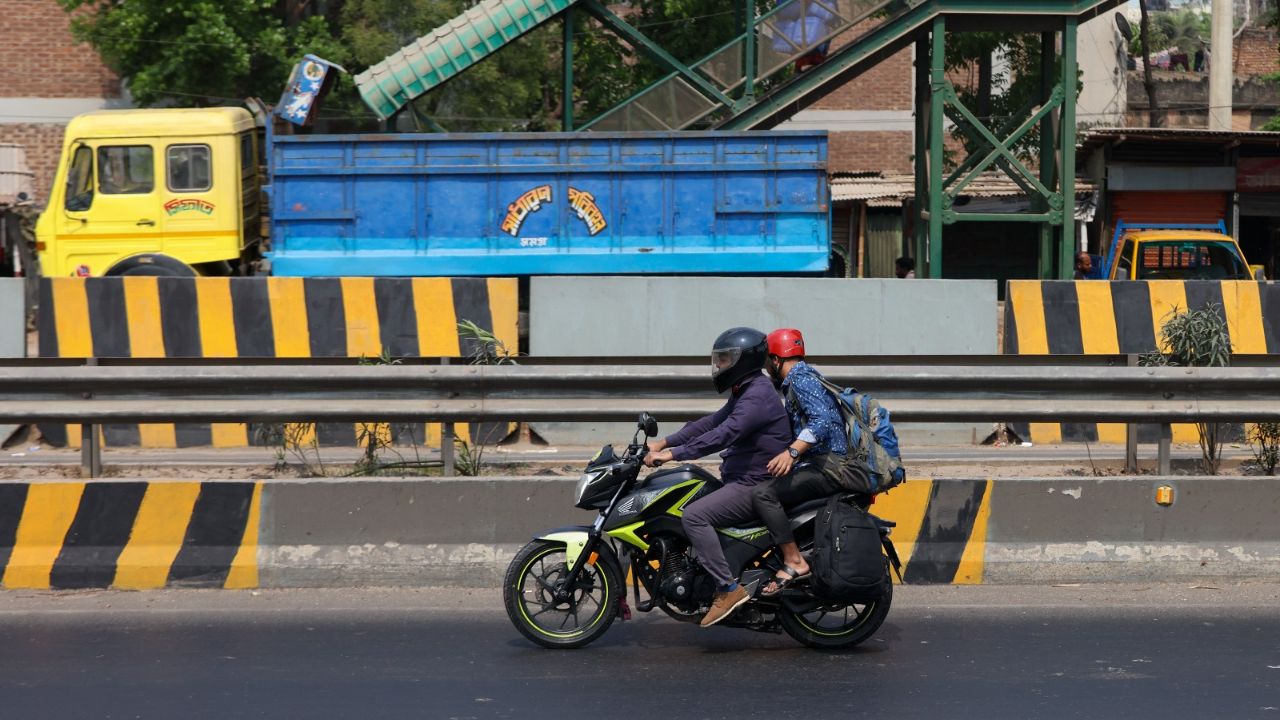
On the streets, passengers are frequently seen using helmets that are already damaged, with cracked shells, loose padding or torn straps. In many cases, the helmets do not fit properly.
Some passengers end up holding the helmet with one hand or tying the strap in a knot just to complete the ride.
Safety experts warn that such temporary fixes not only make the helmets uncomfortable but also eliminate their basic protective function, turning a piece of safety equipment into little more than a formality.

In many local markets, shiny “premium” helmets are sold for as little as Tk300 to Tk500, despite lacking recognised safety certifications such as ISI (Indian Standards Institute), DOT (Department of Transportation) or ECE (Economic Commission for Europe). Many are made with cheap thermocol materials rather than proper protective foam.
Shopkeepers near Dhaka’s Science Laboratory intersection say ride-sharing drivers are among the main buyers of the low-cost helmets, creating strong demand for them in the market.
However, experts warn that these counterfeit products can be dangerous during accidents.Mahmud Omar Imam, former professor in the civil engineering department at Chittagong University of Engineering and Technology, said many helmets on the market may look attractive but fail to meet safety standards.
“In a crash, these helmets can easily break apart,” he said. “In some cases, broken pieces can penetrate the head and make the injury even more severe.”Traffic officials also say fake helmets remain widespread on Bangladesh’s roads.
An officer from the traffic division of Dhaka Metropolitan Police said riders are frequently seen wearing helmets that have no certified safety standard.




Although helmets meeting ISI or DOT standards are legally recognised in Bangladesh, he said the safety requirement is often ignored in practice.
Globally, several certification systems are used to ensure helmet safety, including the United States’ DOT (Department of Transportation) standard, the European Union’s ECE (Economic Commission for Europe) certification – with its latest version, ECE 22.06, considered among the most advanced – and India’s ISI standard.
For everyday riders, helmets certified under DOT or ECE are widely recommended internationally.
In practice, however, enforcement often stops at a simple question: whether a rider is wearing a helmet at all.
Under Bangladesh’s Road Transport Act 2018, both drivers and passengers are legally required to wear helmets properly while riding motorcycles. Violators can face up to three months in jail, a fine of up to Tk10,000, or both penalties.
Authorities have also introduced a “No Helmet, No Fuel” policy.
These measures have increased helmet use in the past two to three years. Yet the number of deaths from motorcycle accidents has not declined. Official figures underline the scale of the problem.
According to the Bangladesh Road Transport Authority (BRTA), 1,706 people were killed in motorcycle accidents in 2024, accounting for 31.13% of all road accident deaths.
The Bangladesh Road Safety Foundation estimates the number to be even higher, reporting 2,609 motorcycle-related deaths that year — 35.76% of the total.
Data from the Accident Research Institute at Bangladesh University of Engineering and Technology (BUET) shows that 88% of motorcycle accident fatalities occurred because riders were not wearing helmets.
The World Health Organization says that using a properly certified helmet can reduce the risk of death in a crash by 40% and lower the risk of serious injury by about 70%.
Doctors say poor-quality helmets can be nearly as dangerous as wearing none at all.
Harun Or Rashid, assistant professor in the orthopaedics department at Dhaka Medical College Hospital, said using substandard helmets can prove fatal.
“A large proportion of seriously injured patients we receive are people who were wearing such low-quality helmets,” he said.
BRTA says it has introduced helmet safety standards, developed in consultation with experts, to ensure rider protection.
According to the agency, approval for certified helmets is now issued within three to five working days. Authorities also say they are conducting mobile court operations and destroying substandard or unauthorised helmets found in the market.
Yet the lack of a comprehensive and effective verification system means unsafe products continue to circulate widely.
The problem is particularly visible in the ride-sharing sector.
Many drivers say the helmets supplied by ride-sharing companies are often of poor quality. Only about two to five per cent of riders, they estimate, use higher-quality helmets at their own expense.
Passenger helmets in ride-sharing services are used by countless people every day.
Sweat, dust, dead skin cells and bacteria accumulate inside the helmet liner, but in most cases there is no regular cleaning or sanitisation.
Health experts warn that this can create additional public health risks. Mohammad Fakhruzzaman, head of the dermatology and venereology department at Dhaka Medical College Hospital, said shared helmets could easily spread infections.
“When the same helmet is used by multiple people, germs can pass from one person to another,” he said, adding that the practice raises serious public health concerns.