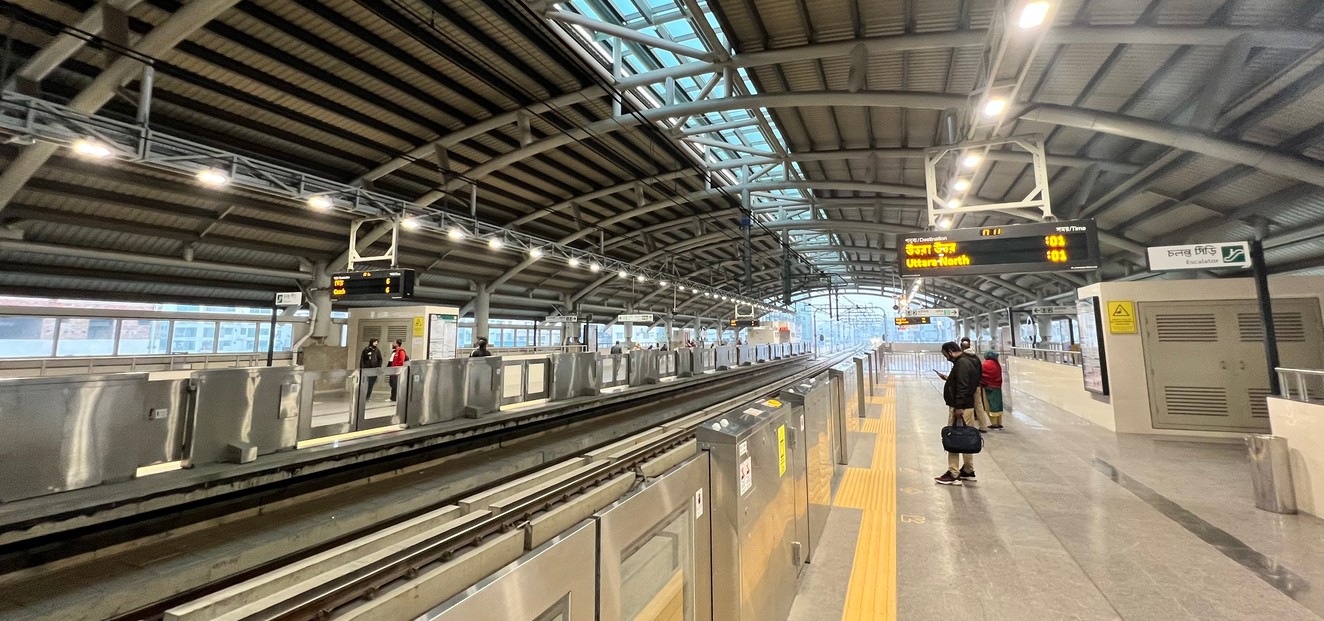



Dhaka’s rapid growth and worsening congestion have made mass rapid transit increasingly urgent. The city now has experience with two systems: Metro Rail and Bus Rapid Transit (BRT). Metro Rail has started positively, providing fast and reliable travel. In contrast, the Dhaka–Gazipur BRT has faced serious delays, with construction still incomplete after more than a decade.
The main rapid transit options available worldwide are BRT, Monorail, Light Rail Transit (LRT) and Metro. Global experience shows that no single mode is best for every situation. The choice should reflect each corridor’s demand, space and local conditions, based on a careful comparison. Rapid transit systems should also be integrated with transport, land use, investment and employment policies.
BRT is relatively low-cost USD 5-25 million (Taka 60-300 crore) per km) and flexible, which requires dedicated bus lanes. Most of the BRT systems in the world are at grade but physically segregated, such as Bogotá’s (Colombia) TransMilenio and Dar es Salaam (Tanzania). Although uncommon, elevated BRT systems do exist, like in Xiamen (China). Its reliability is dependent on protecting and enforcing its lanes. BRT performs well in corridors where demand is moderate. It is often more effective when integrated with rail.
LRT needs tracks and power systems and costs more to build (USD 20-80 million or Taka 240-960 crore per km). It suits medium-to-high demand corridors. LRT can provide an effective intermediate solution where BRT capacity becomes insufficient, and metro investment cannot yet be justified. Manchester (UK) and İzmir (Türkiye) provide successful example of LRT. Manchester LRT expansion occurred progressively as demand increased rather than through one very large initial investment.

Monorail systems are proven medium-capacity transit options for specific needs. They suit narrow roads, difficult terrain and places where space, noise or visual impact matter. They use elevated infrastructure and cost about USD 30–150 million (Taka 360-1,800 crore) per km, considerably less than traditional elevated metro. They can also be built quickly. Chongqing (China) has the world’s largest monorail system, covering approximately 100 km and carrying over 1 million passengers daily.
Metro is the highest-capacity rapid transit option and requires fully separated rail infrastructure. It is also the most expensive: USD 50–150 million (Taka 600-1,800 crore) per km for elevated sections and USD 150–350+ million (Taka 1,800 -4,200+ crore) per km underground. Metro provides reliable service in very high-demand corridors and can support better urban development. However, planning, land acquisition, utility relocation, construction and testing can take years. Metro also needs long-term funding for operations, maintenance and renewal. Strong governance, experienced management and good planning are essential for metro’s success.
The Asian Development Bank (ADB) supported Dhaka–Gazipur BRT project (20 km; approved in 2012) has faced major delays, cost increases and implementation problems. Key causes include weak project preparation, shortcomings in feasibility study and design, contractor underperformance, utility relocation and poor coordination. The main lessons from this initiative are clear: prepare projects carefully, manage implementation strongly, and do not blame the BRT system itself. The project’s failure does not prove that BRT is unsuitable for Dhaka. BRT remains a viable and potentially cost-effective option for suitable moderate-demand corridors, especially where Metro is too costly. With proper design, dedicated lanes, enforcement, good stations, reliable service and integration with other modes, BRT can still play an important role in Dhaka.



Dhaka’s Metro Rail is showing promise, with Line-6 providing fast travel and carrying about 400,000–420,000 passengers daily. However, the 21km Line-6 took over six years to build and costs far more per kilometre than comparable Indian metros. High construction costs, land and construction risks, procurement problems and weak institutional arrangements remain major challenges. The key lessons are to control costs, improve project preparation, use standard designs and competitive bidding, and strengthen governance.
Future metro development should be phased, focusing first on high-demand corridors while considering BRT, Monorail or LRT where demand is lower. Affordable fares, strong bus and last-mile links, local skills, reliable financing and better regulation are essential for metro’s success. With these reforms, Metro can become the backbone of Dhaka’s transport system while working with other modes to create an efficient network. One good example of successful metro system is Singapore MRT. Singapore’s system carries over 3 million passengers daily and has very high reliability.
A mode-neutral approach is necessary for deciding appropriate rapid transit system in Dhaka. The decision framework will involve several steps. First, define the corridor’s transport problems, establish current demand and forecast realistic demand. Then compare alternatives: BRT, LRT, Monorail, Metro, and combination of different modes. Alternatives could be compared using the following criteria: capacity, cost, space, benefits, environmental impact, risks and long-term affordability. An opportunity for integration with other transport modes also needs exploring. A detailed economic and financial evaluation will help in the decision-making process.
For Dhaka’s existing dense development, available road space and land constraints should also be considered. High-demand corridors may justify Metro, while medium-demand corridors may suit BRT, LRT or Monorail. Land-use planning, transit-oriented development, bus integration, parking and walking facilities should be planned together. Investments and employment policies should support development outside the most congested areas. Stronger transport governance, realistic phasing, competitive procurement and sustainable funding are also essential for developing a sustainable rapid transit system.
Major risks factors should also be considered while selecting the appropriate rapid transit mode. Major risks include cost overruns, delays, poor design, weak management, land problems and weak operations. Residual risks, after the implementation of the mitigation measures, need careful evaluation. For instance, metro systems are considered high risks compared with other rapid transit options. Investment decisions should be based on to what extent the risks can be mitigated.
Dhaka needs to build a connected transport network, not isolated investment projects. It is suggested that the city should follow a corridor-based, mode-neutral approach, for the selection of rapid transit mode (BRT, Monorail, LRT, or Metro) according to demand and local conditions. Metro should serve the busiest corridors, while BRT, Monorail and LRT can serve suitable medium-demand routes. Decisions should consider physical costs (construction), temporal costs (potential delays) and fiscal costs (long-term funding and operations). Given Dhaka’s high metro costs and BRT’s poor implementation experience, better preparation, design, procurement, phased investment and risk management are essential. Every project needs to maximise value, integrate buses, walking and cycling, and remain financially sustainable.
The views expressed in this article are solely those of the author
The writer is a Senior Transport Specialist (Retd.), World Bank, Washington D.C.
E-mail: [email protected]