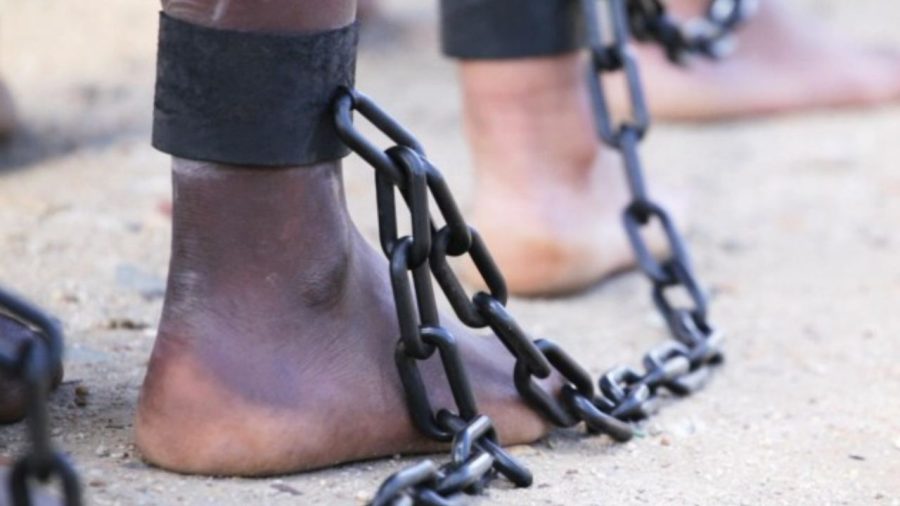

Newly published historical research reveals that enslaved African people were seared with red-hot metal brands bearing the British royal crown, documenting the monarchy’s centuries-long involvement in Britain’s transatlantic slave trade.
The findings form part of the Register of British Slave Traders, a historical record identifying thousands of investors in human trafficking, including British monarchs.
Nicholas Radburn, a historian at Lancaster University and lead investigator for the register, discovered evidence of the crown branding within the archives of the crown-backed South Sea Company.
Radburn identified a letter dispatched by the company’s court of directors to its agents in Buenos Aires, instructing them to brand enslaved captives using a red-hot silver mark bearing a crown emblem, reports Guardian.
Although a physician, Dr Dover, warned that the large mark could endanger the lives of enslaved people, the board directed its agents to disregard the medical warning, asserting that branding was the most effective method to distinguish their enslaved workforce from others.
The directors who authorised the branding included prominent figures from England’s political and financial establishment, such as Members of Parliament and Bank of England directors, who signed the letter as “your affectionate friends, the court of directors”.
Radburn noted that the instructions illustrate calculated cruelty conceived in a London boardroom that directly resulted in human flesh being seared across the Atlantic.

Register of British Slave Traders and royal companies
The Register of British Slave Traders documents how Britain’s enslavement and forced transport of more than three million African people over nearly 250 years functioned as an official national enterprise led by its monarchs.
The publication of the register is expected to intensify calls for King Charles III to explicitly acknowledge the royal family’s historical role in transatlantic human trafficking.
The expansion of the trade reached its height following the restoration of the English monarchy in 1660.
James, Duke of York, who later ascended the throne as King James II, served as governor and a major shareholder of the Royal African Company (RAC), established in 1672.
Historical records show that the RAC trafficked more African men, women, and children than any single entity in history.



The RAC and its predecessor, the Company of Royal Adventurers, were created by King Charles II and financed by royalist courtiers, politicians, and establishment figures holding official titles such as Edward Proger, “groom of the bedchamber”, and the Earl of Falmouth, “groom of the stool”.
Board meetings where trafficking operations were planned took place in James’s private apartment at Whitehall Palace, the royal family’s principal London residence prior to the construction of Buckingham Palace.
Prof William Pettigrew, lead historian for the register, described James II as “the most important English slave trader of the 17th century”, stating that royal slave trading companies were fundamental to the Stuart dynasty’s strategy to solidify the restored monarchy within the British constitution.
James managed transatlantic trafficking operations alongside his cousin, Prince Rupert of the Rhine, whom the register identifies as “the visionary for England’s fully fledged, state-backed slave trade”.
Additional royal investors included Queen Catherine of Braganza, the Portuguese wife of King Charles II.
In her book The Crown’s Silence, historian Prof Brooke Newman chronicled royal ties to human trafficking ranging from early voyages supported by Queen Elizabeth I in the 1560s to King William IV, who opposed the abolition of slavery for decades.
Prof Newman highlighted that the RAC also branded enslaved Africans at coastal forts and factories using the marks “DY” for the Duke of York and “RACE” for the Royal African Company of England, with explicit instructions issued to mark children as young as three years old.
South Sea Company and treaty obligations
In 1713, Queen Anne concluded the asiento peace agreement with King Philip V of Spain, securing a 30-year contract to deliver 4,800 enslaved African men annually to Spanish territories in the Americas.
Queen Anne announced the treaty triumphantly in the House of Lords and assigned the contract to the South Sea Company, in which she held a substantial financial stake granting her rights to nearly a quarter of overall profits.
Her royal successors, King George I and King George II, were likewise personal investors in and supporters of the South Sea Company.
Data from the Slave Voyages database indicates that the South Sea Company trafficked 43,220 African captives from West Africa and Madagascar to the Caribbean and Spanish Americas between 1714 and 1740, while transferring over 50,000 enslaved individuals within the Americas.
Trafficking vessels originating from London bore names such as Crown, King William, and William and Mary, with almost 7,000 African captives dying in transit due to horrific shipboard conditions.
Dr Radburn described the crown-supported South Sea Company as a “merciless, monarchy supported company” built around human trafficking.
Legal actions, constitutional limits, and reparations
Pressure on King Charles III to address this history is expected to build ahead of the Commonwealth Heads of Government Meeting scheduled for November in Antigua and Barbuda.
King Charles III has previously referred to enslavement as an “appalling atrocity” and acknowledged “the most painful aspects of our past”, while expressing support in 2023 for independent academic research into royal ties to trade.
A Buckingham Palace spokesperson stated that His Majesty has repeatedly expressed commitment to promoting understanding of slavery and addressing historic wrongs, adding that he is grateful to academics contributing to the discussion.
However, as a constitutional monarch, King Charles III remains bound by the stance of UK governments, which have consistently declined to issue formal apologies or engage in discussions regarding financial reparations.
Recently, an official delegation from Jamaica submitted a formal petition to King Charles requesting a legal determination from the Privy Council on whether the forced transportation of Africans was lawful, constituted a crime against humanity, and legally obliges Britain to provide restitution.
David Comissiong, the Barbados ambassador to CARICOM, noted that while constitutional constraints prevent the King from departing from government policy, the royal family should follow other British establishment families in formally acknowledging their ties to slavery and offering reparations.