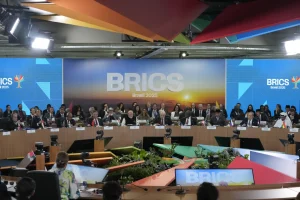
The BRICS bloc of developing nations on Sunday condemned the increase of tariffs and attacks on Iran, but refrained from naming US President Donald Trump. The group’s declaration, which also took aim at Israel’s military actions in the Middle East, also spared its member Russia from criticism and mentioned war-torn Ukraine just once.
The two-day summit was marked by the absences of two of its most powerful members. China’s President Xi Jinping did not attend a BRICS summit for the first time since he became his country’s leader in 2012. Russian President Vladimir Putin, who spoke via videoconference, continues to mostly avoid traveling abroad due to an international arrest warrant issued after Russia invaded Ukraine, reports AP.
In an indirect swipe at the US, the group’s declaration raised “serious concerns” about the rise of tariffs which it said were “inconsistent with WTO (World Trade Organisation) rules.” The BRICS added that those restrictions “threaten to reduce global trade, disrupt global supply chains, and introduce uncertainty.”
Trump, in a post on his social media platform late Sunday, said any country that aligns itself with what he termed “the Anti-American policies of BRICS” would be levied an added 10% tariff.
“Any Country aligning themselves with the anti-American policies of BRICS will be charged an ADDITIONAL 10% Tariff. There will be no exceptions to this policy. Thank you for your attention to this matter!” Trump said in a post on Truth Social.
Brazil’s President Luiz Inácio Lula da Silva, who hosted the summit, criticised NATO’s decision to hike military spending by 5% of GDP annually by 2035. That sentiment was later echoed in the group’s declaration.

“It is always easier to invest in war than in peace,” Lula said at the opening of the summit, which is scheduled to continue on Monday.
Iran in attendance
Iranian President Masoud Pezeshkian, who was expected to attend the summit before the attacks on his country in June, sent his foreign minister Abbas Araghchi to the meeting in Rio.
The group’s declaration criticised the attacks on Iran without mentioning the US or Israel, the two nations that conducted them.
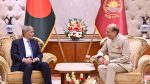

In his speech, Araghchi told leaders he had pushed for every member of the United Nations to condemn Israel strongly. He added Israel and the US should be accountable for rights violations. The Iranian foreign minister said the aftermath of the war “will not be limited” to one country.
“The entire region and beyond will be damaged,” Araghchi said.
BRICS leaders expressed “grave concern” for the humanitarian situation in Gaza, called for the release of all hostages, a return to the negotiating table and reaffirmed their commitment to the two-state solution.
Later, Iran’s Araghchi said in a separate statement on messaging app Telegram that his government had expressed its reservation regarding a two-state solution in a note, saying it will not work “just as it has not worked in the past.”
Also on Telegram, Russia’s foreign ministry in another statement named the US and Israel, and condemned the “unprovoked military strikes” against Iran.
Russia spared
The group’s 31-page declaration mentions Ukraine just once, while condemning “in the strongest terms” recent Ukrainian attacks on Russia.
“We recall our national positions concerning the conflict in Ukraine as expressed in the appropriate fora, including the UN Security Council and the UN General Assembly,” the group said.
Avoid Trump’s tariffs
While Lula advocated on Sunday for the reform of Western-led global institutions, Brazil aimed to avoid becoming the target of higher tariffs.
Trump has threatened to impose 100% tariffs against the bloc if they take any moves to undermine the dollar. Last year, at the summit hosted by Russia in Kazan, the Kremlin sought to develop alternatives to US-dominated payment systems which would allow it to dodge Western sanctions imposed after Russia’s invasion of Ukraine in February 2022.
‘Best opportunity for emerging countries’
BRICS was founded by Brazil, Russia, India, China and South Africa, but the group last year expanded to include Indonesia, Iran, Egypt, Ethiopia, and the United Arab Emirates.
As well as new members, the bloc has 10 strategic partner countries, a category created at last year’s summit that includes Belarus, Cuba and Vietnam.
That rapid expansion led Brazil to put housekeeping issues — officially termed institutional development — on the agenda to better integrate new members and boost internal cohesion. For Lula, the summit is a welcome pause from a difficult domestic scenario, marked by a drop in popularity and conflict with Congress.
The meeting was also an opportunity to advance climate negotiations and commitments on protecting the environment before November’s COP 30 climate talks in the Amazonian city of Belem.