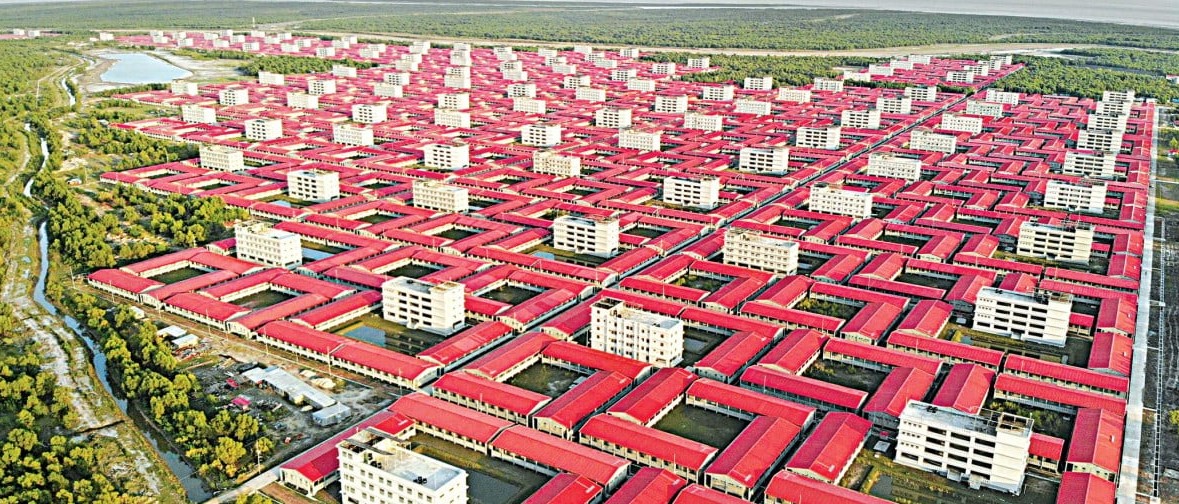

The relocation of Rohingya Forcibly Displaced Myanmar Nationals (FDMN) to Bhasan Char was presented as a humanitarian solution – a chance to escape the squalor of Cox’s Bazar’s overcrowded camps. The ‘2024 Bhasan Char Needs Assessment’, conducted by UNHCR, reveals that 93% of households now have sufficient water, and 89% receive menstrual hygiene kits on time. These are measurable victories that deserve recognition. However, a far more insidious crisis is brewing beneath the surface – one that threatens to undo these gains and expose approximately 34,052 FDMN residing in Bhasan Char to devastating health consequences. It is a crisis we can no longer afford to ignore.
On the surface, Bhasan Char’s waste management appears functional. The same UNHCR assessment shows that 89% of households report daily waste collection, and 69% say they never see visible waste in their surroundings. Yet these statistics are misleading, masking a fragmented system that lacks the infrastructure to handle the island’s growing waste stream sustainably. The challenges are stark. According to the Inter-Agency WASH Sector factsheet for Bhasan Char, the island currently operates without a fecal sludge treatment plant, creating a public health time bomb waiting to explode. The island’s tube wells, the primary source of drinking water for all residents, are overburdened.
UNICEF, which is actively involved in groundwater monitoring on Bhasan Char, has identified continuous monitoring of groundwater quality and quantity as a top priority to assess risks of saline intrusion and contamination. When waste is not properly managed, it contaminates groundwater. The result is a direct pathway from latrine to drinking cup. A study on waste exposure and health outcomes found that residents living near improperly managed waste sites had a relative risk of Hepatitis A that was 2.5 times higher than those in unexposed areas, while the risk of typhoid and cholera was nearly double. These are diseases that thrive in environments where sanitation and waste management fail.
Under BRAC’s WASH sector activities, the organisation is conducting clean water, sanitation, and hygiene promotion across 37 clusters on the island, benefiting approximately 21,114 Rohingyas. BRAC USA has also received funding contributions exceeding $2.3 million for WASH programming in the Cox’s Bazar and Bhasan Char areas. The WASH Sector as a whole, coordinated by the government and UNHCR, has been making significant strides. The Inter-Agency factsheet notes that in 2023, the sector ensured WASH services for 32,560 individuals, improving 85 tube wells, 297 bathing facilities, and 198 inclusive latrines designed with considerations for disability and gender. The sector also protected 1,175 open boreholes through sanitary seals, established 66 WASH committees and 181 water user groups, and conducted an impressive 25,952 hygiene sessions.

The Asian Development Bank (ADB), in its study on strengthening climate-resilient WASH systems, has modelled the impact of waste management interventions on refugee populations. The ADB study found that improved solid waste disposal could reduce dengue fever risk by 14%, and better drainage, which requires removing waste that blocks canals, could cut dengue risk by 12% and malaria by 3%. These are not minor improvements. They represent thousands of cases of preventable disease. Similar canal rehabilitation work in Cox’s Bazar is aimed at reducing mosquito breeding sites. But these initiatives are just the beginning.
What Bhasan Char needs is a comprehensive zero waste strategy. The concept is simple: prioritise waste prevention, reuse, and recycling over landfill disposal. The implementation, however, requires political will and sustained investment. Initiatives in Cox’s Bazar offer a blueprint. World Vision Bangladesh has set up a plastic recycling plant in the Rohingya camps, which has recycled 80 metric tons of plastic, 3 metric tons of polythene, and produced 8 metric tons of plastic flakes and half a metric ton of plastic pellets. On Bhasan Char itself, the WASH sector has established a recycling plant where community volunteers segregate inorganic and organic waste, with plastic materials sent to the recycling plant and organic waste used to produce compost for the livelihoods sector. These efforts have already reduced plastic waste going to dumping sites by approximately 70%. The island has space that the Cox’s Bazar camps lack. It has an existing infrastructure that can be adapted. The 77% of households that report having two bins for waste segregation but do not use them correctly represent an opportunity for behavioural change campaigns, not a failure of intent.




The Government of Bangladesh has shown remarkable commitment to the Rohingya community. The establishment of Bhasan Char and the investment in its infrastructure demonstrate this. The government is currently supporting 10 to 15 Bangladeshi NGOs, alongside UN agencies, in providing essential humanitarian services on the island. But we cannot claim to provide humane living conditions while allowing preventable diseases to flourish due to inadequate waste management.
The health impacts are felt most acutely by the most vulnerable – children, the elderly, and those with pre-existing conditions. The refugee population on Bhasan Char is temporary, but the island’s environment will outlast this crisis. Poor waste management practices today will leave a legacy of contaminated soil and water for decades. The ‘zero waste’ concept is not just an environmental ideal; it is a practical necessity for protecting both FDMN and the host communities who will inherit the island.
The government, international organisations, and humanitarian partners should prioritise comprehensive solid waste management on Bhasan Char. The WASH Sector itself has identified the need to explore centralised systems for fecal sludge management to mitigate operational challenges with biodigesters. There is no excuse for allowing untreated human waste to contaminate groundwater. It means expanding recycling and composting initiatives.
As the WASH Sector has noted, there is a need to increase capacity to process or recycle accumulated plastic and other inorganic waste to ensure a safe environment and reduce public health risks. The technology exists, the models are proven, and the benefits are clear. Waste segregation only works when people understand why it matters and how to do it correctly. The WASH Sector has already mobilised communities through water and latrine user groups to promote hygiene education, but more is needed. It means integrating climate resilience into waste management planning.
The ADB has emphasised that WASH systems must be designed to withstand extreme weather and address the needs of women, children, and persons with disabilities to ensure inclusivity and sustainability. The next cyclone will not wait for us to be ready. It means ensuring that waste management systems are designed with gender sensitivity. The UNHCR needs assessment found that 29% of women report feeling unsafe using latrines at night due to inadequate lighting and privacy concerns, highlighting the need for gender-sensitive upgrades to communal sanitation infrastructure.
The people of Bhasan Char deserve more than promises. They deserve systems that protect their health and dignity. The zero-waste concept offers a path forward – a way to turn a crisis into an opportunity for sustainable development. The question is not whether we can afford to act. The question is whether we can afford not to. Every day of delay is a day of preventable suffering. For the 34,052 FDMN on Bhasan Char, and for the generations who will follow, the time to act is now.
The views expressed in this article are solely those of the author
The writer is an educator, author, and media commentator. E-mail: [email protected]