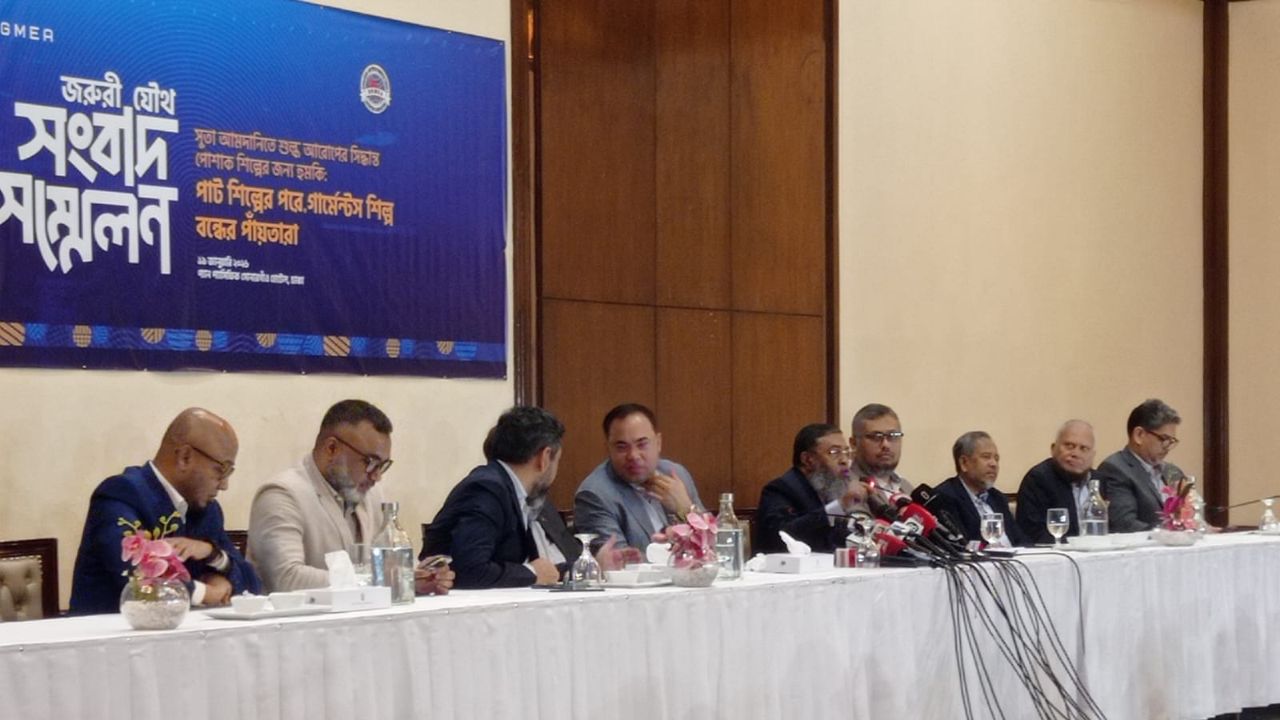

Bangladesh Garment Manufacturers and Exporters Association (BGMEA) and Bangladesh Knitwear Manufacturers and Exporters Association (BKMEA) have described the decision to impose duty on yarn imports as “suicidal” and “severely catastrophic”.
The BGMEA and BKMEA members demanded withdrawal of the decision at a press conference on Monday in Dhaka’s Pan Pacific Sonargaon Hotel, where BGMEA’s Acting President Salim Rahman delivered the written statement.
He stated that when the apparel industry is already in a fragile state due to the triple pressures of a global market recession, geopolitical instability, and the domestic energy crisis, the decision to impose duty on yarn imports will push the industry directly into an existential crisis.
Selim Rahman alleged that this unilateral decision was taken ignoring the apparel industry’s opinion, despite discussions being ongoing with the Tariff Commission. He also claimed that this decision is a clear violation of the World Trade Organisation’s (WTO) “Safeguard Agreement”.

He informed that the readymade garment sector contributes about 82 percent of the country’s total export earnings. Within this, the knitwear sector alone contributes 55 percent, or about $27 billion. Millions of people are directly and indirectly employed in this sector.
Furthermore, noting that yarn imports have increased in proportion to the rise in knitwear exports, he informed that knitwear exports increased by 9.72 percent in the 2024-25 fiscal year compared to the 2022-23 fiscal year.




During the same period, the volume of yarn imports increased by almost 99 percent. Salim Rahman commented that this is a normal process of a market economy.
He further informed that while the price of 30 carded yarn in the international market is $2.50 to $2.60 per kilogram, the local spinning mills are seeking to supply yarn of the same quality at nearly $3.
“Where export orders get cancelled over a difference of just one or two cents, an additional cost of about 40 cents per kilogram is in no way acceptable,” he said.
He alleged that imposing duty is creating artificial protection for local spinning mills, which will risk the formation of a monopoly market in the future. Simultaneously, he claimed that the local mills are not capable of supplying all types of premium and special count yarn uninterruptedly and on time.
The written statement informed that in the July-December period of the current 2025-26 fiscal year, apparel exports decreased by 2.63 percent compared to the same period of the previous year.
Exports in December alone decreased by 14.23 percent. In this situation, it was expressed that if the cost of raw materials increases, exports will be further impacted negatively.
At this time, as an alternative proposal to the government, the BGMEA and BKMEA leaders said that to protect the textile sector, instead of imposing duty on imports, it is necessary to provide direct cash assistance, special incentives, uninterrupted gas and electricity supply, reasonable fuel pricing, and arrangements for low-interest loans.
At the press conference, Salim Rahman warned that if the decision to impose duty on yarn imports is not withdrawn, apparel sector entrepreneurs will be compelled to undertake strict programmes to protect the industry’s existence.