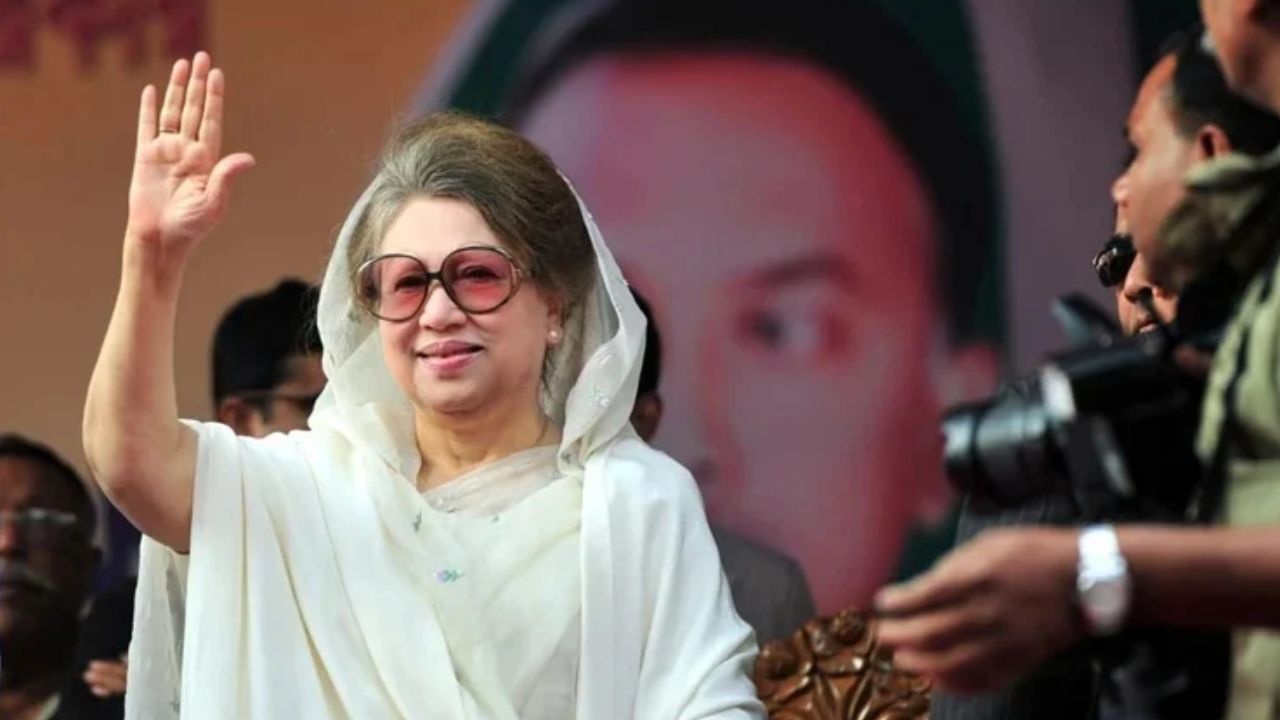



Khaleda Zia, a towering figure in Bangladesh’s turbulent political history, breathed her last at a hospital in Dhaka on Tuesday morning. She was 80.
Elegant, humble and soft-spoken, Khaleda Zia never yielded even in the most difficult times. Instead, she remained resilient. Her 43-year political career was marked by decisive actions, particularly in defending Bangladesh’s fragile democracy, while many of her decisions left a lasting imprint on the country’s political landscape.
An ordinary housewife, Khaleda Zia assumed the leadership of the Bangladesh Nationalist Party (BNP) on 1 September 1978, following the assassination of her husband, Major General Ziaur Rahman—the country’s first military-cum-popular president and the founder of the party.
She is widely credited with restoring democratic governance and advancing girls’ education and women’s rights. Known as an “uncompromising” leader and an icon of democratic resistance, she earned respect across political divides for maintaining decency in politics at a time when rivals routinely resorted to personal attacks and obscene language.
Despite years of sustained political attacks and humiliation by her rivals, Khaleda never retaliated with abusive words. She also never made disparaging remarks about Sheikh Mujibur Rahman, the country’s founding president and the father of her archrival, Sheikh Hasina.
A three-time prime minister, Khaleda endured immense hardship during the 1971 Liberation War. Her husband, one of the 11 sector commanders, left Khaleda and their two young sons behind when the war began in March that year. During the conflict, she was detained by invading Pakistani forces.
Her personal strictness made her an undisputed leader within BNP, commanding unflinching loyalty across all party factions. Following the military takeover in 1982, she rejected several lucrative offers from Chief Martial Law Administrator and later president Lt Gen HM Ershad, including a proposal to become deputy president. Her refusal further cemented her image as an uncompromising leader.

Committed to restoring democracy, Khaleda boycotted the controversial parliamentary election of 1986, refusing to legitimise Ershad’s military regime. She was assaulted by state forces during the anti-military movement but remained defiant.
Ahead of the polls, two major political alliances—one led by BNP and the other by Awami League—initially declared a boycott. However, Hasina later decided to contest the election under Ershad, a move widely criticised by the public. Khaleda, by contrast, stood firm in her refusal.
Public support for the boycott did not wane. Following Ershad’s ouster through a mass uprising on 6 December 1990, BNP won the subsequent general election held under a non-partisan caretaker government, an outcome few had anticipated against a strong Awami League under Hasina’s leadership.
Two days before the election, both leaders unveiled their manifestos. While Hasina predicted that the BNP would secure only a handful of seats, Khaleda refrained from counterclaims, focusing instead on seeking votes and highlighting her husband’s legacy.

She became Bangladesh’s first female prime minister after BNP won 140 of the 300 parliamentary seats, with support from Jamaat-e-Islami Bangladesh, which secured 18 seats. During her tenure, political parties reached a consensus to restore the parliamentary system of government, reversing the presidential system introduced through a controversial constitutional amendment on 25 January 1975.
Political analysts argue that the abolition of the Westminster-style system under Sheikh Mujibur Rahman paved the way for subsequent military interventions following his assassination on 15 August 1975.
Her political career, however, was not beyond controversy. The first major challenge came with a 1994 by-election in Magura, where Awami League alleged massive vote rigging. The dispute triggered Hasina’s demand for a neutral caretaker government to oversee future elections, a proposal Khaleda Zia initially rejected, famously remarking that no one other than children or the insane could be neutral.
The caretaker government demand gained momentum, leading to prolonged street agitations that resulted in deaths and widespread damage to public and private property. Amid intense unrest, Khaleda held a one-sided election, echoing a similar move by Ershad in 1988. The BNP-led parliament later enacted a constitutional amendment in June 1996 to introduce the caretaker system.
In the June 1996 election, Sheikh Hasina formed the government, while the BNP emerged as the main opposition with a record 116 seats. Khaleda returned to power in the October 2001 election, leading a coalition with Jamaat-e-Islami and other Islamist parties. The alliance won 193 of the 252 seats it contested.
During her second term, her authority was undermined by the rise of an informal power centre known as Hawa Bhaban, run by her elder son, Tarique Rahman. The office became synonymous with corruption allegations, while the growing influence of Islamist militant groups further challenged her leadership.
Bangladesh’s political crisis deepened after Awami League government abolished the caretaker system through a constitutional amendment in 2011. BNP boycotted the 2014 election, enabling Hasina to secure a second consecutive term. Subsequent elections in 2018 and 2024, held under Hasina regime, were widely criticised as sham elections that completely eroded democratic and electoral norms.
In the final decade of her life, an ailing Khaleda faced relentless persecution. She was evicted from her Dhaka cantonment residence and later jailed or confined to her home for extended periods. Convicted in corruption cases viewed as politically motivated, she was held in near-solitary confinement, during which her health deteriorated sharply.
Despite repeated appeals from her family and party, the government denied her permission to travel abroad for advanced medical treatment, even after she contracted Covid-19 in 2021, a decision that drew widespread criticism.
Released on humanitarian grounds in 2020, she remained confined to her Gulshan residence. She was finally freed following the violent mass uprising that led to the fall of Hasina’s regime last year. From her hospital bed, Khaleda hailed Hasina’s downfall as “the end of tyranny.”
In her final public statement, she said: “Through a long movement of struggle and sacrifice, we have freed ourselves from the fascist, illegal government.”
She later travelled to London for treatment and reunited with her elder son after nearly 16 years. Though her health improved, she was admitted to Evercare Hospital in Dhaka last month, where she remained bedridden until her death.
Even during her illness, BNP nominated her as a candidate in three constituencies for the upcoming February election.
Her lifelong struggle against autocracy and her relentless campaign for democracy will remain etched in Bangladesh’s political history. Despite adversity, she never allowed hardship to overwhelm her.
With Sheikh Hasina now in exile and her party barred from contesting the February 12 general election, BNP is widely expected to form the next government. Political analysts believe that, had she lived, Khaleda would have played a decisive role in both the electoral victory and in guiding her son, Tarique Rahman, in governing the country.
They say Tarique Rahman, who steered the party during his mother’s prolonged illness and imprisonment, is poised to carry forward her political legacy.