



Long before Ayurveda became a global business, a factory tucked away in the narrow lanes of Old Dhaka was exporting herbal medicines across continents.
Its products reached Europe, North America, China, the Middle East and South Africa decades before “natural medicine” became an international trend. Today, however, the 111-year-old Sadhana Oushadhalay – once one of the largest Ayurvedic manufacturers in undivided India – is struggling to survive.
Behind the weathered walls of an old building on Dinanath Sen Road in Gendaria lies one of Bangladesh’s forgotten industrial landmarks.
Sadhana was founded in 1914 by Principal Jogesh Chandra Ghosh, a chemist, educator, researcher and Ayurvedic scholar. Born in present-day Shariatpur in 1887, he earned a master’s degree in chemistry from the University of Calcutta before dedicating his career to teaching and scientific research.
While studying in Kolkata, Jogesh came under the influence of Acharya Prafulla Chandra Ray, the pioneering scientist who believed that indigenous plants, herbs and scientific knowledge could be harnessed to build a homegrown pharmaceutical industry. Inspired by that vision, Jogesh Chandra sought to demonstrate that Ayurveda was not merely a traditional healing practice but could also become a modern, research-based industry capable of competing internationally.
He began with a small Ayurvedic research laboratory in Gendaria. Public confidence grew quickly, and within a few years the laboratory expanded into a full-scale factory. Commercial production using electrically powered machinery began in 1917, making Sadhana one of the earliest industrial-scale Ayurvedic manufacturers in the region.

The company combined scientific production with traditional medical practice. Each branch employed trained Ayurvedic physicians who diagnosed patients, prescribed medicines and provided treatment.
Its laboratories produced hundreds of herbal preparations, including Chyawanprash, Dashan Churna, Mrityu Sanjibani, Sarbajwar Bati, Saribadi Salsa and Sri Gopal Oil. Their affordability and effectiveness earned Sadhana a reputation across British India.
At its peak, the company operated more than 150 branches and over 2,000 distributors throughout the subcontinent. Orders came from Bihar, Assam, Odisha and Bengal, while exports reached Europe, North America, China, the Middle East and South Africa. Distinguished visitors, including Acharya Prafulla Chandra Ray and Netaji Subhas Chandra Bose, visited the factory.




The Partition of 1947 marked the beginning of Sadhana’s decline. Border restrictions, customs duties and administrative barriers disrupted trade between Dhaka and India. To maintain its presence in the Indian market, the family established another factory in Dum Dum, Kolkata, in 1950 under the leadership of Jogesh Chandra’s son, Naresh Chandra Ghosh.
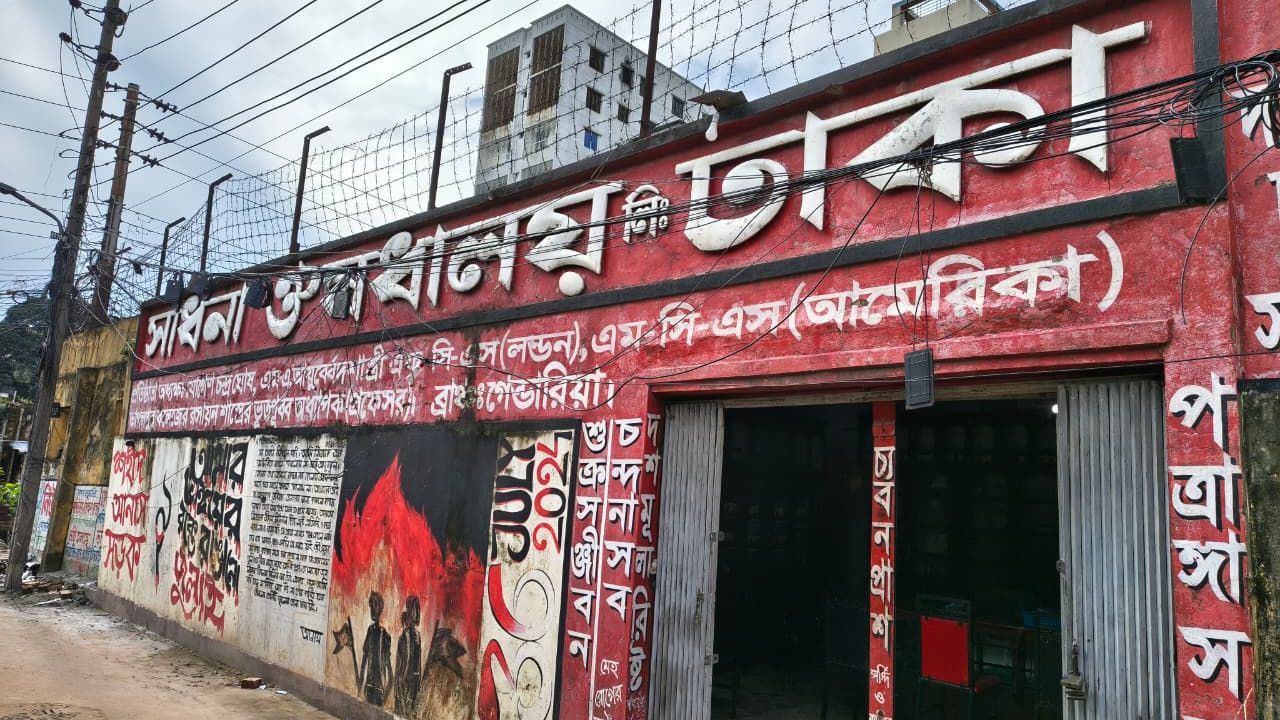
Despite mounting challenges, Jogesh Chandra refused to abandon the Gendaria factory. He believed the institution represented not only a business but also the country’s scientific potential and indigenous knowledge.
That conviction ultimately cost him his life.
As the Liberation War began in 1971, many Hindu families left Old Dhaka for safety in India. Although his family urged him to leave, the 84-year-old founder refused. “If I must die, I will die in my own country,” he reportedly told his family before sending them across the border.
On the night of 3 April, Pakistani soldiers forced their way into the Sadhana compound. The following morning, they killed Jogesh Chandra Ghosh.
After Bangladesh’s independence, Naresh Chandra rebuilt the damaged factory and resumed production. But the world around Sadhana had changed. Modern pharmaceutical companies expanded rapidly, while large-scale investment transformed the Ayurvedic industry elsewhere, particularly in India. Sadhana, meanwhile, struggled to keep pace with changing technologies, branding and research.
Today, Managing Director Shila Ghosh oversees the company from India while production continues on a much smaller scale in Gendaria.
Employees say sourcing quality herbal ingredients has become increasingly difficult, while production costs have risen sharply.
Bhavatosh Deb, who has worked at the factory for 26 years, said operations continue with upgraded machinery, although production is only a fraction of what it once was.
“The factory is still running, but it is not like the old days,” he told TIMES of Bangladesh. “One thing has never changed; we always receive our salaries on time.”
Another employee, Chittaranjan Biswas, said around 70 to 75 people currently work at the factory. Once operating through hundreds of branches and distributors across the subcontinent and overseas, Sadhana now serves customers through just five branches in Bangladesh.
The machines still hum inside the century-old factory in Gendaria. Workers continue producing medicines first developed more than a hundred years ago. Yet outside its faded gates, few realise they are passing a place that once helped take Bengal’s herbal medicine to the world.
For a country that now looks to build knowledge-based industries and revive indigenous innovation, Sadhana is more than the story of a struggling company. It is a reminder that Bangladesh once stood at the forefront of scientific entrepreneurship and that preserving such legacies may be as important as creating new ones.