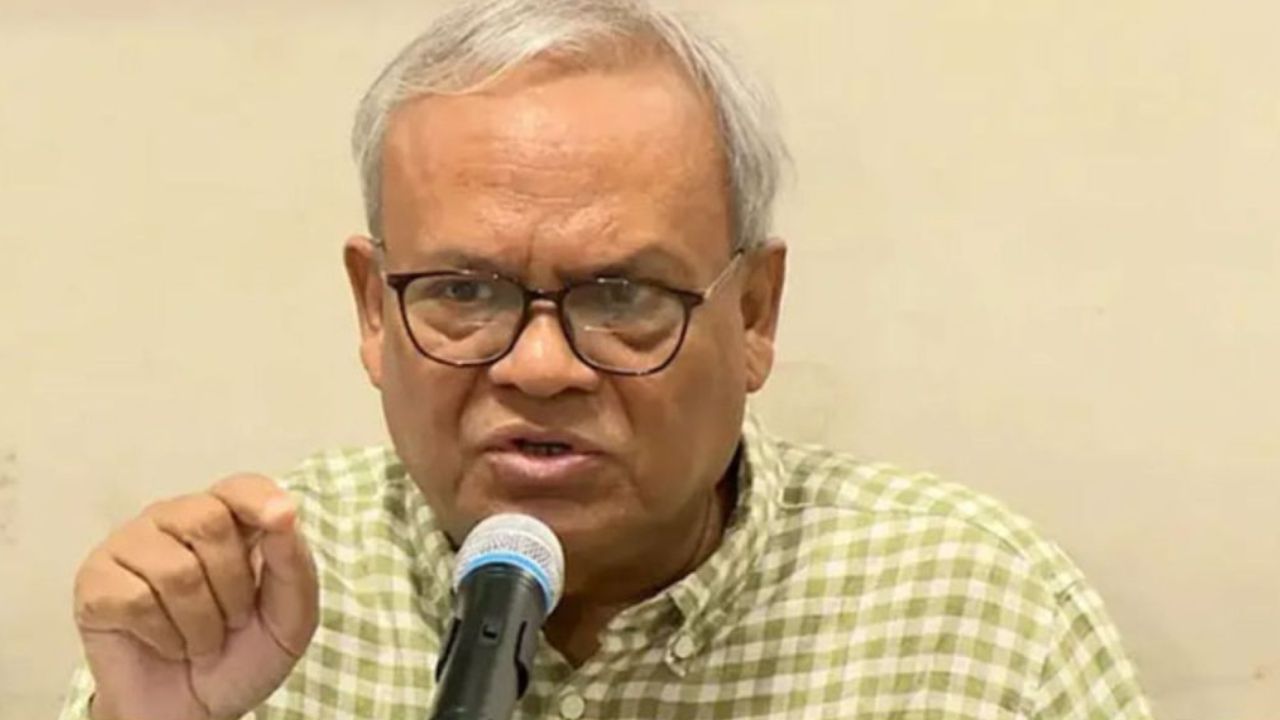

BNP Senior Joint Secretary General Ruhul Kabir Rizvi has claimed that Bangladesh’s “true liberation” was achieved on 7 November, 1975, when, according to him, the people united to reclaim the nation’s freedom.
Speaking on Friday afternoon at a photo exhibition organised by the Dhaka University unit of Jatiyatabadi Chhatra Dal (JCD) near the Arts Building to mark National Revolution and Solidarity Day, Rizvi said, “Although we achieved victory on 16 December, 1971, the nation did not gain true freedom then, it was only the Awami League, Jubo League, and Chhatra League that were liberated. The people’s actual emancipation came on 7 November, 1975.”
The event was attended by JCD Central President Rakibul Islam Rakib, General Secretary Nasir Uddin Nasir, DU JCD President Ganesh Chandra Roy Sahas, and General Secretary Nahiduzzaman Shipon.
Describing the exhibition as “a living display of history,” Rizvi said, “Those who came to power after 15 August, 1975, were part of Sheikh Mujibur Rahman’s government, only the titles changed. After that, the people found a true leader in Shaheed President Ziaur Rahman.”

He said Ziaur Rahman, who had led the nation in 1971, again emerged as a symbol of hope for the people in 1975. “Before 7 November, there was widespread fear that one-party rule under BAKSAL would return,” Rizvi said. “That fear ignited a revolutionary flame across the nation, and on that day, true liberation was achieved.”
Rizvi added that the government formed in 1972 promoted a “regional nationalism” that failed to reflect Bangladesh’s distinct identity. “Shaheed Zia resolved that crisis by introducing ‘Bangladeshi nationalism,’ giving the nation a new self-definition,” he said.

“By establishing multi-party democracy, Ziaur Rahman opened the door to political freedom. This exhibition by the Chhatra Dal is not just an event, it is a reflection of living history,” Rizvi said.
Accusing the Awami Legue government of distorting history, he alleged, “Through Sheikh Hasina, her foreign patrons attempted to erase our history and culture. But the spirit of 7 November has once again dispelled that darkness.”
Praising the JCD’s “remarkable role” in the recent July movement, Rizvi said, “Students took to the streets and brought down a brutal fascist regime through immense sacrifice. Even its foreign backers could not save it.”
JCD President Rakibul Islam Rakib compared the 1975 uprising to the 2024 mass movement, saying, “Just as the sepoy–people’s revolution took place on 7 November, 1975, we witnessed another mass uprising in 2024.”
He said, “On that day in 1975, Shaheed President Ziaur Rahman not only rose from captivity to leadership but also united a divided nation.”
Expressing concern over continuing political divisions, Rakib said, “Even after the 2024 uprising, we have yet to achieve true national unity. Some groups are still pursuing divisive politics when we should be working together to build the democratic and just Bangladesh envisioned by our martyrs.”
He concluded with optimism, “Just as the 1975 revolution ushered in a golden era, we believe that Bangladesh will enter a new golden age after the upcoming February elections.”