Air travel across East Asia has been thrown into turmoil after Typhoon Ragasa battered the region, leading to massive cancellations and widespread chaos at some of the busiest airports.
Authorities confirmed that more than 1,400 flights were scrapped and thousands of passengers stranded as the storm swept across China, Hong Kong, and Taiwan with fierce winds and heavy rainfall.
Flights at major hubs – including Shanghai, Shenzhen, Hong Kong, Taipei, and Guangzhou – were grounded as the storm disrupted air traffic control systems and made it unsafe to operate.
Airlines such as China Southern, China Eastern, Air China, Cathay Pacific, and EVA Air were among the hardest hit, suspending both domestic and international services.
Severe impact on Guangzhou operations

At Guangzhou Baiyun International Airport, one of China’s busiest gateways, the scale of disruption was particularly severe. More than 340 flights never took off, and over 100 faced lengthy delays.
China Southern Airlines, the airport’s primary operator, accounted for 160 cancellations and 49 delays, while China Eastern reported 87 cancellations and 17 delays.
Hainan Airlines and Air China also experienced setbacks, leaving large numbers of passengers stranded with limited guidance on rebooking.
Shanghai and Shenzhen reported similar difficulties. China Southern canceled more than 200 flights from those hubs, while China Eastern also logged dozens of cancellations.


Long queues formed at service counters as travelers sought updates, though many complained of being left without clear information or accommodation options.
Bangladeshi passengers stranded in Guangzhou
Among those most affected were Bangladeshi nationals scheduled to fly to Dhaka on China Southern’s CZ391, set to depart Guangzhou on September 23 at 7:35 p.m. local time.
Passengers arriving from South Korea, Australia, and Southeast Asia on connecting flights were told their journey onward had been canceled.
Airline staff allegedly informed them that temporary visas for hotel stays outside the terminal would not be available, leaving families with children and elderly relatives confined to the airport overnight.
Md Yusuf Ali Sabuj, a 42-year-old businessman from Bangladesh, said he managed to secure a hotel voucher after considerable effort.
He was later transferred to a nearby airport hotel but noted that many others, including families with children, remained inside the terminal without proper food or shelter.
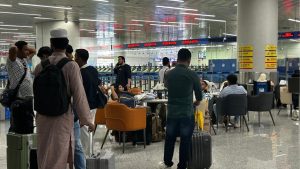
Passengers at Guangzhou Baiyun International Airport (CAN) in China after their flights are cancelled. Photo: Times
Filmmaker Abu Shahed Emon, another Bangladeshi traveler on the same flight, challenged the information given by the airline.
Instead of entering the transit area, he approached immigration directly, where officers immediately granted him a 24-hour visa. “They knew about the cancellations already and issued the visa without hesitation,” he said.
However, once stamped into China, Emon was not allowed to return to the transit zone to notify fellow passengers of the option. He attempted to escalate the matter through hotel staff, asking them to contact airport authorities, but no response came.
Passengers described China Southern’s management of the crisis as “chaotic” and “unfair,” pointing out that Bangladeshi travelers appeared to be disproportionately left without accommodation.
With hundreds still stuck inside Guangzhou’s airport late into the night, frustration was mounting as many waited without clear instructions on when they would be able to fly home.
Typhoon Ragasa’s unexpected path has been blamed for much of the operational breakdown, but the handling of stranded passengers – particularly Bangladeshis in Guangzhou – has raised questions about the airline’s crisis response and communication practices.