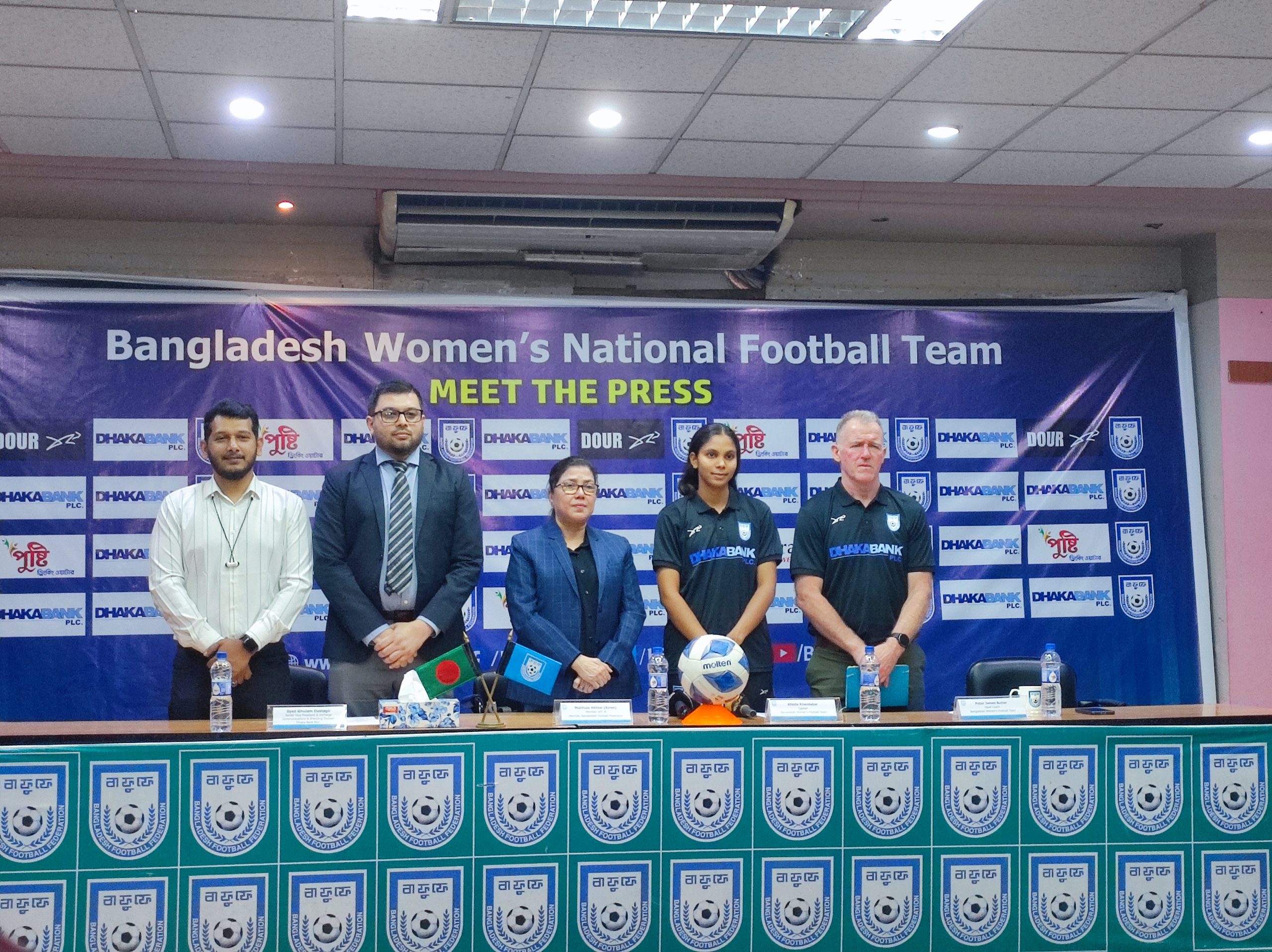



The Bangladesh national women’s football team is set to travel to Thailand to play two international friendlies on 24 and 27 October, marking an important phase in their preparation cycle for the AFC Women’s Asian Cup 2026.
Though Thailand failed to qualify for the upcoming Asian Cup, they remain one of Asia’s more technically advanced sides. Their current FIFA ranking of 53 reflects their long-term pedigree in women’s football, compared to Bangladesh’s 104th place.
BFF Women’s Wing head Mahfuza Akhter Kiron said the matches were arranged at the request of head coach Peter Butler, who wanted stronger opposition to measure Bangladesh’s progress.
“Our coach Peter wanted to play against big teams, so we arranged matches against Thailand. They are a very strong side even though they did not qualify this time, but they have played this tournament 17 times and won it once in 1983 when they were hosts,” said Kiron.
Her remarks underline a growing intent within the BFF to push the women’s team beyond familiar regional challenges. Thailand’s technical ability and structured football are likely to expose any tactical or positional flaws in Bangladesh’s setup exactly the kind of test Butler seems to want.

The English coach sounded pleased with his squad’s preparation, particularly after a three-week training camp at EPZ, Chattogram.
“In my playing and coaching career, I’ve attended hundreds of training camps, but most were a maximum of 15 days. Ours ran for nearly 20 to 21 days, which is quite long,” Butler noted, suggesting the extended period allowed the team to work on cohesion and pressing structures.
Tactically, Butler admitted the Thailand test will require courage and discipline.



“They play a completely different game from us. We’ve realised that if you stay deep, you won’t get results. Pressing high against them will make them uncomfortable and give us a chance.”
His comments reflect a shift in mentality. Bangladesh have often relied on deep defensive setups against stronger nations, but Butler’s coaching era is different. His insistence on proactive pressing shows an effort to evolve beyond reactive football. Whether his players can execute that plan under pressure remains to be seen.
The coach, however, voiced frustration over training conditions at home.
“The pitch condition in Bangladesh isn’t ideal for beautiful and attacking football. You need a different setup to perform and upgrade that style,” he said, hinting that an overseas camp could have added valuable experience.
His point has merit, Bangladesh’s heavy grass pitches and inconsistent surfaces often make it difficult to play the quick, short-passing football Butler prefers.
Meanwhile, Kiron confirmed that the federation is planning a tri-nation series involving Azerbaijan and Vietnam as part of the same preparation cycle. Azerbaijan (ranked 74) have already confirmed participation, while Vietnam (37) are still in talks.
Butler welcomed the idea of facing competitive teams but dismissed earlier plans to play Malaysian local sides.
“As I’ve been there for a long time, I know those matches would be a waste of time. If we could arrange games against Australian state teams, that would be more competitive,” he suggested.
That comment highlights Butler’s long-term vision, quality over convenience. Playing higher-ranked teams may expose weaknesses, but it’s the kind of exposure that builds real progress.
Before departing for Thailand, captain Afeida Khandaker shared quiet confidence about the team’s readiness.
“The camp went well. We’ve been given the necessary facilities, and I believe we can perform strongly against Thailand.”
Her optimism captures the spirit of a team trying to break past old barriers. The Thailand friendlies may not define Bangladesh’s campaign, but they represent a vital checkpoint in the national team’s development cycle, both tactically and mentally.