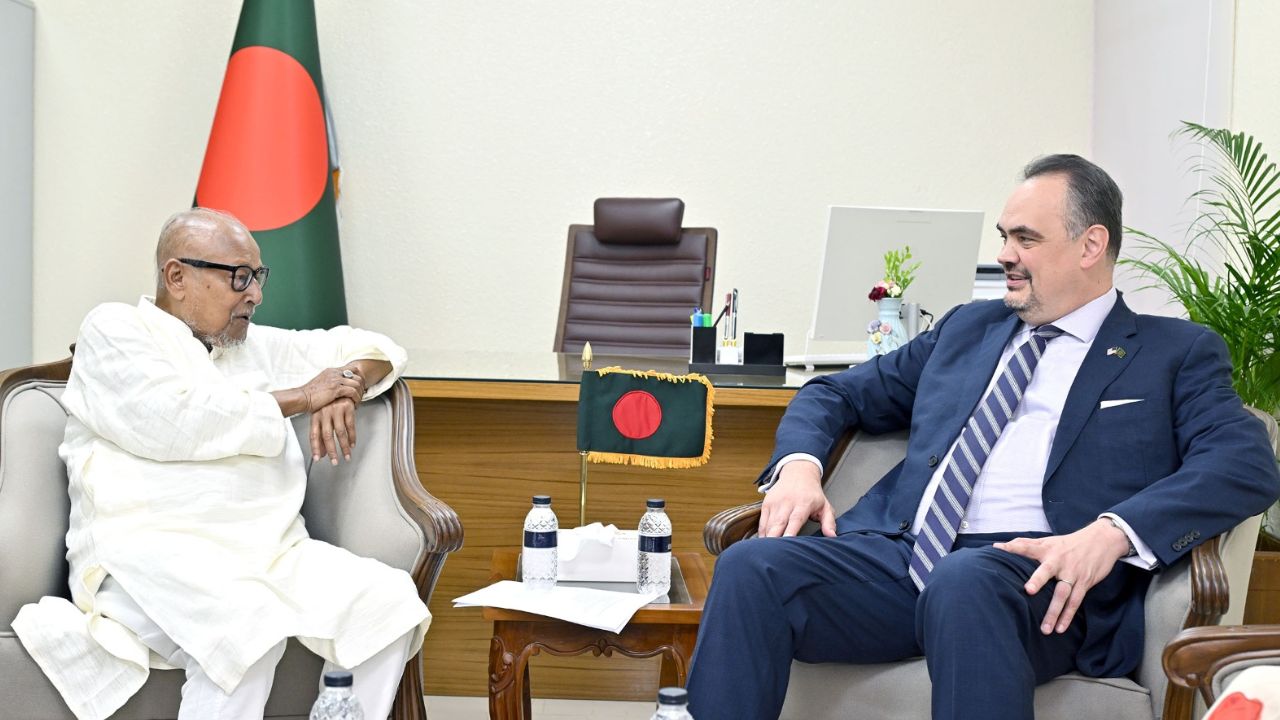



Bangladesh and the United States have discussed deepening cooperation in agricultural technology, trade logistics, and labour reforms, as US Ambassador Brent T Christensen called on Political Adviser Nazrul Islam Khan on Tuesday.
During the meeting held at the Prime Minister’s Office, the two sides reviewed a wide range of bilateral interests, including agriculture, trade, labour rights, education, health, energy, and the Rohingya crisis.
Agricultural modernisation, food security
Nazrul Islam Khan, who also serves as the adviser to Ministry of Agriculture, highlighted the longstanding friendly relations between the two nations since independence.
He emphasised that there is significant scope to expand cooperation in food security, technology, and employment generation to make this partnership more fruitful.
Noting that Bangladesh is a densely populated country with limited land, the adviser stressed the necessity of modernising agriculture and adopting advanced technologies to ensure food security for the masses. He said US technical and technological assistance could play a vital role in increasing agricultural productivity.

The adviser also briefed the ambassador on government initiatives to boost rural income, such as the prime minister’s “Agriculture Card” programme and the promotion of region-specific products.
He underscored the importance of expanding renewable energy, particularly solar power, in remote and “char” (river island) areas to facilitate irrigation, product preservation, and local employment.
Trade and infrastructure
The discussion also explored the potential for exporting Bangladeshi agricultural products, including mangoes, to the US market. Ambassador Christensen expressed US interest in supporting the development of effective cold chains and refrigerated transport systems to ensure quality preservation during the movement of goods.




However, the ambassador raised concerns regarding administrative complexities and delays in clearing US goods at Bangladeshi ports. In response, the adviser assured him that the government is working to simplify trade processes and remove unnecessary hurdles, expressing hope for a swift resolution to these issues.
Labour rights and reforms
Detailed discussions were held on labour rights, workplace environments, and trade unions. Ambassador Christensen lauded the passage of the ‘Bangladesh Labour (Amendment) Bill, 2026’ in the National Parliament, describing the initiatives to align the law with international standards as positive steps.
The adviser reiterated that ensuring workers’ fair rights is a top government priority. He noted that the government aims to build a labour system that protects the dignity of workers while maintaining a conducive environment for industrial production and investment.
He added that the government would take necessary measures to strengthen trade union activities and ensure the effective implementation of laws.
Rohingya crisis, social sector cooperation
On the Rohingya crisis, the adviser called for a safe, sustainable, and dignified solution, urging the international community to maintain pressure on Myanmar.
The US ambassador acknowledged the complexity of the crisis and the need for continued regional and international cooperation.
Regarding education, the meeting addressed opportunities for Bangladeshi students in the US and the improvement of institutional standards. The ambassador noted that the US continues its school feeding programmes in several regions of Bangladesh to enhance student nutrition and attendance.
In the health sector, the ambassador announced that the US is launching new activities to prevent infectious diseases. This cooperation will focus on disease detection, prevention, public awareness, and strengthening healthcare capacity.
The Bangladesh delegation included Md Mahmudur Rahman, additional secretary of the Ministry of Agriculture; Shahadat Hossain Shadhin, deputy press secretary; and Abdullah Al Mahmud Shahriar, assistant press secretary.
The US delegation included Erin Covert, agricultural attaché; James A Stewart, political officer; and Leena Khan, labour attaché.