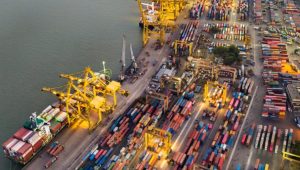
Bangladesh increased its share of the European Union apparel market to 21.57 per cent in 2025 from 20.78 per cent a year earlier, as exports rose to €19.41 billion, according to Eurostat data.
Total European Union apparel imports stood at €89.99 billion in 2025, up from €88.15 billion in 2024, indicating modest demand recovery.
Bangladesh’s shipments were valued at €18.32 billion in 2024.
Over five years, Bangladesh has remained the second-largest apparel supplier to the European Union after China while expanding its footprint.
Exports were €14.30 billion in 2021, with a 19.78 per cent market share.

Shipments surged to €21.92 billion in 2022, when its share peaked at 22.06 per cent amid post-pandemic demand recovery.
Exports moderated to €17.44 billion in 2023, with a 20.67 per cent share, before recovering in 2024 and 2025.
China remained the top supplier in 2025, exporting €26.58 billion and capturing 29.54 per cent of the market.



China’s share fell from 30.28 per cent in 2021 to 27.85 per cent in 2023 before rebounding in 2024 and 2025.
Turkey’s exports declined to €8.34 billion in 2025 from €9.35 billion in 2024, reducing its share to 9.27 per cent from 12.76 per cent in 2021.
India exported €4.52 billion in 2025, raising its share to 5.03 per cent from 4.75 per cent in 2024.
Cambodia increased exports to €4.49 billion in 2025, lifting its share to 4.99 per cent from 4.45 per cent a year earlier.
Vietnam shipped €4.38 billion, capturing 4.86 per cent of the market.
Pakistan’s exports reached €3.86 billion, raising its share to 4.29 per cent from 3.99 per cent in 2024.
Morocco exported €2.73 billion, holding a 3.03 per cent share, largely stable in recent years.
Sri Lanka’s exports stood at €1.36 billion with a 1.51 per cent share, while Indonesia shipped €970 million, accounting for 1.08 per cent.
Former Bangladesh Garment Manufacturers and Exporters Association director Mohiuddin Rubel said the rise reflected both cyclical recovery in European demand and structural strengthening of Bangladesh’s apparel industry.
“Despite global volatility and inflationary pressure in Europe, Bangladesh has expanded its market share, indicating sustained buyer confidence and long-term sourcing commitments,” he said.
He said Bangladesh is benefiting from scale, compliance improvements and diversification into value-added and sustainable segments, while Turkey has lost ground and China’s share has not significantly expanded.