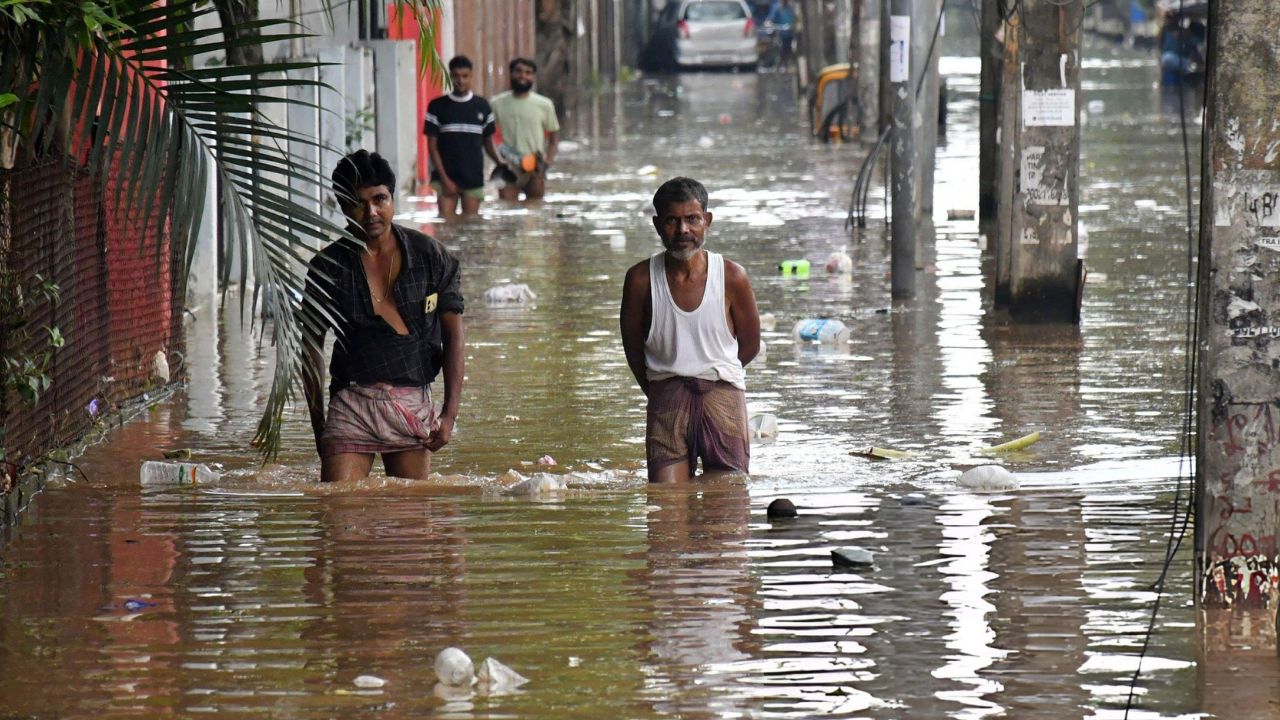



The death toll from this year’s devastating floods in India’s north-eastern state of Assam rose to 98 on Saturday after officials confirmed one further fatality, even as more than 1.55 lakh people across thirteen districts continued to grapple with the deluge’s aftermath.
The latest death was reported from the Mahmora revenue circle in Charaideo district, according to officials, as authorities prepared to launch a fresh assessment of flood damage from Sunday to speed up the release of funds for permanent rehabilitation in the worst-affected areas, reports NDTV.
Thirteen districts remained under the grip of floodwaters on Friday: Sivasagar, Golaghat, Nagaon, Hojai, Sonitpur, Dhemaji, Darrang, Biswanath, Kamrup (Metropolitan), Lakhimpur, Udalguri, Jorhat and Charaideo.
Together, these districts accounted for a total of 1,55,849 people still affected by the disaster, though the figure marks a decline from Thursday, when more than 1.68 lakh residents across 15 districts had been reeling under the floods.

Golaghat has emerged as the worst-hit district in the current spell of flooding, with 58,750 people affected, according to figures released by officials.
It was followed by Sivasagar, where 48,286 residents remained affected, and Jorhat, which recorded 25,259 people still grappling with the impact of the floodwaters.
To cope with the scale of displacement, the state administration has been running 55 relief camps, which together are sheltering more than 10,000 people who have been forced from their homes.




A further 18 relief distribution centres have also been set up and remain operational, officials said, as authorities work to ensure aid reaches those worst affected by the disaster.
The floods have also taken a heavy toll on agriculture and livestock across the state. A total of 10,748.64 hectares of cropland remains submerged beneath floodwaters, officials said, while more than 47,000 animals have been affected by the deluge, underscoring the scale of the disaster’s impact on rural livelihoods.
Assam’s Chief Minister, Himanta Biswa Sarma, announced on Friday that his government would carry out a door-to-door assessment of flood damage in the four worst-hit districts — Jorhat, Sivasagar, Golaghat and Charaideo — over a three-week period running from 9 to 30 August.
The exercise is intended to ensure that the true extent of the destruction is properly recorded ahead of any rehabilitation effort.
Sarma stressed that no household affected by the floods would be excluded from the assessment process, pledging that his government would provide the maximum level of relief permissible under existing norms.
He said the initiative was designed to guarantee that assistance reached every eligible family in the affected region, regardless of how remote or difficult to access their location might be.
Once the initial assessment list has been compiled, it will undergo a further round of re-verification directly with the affected families themselves, the chief minister explained. This process, he said, is expected to be completed in time for the government to have a clear estimation of the funds required for rehabilitation purposes by 10 September.
“Once we have the estimate of the funds, we can start providing the requisite financial assistance for permanent rehabilitation,” Sarma said, outlining the timeline his administration intends to follow in the coming weeks.
The chief minister’s announcement comes as Assam continues to reel from one of its most severe flood seasons in recent years, with the state government under mounting pressure to accelerate both immediate relief efforts and longer-term rehabilitation plans for the hundreds of thousands of people whose homes, farmland and livelihoods have been affected by the rising waters.