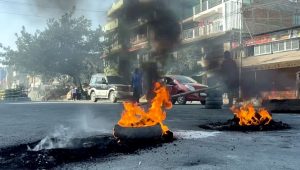
Yemen has descended back into a state of full-scale war, ending four years of relative calm that followed a 2022 UN-brokered truce. Speaking to the United Nations Security Council, UN Special Envoy Hans Grundberg warned that fighting has reignited after the ceasefire collapsed in July this year.
The conflict escalated sharply on 4 October when Rashad al-Alimi, leader of the Presidential Leadership Council (PLC), launched a military offensive to restore government authority.
This was followed by the formal launch of operation “Dawn of Yemen”, declared by the government to reclaim all territory held by the Iran-backed Houthis, also known as Ansar Allah, including the capital, Sanaa.
Military spokesperson Colonel Majid al-Nuzaili reported via the Saba news agency that ground forces breached Houthi defences, carrying out over 2,750 precision strikes in 24 hours and neutralising more than 1,400 rebel fighters.
Meanwhile, Saudi-led coalition air strikes hit 136 targets in Houthi-held regions, bombarding Sanaa International Airport, Mount Attan with 10 raids, four telecommunications facilities, and industrial sites including a sponge factory and a chips factory.
Lethal missile strike on Riyadh airport
The conflict expanded internationally on Saturday when a ballistic missile struck King Khalid International Airport in Riyadh, Saudi Arabia.
Striking terminal facilities near Gate 401, the blast killed at least 12 people and injured 309 others in the deadliest attack on Saudi territory in over a decade.

Saudi civil aviation officials confirmed the dead included four Saudis, two Bangladeshi nationals, one American, one Egyptian, one Jordanian, one Syrian, one Palestinian, and one Sudanese citizen.
Emergency medical calls were issued to treat hundreds of casualties, including pilgrims travelling to Mecca.
Major General Turki al-Malki, spokesperson for the coalition, called the attack a cowardly terrorist strike and a war crime.
Flight operations were disrupted, leading foreign embassies to issue security alerts and Biman Bangladesh Airlines to suspend flights to Riyadh.


Despite Houthi warnings declaring Saudi airspace a military zone, organisers confirmed that major business events, including the World Petroleum Congress and the Future Investment Initiative, would proceed as scheduled.
Strategic battlegrounds and maritime control
A primary focus of the renewed fighting is control over the Bab al-Mandeb strait, a crucial shipping channel connecting the Red Sea to the Gulf of Aden.
The waterway has acquired vital global significance as the broader US-Iran war halted commercial shipping through the Strait of Hormuz.
After declaring a naval blockade against Saudi-linked vessels in July, the Houthis captured the port city of Mocha, At Turbah, and Mayyun Island.
Heavy ground combat is now taking place around coastal Mocha and Dubhab, alongside the contested governorate of Taiz, as government forces fight to reclaim maritime routes.
Humanitarian collapse and siege of Taiz
The civilian population faces a severe humanitarian crisis, with the UN reporting at least 46 civilian deaths and over 130 injuries since August 2026, while the International Organization for Migration (IOM) estimates more than 200,000 people have been displaced since September.
In southwestern Taiz, Houthi forces captured At Turbah on 4 October, severing the last main road connecting the city to government-held areas.
Yemen’s Ministry of Public Health and Population warned that health facilities face total depletion of fuel, oxygen, fluids, and medicines, threatening the shutdown of emergency care, intensive care, surgery, dialysis, and neonatal units.
Nabil Jamil, director-general of planning in Taiz, noted that 2.8 million residents and 200,000 newly displaced people are affected, with black-market petrol prices surging from 30,000 Yemeni riyals ($19) to 90,000 riyals ($58) per 20-litre container.
Nabil Sharyan, head of the Justice for Rights and Development Organization, stressed that civilians must not be used to exert pressure.
Moreover, the Houthis continue detaining 72 UN personnel, five former staff, and dozens of aid workers, referring at least eight for prosecution on espionage charges carrying the death penalty.
International condemnation and geopolitical stance
The strike on Riyadh and the resurgence of war drew swift global condemnation. US President Donald Trump called the attack terrible and unacceptable, stating Washington may consider joining Saudi Arabia in military action against the Houthis.
US Secretary of State Marco Rubio confirmed an American fatality, while US Ambassador Jeff Bartos demanded Iran end support for the rebels.
UN Secretary-General Antonio Guterres expressed deep shock over the strike on civilian infrastructure.
Pakistani Prime Minister Shehbaz Sharif reaffirmed commitment to Saudi security under the Mecca Joint Defence Agreement.
Canadian Prime Minister Mark Carney condemned the strikes as abhorrent, alongside formal statements from Kuwait, Qatar, Egypt, Jordan, Oman, Palestine, Japan, and GCC Secretary-General Jasem al-Budaiwi.
Marwan Ali Noman, political adviser to Yemen’s foreign minister, said a decade of peaceful efforts had failed, describing military counter-measures as the necessary antidote to Houthi aggression.