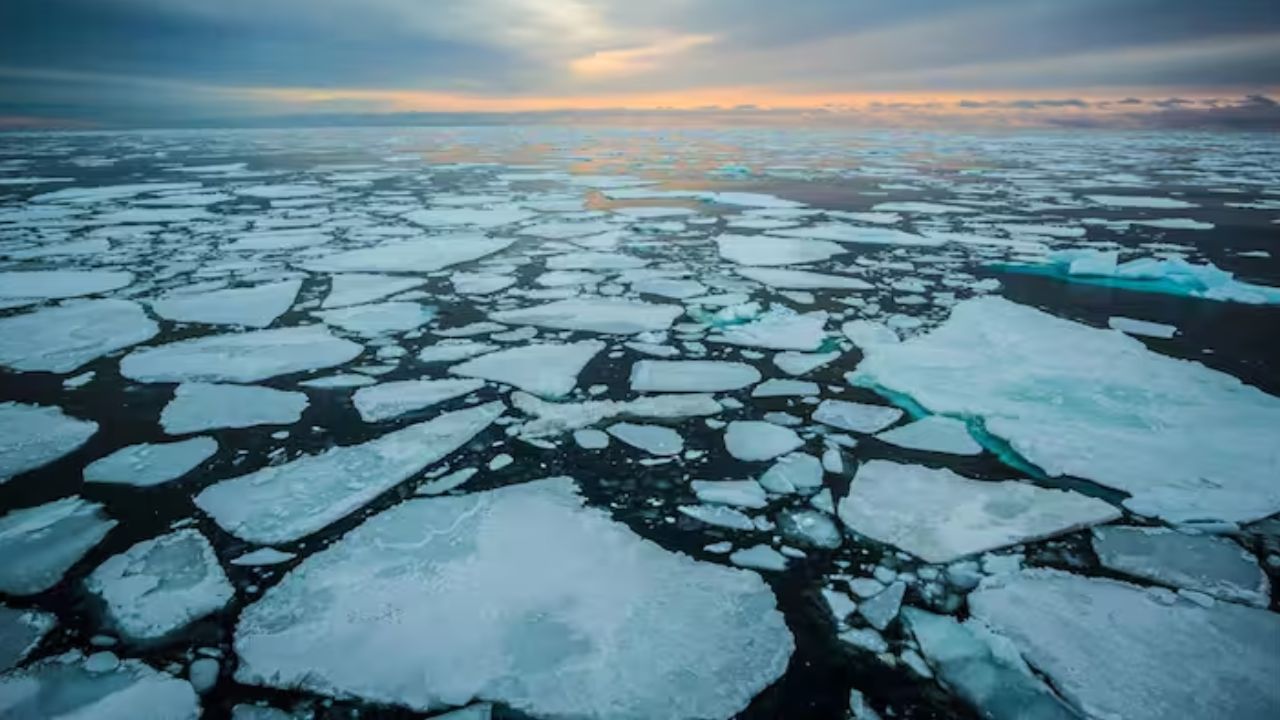



The brief period where Arctic sea ice decline appeared to stall has concluded following a record-breaking winter loss, a new study reveals.
A study released last summer indicated that the rate of melting in the Arctic had decelerated over the previous two decades, with no statistically significant change in ice extent recorded between 2005 and 2024.
Scientists initially suggested that natural shifts in ocean currents had temporarily offset the impacts of rising global temperatures.

However, fresh research utilizing the latest satellite data has confirmed that this pause was a “temporary rather than sustained” phenomenon.
The region saw a 5.8 per cent decline in sea ice within 2024 and 2025, marking the most significant year-on-year winter reduction since satellite monitoring began in 19790.




Dr Duo Chan, the lead author from University of Southampton’s School of Ocean and Earth Science, explained that the apparent stabilization seen in the early 2020s was merely a short-lived slowdown within a persistent, long-term downward trend.
The data shows that the area of sea ice in September, the point of annual minimum, has now been reduced by half since the late 1970s.
Dr Alessandro Silvano, a co-author also based at University of Southampton, described the sharp 2025 drop as unusual but consistent with current Arctic warming conditions. The environmental consequences of this loss are substantial, as winter sea ice serves as a vital insulator between the relatively warm ocean and the cold atmosphere.
Its absence allows significant amounts of ocean heat and moisture to escape into the air, which the authors warn can disrupt pressure patterns, storm development, and large-scale atmospheric circulation. These changes have the potential to alter weather patterns far beyond the Arctic.
Dr Chan noted that the findings serve as a stark warning regarding the climate crisis. He emphasized that short-term recoveries can often mask the true direction of environmental change, stating that the record lows seen in 2025 and 2026 prove that Arctic sea ice loss is continuing in a warming world.