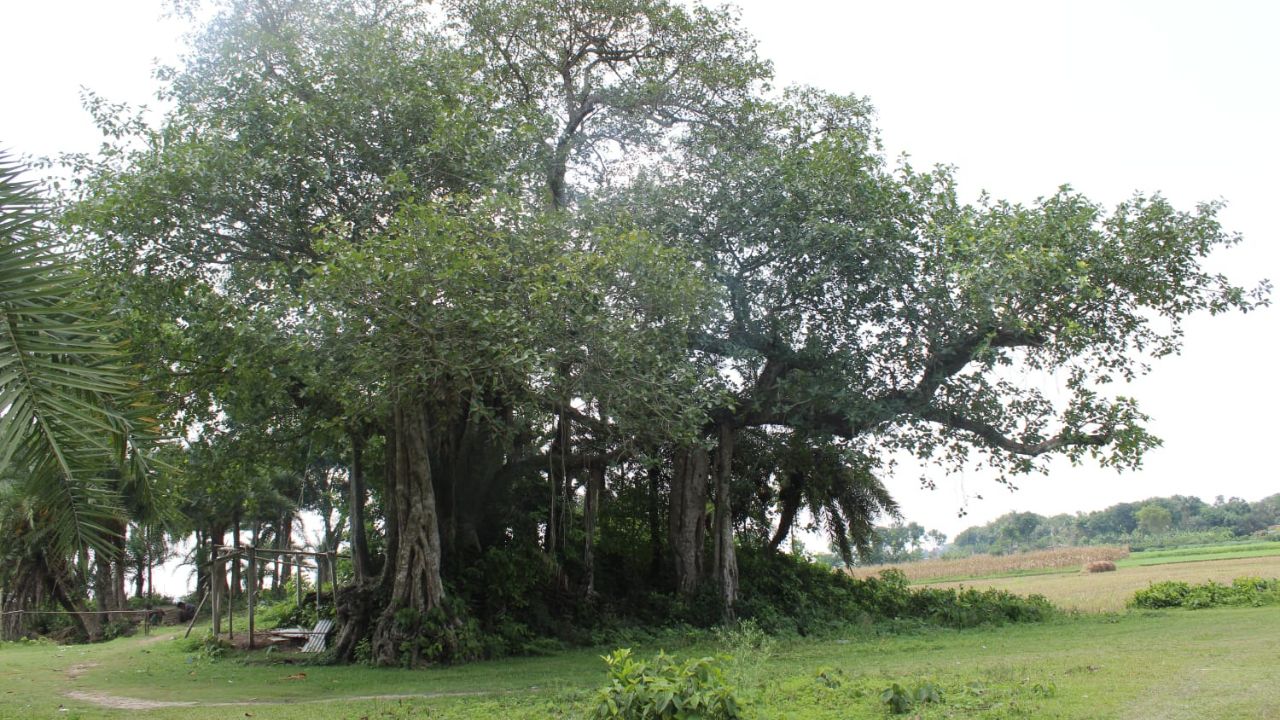



Nestled amid paddy fields and agricultural land, the Jamtala pond area in Jhenaidah Sadar Upazila harbours a sprawling banyan tree that has become a haven for wildlife. Despite minimal shade in surrounding fields, this mature tree, estimated to be 120–150 years old, supports a remarkable array of birds, squirrels, and a fox den at its base. Two nearby palm trees host nesting babblers, while the banyan itself draws parakeets, doves, cuckoos, bulbuls, mynas, and sunbirds from sunrise to dusk, creating what resembles a natural aviary.
The tree’s fruit attracts both native and migratory birds throughout the year. Rabiul Islam, 75, the pond’s long-time guardian, resides in a temporary shelter nearby and feeds the birds daily. Recently, a mother fox had cubs at the tree’s base, which have since moved elsewhere. This year marks the rare return of babblers nesting in the palm trees for the first time in nearly three decades.
The Jamtala pond lies between Maharajpur and Haripur villages, spanning 430 decimals of water and roughly 750 decimals including adjoining grazing land. Surrounding flora comprises date palms, palm trees, mahogany, and banana trees, providing additional habitat for birds. Harun Or Rashid, 63, recalled that even when he was ten, the banyan was already larger, though several branches have since fallen. Traditionally, Hindus have performed rituals under the tree, a practice that continues today.
Ziarul Mondal, a local resident, said, “If nature is left undisturbed, it arranges itself beautifully. Workers rest in the shade, and wild birds and animals thrive. This single tree hosts an extraordinary variety of birds, including the recently returned babblers.”
Abdul Quddus, who leases part of the pond for fish farming, noted that the area provides ample space and shelter for the birds. He explained that protection from hunters over the past five to six years has allowed bird populations to increase steadily, drawing locals who enjoy visiting the site.
Md. Zakir Hossain, acting officer of the district forestry department, highlighted that many old trees exist on government land across the district. He added that the return of babblers after a 25-year absence is a positive sign, and if their habitat continues to be protected, their numbers are expected to grow further, preserving this unique natural aviary for future generations.