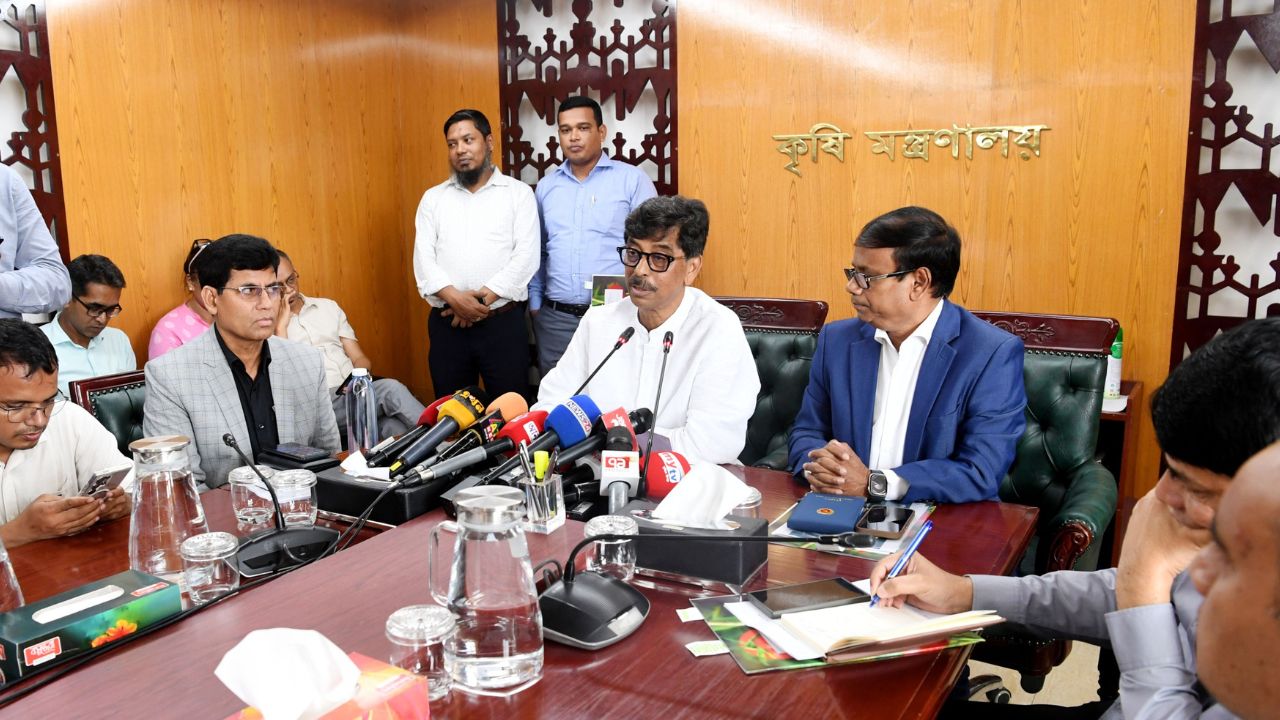



Agriculture, Fisheries and Livestock Minister Mohammed Aminur Rashid on Tuesday expressed satisfaction with progress after the government’s first 180 days, adding that Bangladesh will gradually move away from its dependency on agricultural imports.
Speaking to journalists at the Agriculture Ministry’s conference room, Rashid emphasised that increasing production, expanding storage facilities, and enhancing the use of technology are key to achieving this goal.
Addressing concerns regarding fertilisers, Rashid clarified that there is currently no shortage in the country. He stated that stocks are actually higher than the previous year and exceed current demand.
He further dismissed claims of an artificial crisis as part of a “planned conspiracy” intended to create confusion.

Regarding the digital integration of the sector, the minister announced that “Farmer Cards” will be distributed to between 350,000 and 400,000 farmers every month. A database for approximately 1.4 million farmers has already been prepared during the pilot phase.
Rashid also shared progress on environmental and infrastructural targets. Out of a six-month target to plant 2.5 million saplings, over 2.418 million have already been planted. Similarly, 475.61 kilometres of canals have been excavated against a target of 478.9 kilometres.



On the subject of onion production, Rashid noted that Bangladesh has not needed to import any onions so far this year.
He attributed this to new technology that allows onions to be preserved for up to six months, preventing the rot that previously caused significant losses. Plans are underway to develop infrastructure capable of storing 300,000 tonnes of onions in the future.
The government is also targeting self-sufficiency in jute, onion, and ginger seeds to further reduce import reliance. To boost food production and protect against natural disasters, a new rice variety named “BRRI 118” will be introduced next year.
This variety can be planted 10 to 15 days earlier than traditional types in Haor regions, making it vital for protecting crops from early flash floods.
In an effort to reduce production costs, the government plans to bring all irrigation pumps under solar power. Preparations have already been completed to transition 60,000 to 62,000 pumps to solar energy as an initial step.
Agriculture Secretary Md Selim Khan was also present during the briefing.