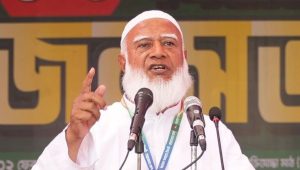
Gonotantrik Odhikar Committee member and retired Jahangirnagar University teacher Anu Muhammad has pointed out that despite repeated promises of reform, the interim government has yet to take any concrete steps.
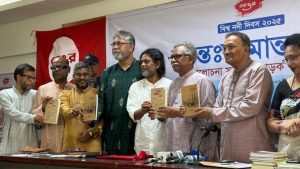
Speaking at a discussion and book launch on transboundary rivers at the National Press Club on Friday, he added, “This government speaks a lot about reforms. In the past year alone, we have heard more talk of reform than in the last 54 years.
“But we still do not see where and how these reforms will actually take place.”
Anu Muhammad pointed out that only constitutional reform has seen some focused discussion, while in other areas there has been no genuine initiative.
Questioning the government’s political will, he said, “We hear loud voices about Delhi or Dhaka, but we do not see specific initiatives to further strengthen Dhaka.”

‘Rivers in dire straits’
Highlighting the dire state of the country’s rivers, Anu Muhammad said no reform commission had been formed to address the issue.




“The easiest steps for the government would have been to engage river experts and sign the United Nations’ 1997 International Watercourses Convention, yet no such move has been made,” he added.
He accused ruling and opposition parties alike of remaining silent on protecting rivers from encroachment and pollution, while uniting in destructive practices.
Referring to recent incidents, he said, “In terms of stone extraction, we saw a kind of national unity that cannot be found anywhere else. Awami League, BNP, Jatiya Party, NCP, Jamaat-e-Islami, bureaucrats, police – all together were carrying out river-destroying activities.”
Anu Muhammad expressed doubt over whether any party would make specific pledges on river protection in their election manifestos.
He said the country’s maritime boundary victory had been possible only by resorting to international law, which showed that bilateral talks were not enough for shared river disputes.
Anu Muhammad also called for Bangladesh to sign the 1997 UN Watercourses Convention, which India has yet to sign.
Identifying three major causes of river disasters, he cited India’s construction of dams and interlinking projects, Bangladesh’s own reckless projects such as polders, embankments and sluice gates, and the capture and pollution by politically powerful groups.
“To protect rivers, everyone must be held accountable,” he said, adding that questions must be raised about how projects by the Water Development Board, the World Bank, the Asian Development Bank and bureaucrats have devastated rivers.
Calling for “counter-surveillance” against state surveillance on public, he urged people to raise their voices, build solidarity and continue resistance.
“In response to the political parties’ so-called national unity, people must create their own national unity. Only then can rivers be saved and our very existence protected,” he said.