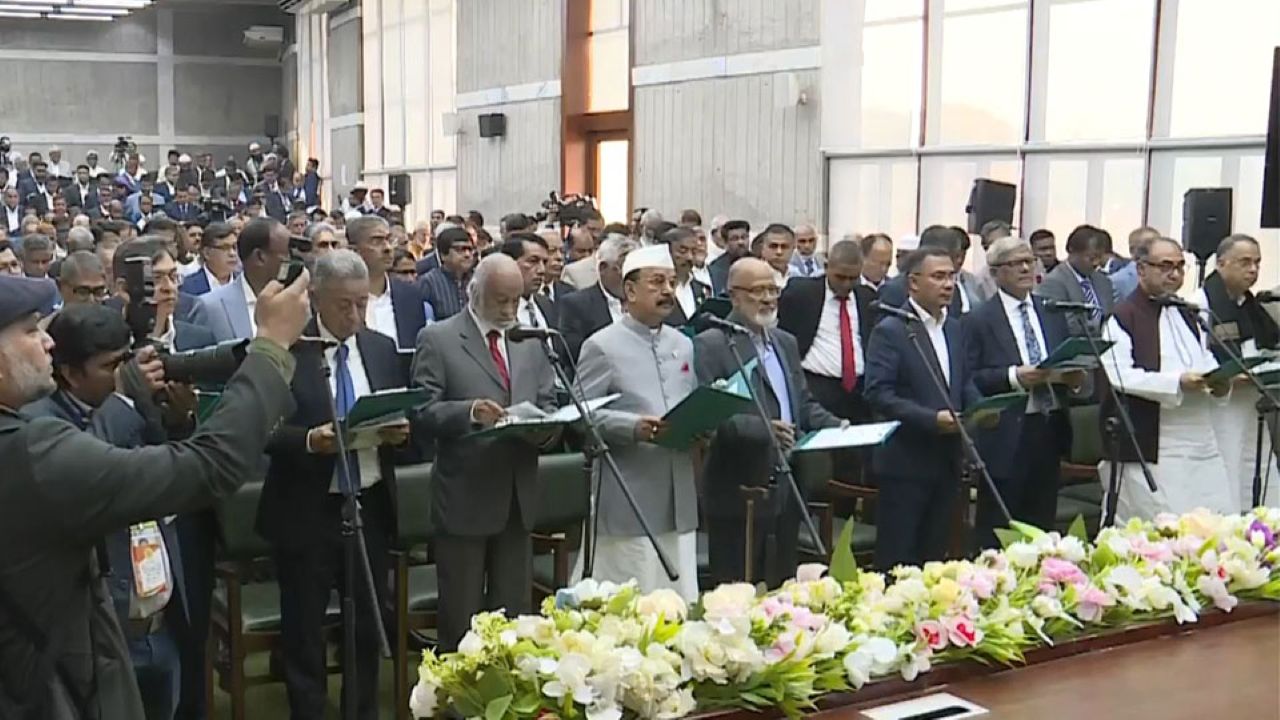

After its victory in the 1991 general election, BNP formed a government under the leadership of Khaleda Zia with a cabinet largely made up of new faces. Only a handful of ministers who had served during the tenure of Ziaur Rahman were retained in her administration.
More than three decades later, a similar sense of surprise has followed the formation of a new cabinet under Tarique Rahman, the son of Ziaur Rahman and Khaleda Zia.
Political analysts say the structure and composition of the cabinet have drawn attention for their scale and diversity. The 50-member cabinet, including the prime minister, stands out for the dominance of newcomers.
Of those appointed under Prime Minister Tarique Rahman, only eight ministers, state ministers or deputy ministers previously served in Khaleda Zia’s government. The remaining 42 have never before held positions in a BNP-led cabinet.
Although most are new to ministerial office under the party, two among them earlier served in the cabinet of former president Hussain Muhammad Ershad.
One of the defining features of the new cabinet is its emphasis on youth and fresh leadership over parliamentary experience. A majority of cabinet members have been elected to parliament for the first time.

In the 50-member cabinet, three ministers and state ministers have been appointed under the technocrat quota. Among the remaining members, at least 30 are first-time members of parliament.
Many had expected a cabinet combining experience and youth, with perhaps half drawn from previous administrations. That did not happen.
Political analysts say Tarique Rahman has broken with convention by placing his trust largely in newcomers as he prepares to confront the challenges of governing. They describe his willingness to take that risk as a significant political statement.




The BNP has nominated 25 full ministers and 24 state ministers in the cabinet formed under the leadership of party chairman and Prime Minister Tarique Rahman.
Of the 25 full ministers, 23 are elected members of parliament, while two have been appointed as technocrats.
The full ministers are Mirza Fakhrul Islam Alamgir, Amir Khoshru Mahmud Chowdhury, Salahuddin Ahmed, Iqbal Hasan Mahmud, Major (retd) Hafiz Uddin Ahmed Bir Bikram, Abu Jafar Md Zahid Hossain, Khalilur Rahman (Technocrat), Abdul Awal Mintoo, Kazi Shah Mofazzal Hossain Kaikobad, Mizanur Rahman Minu, Nitai Roy Chowdhury, Khandaker Abdul Muktadir, Ariful Haque Chowdhury, Zahir Uddin Swapon, Mohammad Amin Ur Rashid (Technocrat), Afroza Khanam Rita, Shahid Uddin Chowdhury Annie, Asadul Habib Dulu, Md Asaduzzaman, Zakaria Taher, Dipen Dewan, ANM Ehsanul Hoque Milon, Sarder Md Sakhawat Hossain, Fakir Mahbub Anam and Sheikh Rabiul Alam.
The 24 state ministers are M Rashiduzzaman Millat, Anindya Islam Amit, Md Shariful Alam, Shama Obaed Islam, Sultan Salahuddin Tuku, Barrister Kaiser Kamal, Farhad Hossain Azad, Md Aminul Haq (Technocrat), Mir Mohammad Helal Uddin, Habibur Rashid, Md Rajib Ahsan, Md Abdul Bari, Mir Shahe Alam, Zonayed Abdur Rahim Saki, widely known as Zonayed Saki, Ishraque Hossain, Farzana Sharmin, Shaikh Faridul Islam, Nurul Haque Nur, Yasser Khan Chowdhury, M Iqbal Hossain, MA Muhith, Ahammad Sohel Manjur, Bobby Hajjaj and Ali Newaz Mahmud Khaiyam.
The line-up strongly reflects the participation of coalition partners and the emergence of younger political leaders within the alliance.
Amid the large influx of new faces, the absence of several senior figures has surprised many political observers.
Despite strong expectations, seasoned politicians such as Khandaker Mosharraf Hossain, Mirza Abbas and Gayeshwar Chandra Roy were not included in the cabinet.
Analysts suggest their exclusion may reflect a strategic decision to keep experienced leaders focused on reorganising the party and strengthening its activities, rather than assigning them executive roles in government.
There is also speculation that Khandaker Mosharraf Hossain could be considered for the presidency, Abdul Moyeen Khan for the post of speaker of parliament, and Gayeshwar Chandra Roy for a senior position in a proposed upper house. On Tuesday, Mirza Abbas was appointed as an adviser to the prime minister with the status of a minister.
The most discussed and contentious appointment in the new cabinet is that of Khalilur Rahman as foreign minister. His elevation has stirred debate in political and diplomatic circles, largely because of his role in the recently concluded interim government.
During the interim administration, BNP publicly called for the resignation of two advisers, one of whom was Khalilur Rahman. He was first appointed as High Representative on Rohingya Affairs and later as National Security Adviser, a move that sparked controversy. At the time, there were also reports of unease within sections of the armed forces over his appointment.
Questions were also raised about his citizenship, with claims that he held United States nationality. Khalilur Rahman, who has lived in the United States for nearly three decades, has consistently denied those allegations.
His appointment is seen by some critics as controversial not only because of those debates, but also because it appears to contradict a pledge made by the interim government’s chief adviser. He had stated that no member of the interim administration would take up a position in a subsequent political government. With BNP now in office, that earlier position has effectively been set aside.