
Political parties, participating in months-long talks with the National Consensus Commission (NCC), have unanimously agreed on the proposal to hold a referendum for the implementation of the July Charter.
However, there remains a disagreement over the date to hold the referendum between the parties. BNP and NCP want it to be held the election day while Jamaat wants it earlier.
The consensus was reached on Sunday, the fourth day of the final round of talks between the NCC and political parties, at the Foreign Service Academy in the capital.
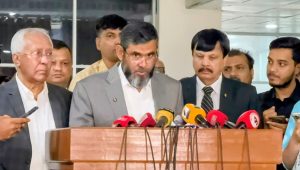
“All the political parties have agreed on holding a referendum to ensure public participation and consent for the implementing the July Charter 2025,” NCC vice chairman Ali Riaz told reporters after the talks.
“This will be the first step for political parties in implementing the national charter,” he said, expressing optimism that such consensus among political parties will be established on other issues as well.
But, the statement of Riaz has not cleared when the referendum will be held.
There has been a sharp disagreement among political parties regarding the process of implementing the July Charter.
The Bangladesh Nationalist Party and like-minded parties have been advocating for the implementation of the charter through the elected parliament while Bangladesh Jamaat-e-Islami and others are calling for the implementation of the charter before the elections.
This disagreement between the two major forces has created a kind of deadlock.

In an effort to break the deadlock, Jamaat and like-minded parties have proposed a referendum. Initially, the BNP and its allies opposed the referendum, but later they shifted their position.
Now, they are saying that a referendum can take place, but it must be held on the same day as the parliamentary elections.
But, disagreements have also emerged over the timing of the referendum. Major parties, including the BNP, National Citizen Party and others want the referendum to be held on the day of the general elections while Bangladesh Jamaat-e-Islami wants the referendum to be held before the general elections.
Amid a sharp division between the political parties on reaching consensus on the implementation of the constitution-related issues of the July Charter, the NCC, headed by Chief Adviser Muhammad Yunus, sat for the last round of talks as the commission wants to complete the job by 15 October, the final day of the commission’s tenure.
Riaz said that all political parties reached the consensus that the parliament, which would be formed through the February elections, would carry out the reforms based on the July Charter and those should be sustainable.
Expressing gratitude to the political parties for moving away from their hard stances, he said the commission would soon place a set of specific recommendations to the interim government for the implementation of the July Charter.



He further said that many political parties had earlier called for taking the opinion from the Supreme Court under article 106 of the Constitution.
“In today’s discussion, most political parties believe that it may not be necessary to seek the Supreme Court’s opinion under article 106 for implementing the charter,” he said.
Representatives from 28 political parties, including BNP, Jamaat, NCP, Gana Odhikar Parishad, Ganasanghati, Communist Party of Bangladesh (CPB), Biplabi Workers’ Party, and Amar Bangladesh (AB) Party, among others, participated in the discussion.
Emerging form the meeting, BNP Standing Committee Member Salahuddin Ahmed told reporters that the proposal on holding a referendum was finalised.
“In a broader sense the political parties are moving ahead for the final decision,” he said.
Over the proposal for a referendum, he said, “The question is whether we, all political parties, represent the entire population. Therefore, if we can obtain the consent of the people that we, the political parties, have signed the July National Charter and committed to it—whether the people support it—only then there will be a final opinion from the people for the implementation of this July National Charter.”
He also said that no constitutional amendment is needed for the referendum.
“The article 142 on referendums, annulled by the fascist Awami League government, has been reinstated through the High Court ruling. Now, there is no provision in the Constitution that prohibits a referendum. Therefore, an ordinance can be issued, giving the Election Commission the authority to conduct a referendum on a separate ballot alongside the parliamentary elections on the same day,” Salahuddin said.
“The public opinion that comes through the referendum is a verdict of sovereign power. Therefore, all Members of Parliament will be compelled to go by it,” he added.
When asked whether MPs, who oppose the July Charter but become a majority in the next parliament, would be obligated to accept the public verdict, the BNP leader said, “The public verdict is final… when they give the verdict on certain point, that parliament and its members will have to accept it.”
He also reminded that the parliament is always sovereign.
According to article 78, proceedings within the Parliament cannot be questioned in any court, he said.
When asked about the notes of dissent on various provisions of the July Charter, he said, “The July Charter will be drafted, signed, and everyone will sign the pledges. it will be posted on the website, included in all party manifestos…the public will know what the July Charter contains. Those who receive the public mandate will be able to proceed according to their notes of dissent.”
Jamaat, which also agreed on the proposal on referendum, wants the referendum to be held before the elections.
“We believe the referendum should be held before the elections so that the July Charter gains a strong legal basis backed by the people’s mandate,” Jamaat Assistant Secretary General Hamidur Rahman Azad told reporters.
He said that all major political parties, including the BNP, supported the idea of the referendum.
“All the parties agree on the necessity of a referendum. But Jamaat is in favour of holding it before the elections,” he added.
Azad acknowledged that the concept of the referendum is still unfamiliar to many in the country.
“But it is still possible to hold the referendum in November or December, even before the election schedule is announced,” he said, arguing that a pre-election referendum would simplify the political process and reduce uncertainty.
Azad further said that if the referendum is completed, there will be no problem in holding the election in February.
“If the referendum goes against Jamaat, we will still accept the people’s decision and will not raise any objections,” he said.
NCP Joint Convener Sarwar Tusher said political parties are gradually converging on the idea of holding the referendum to establish the legal and constitutional foundation of the July Charter.
“Our position is that a referendum should be held on that basis—ideally on the same day as the general elections,” he told reporters.
Tusher said that public opinion would likely become more supportive once political parties unite behind the referendum.
“The people already want the July Charter to be implemented. Earlier, the lack of unity among political parties held things back. But with consensus, public support will grow even stronger,” he added.