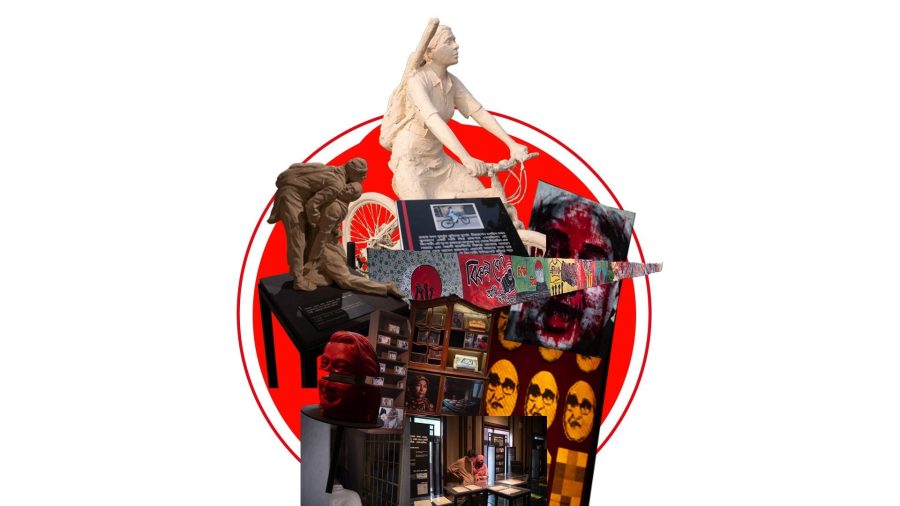



For nearly 15 years, the fortified walls of Ganabhaban in Sher-e-Bangla Nagar stood as a symbol of political power, shielding the former prime minister’s residence from public scrutiny. Today, the gates open to visitors seeking to understand the events that brought that era to an end. Transformed into the July Mass Uprising Memorial Museum, the compound has become a site of remembrance for the 36 days that changed Bangladesh’s political trajectory.
Inside, the contrast between the building’s past and present is difficult to miss. Once a centre of political authority, the former residence now houses photographs, videos, personal belongings and other exhibits documenting the July uprising and the years of repression that preceded it. Through displays and multimedia installations, the museum attempts to preserve the memories of those who took to the streets and those who lost their lives in the struggle.
The experience begins before visitors enter the exhibition halls. Outdoor sculptures depict scenes of resistance, while the names of martyrs are inscribed on the memorial grounds. Among the most poignant displays is the final letter written to his mother by Shahriar Khan Anas, an eighth-grade student killed by police fire on 5 August. The letter offers a glimpse into the life of a young victim whose death became part of a much larger national tragedy.
Inside the galleries, 5 August occupies a central place. Photographs and video footage document the moment protesters breached the heavily guarded compound, marking a dramatic turning point in the uprising. These scenes are juxtaposed with images of violence and police crackdowns in the preceding weeks, placing the public’s eventual breakthrough within the broader context of the movement.
The displays also seek to recognise the contributions of people from different backgrounds who joined the protests. Photographs and recordings show men and women standing together on the frontlines, underscoring the breadth of public participation.

Yet the museum’s most affecting exhibits are often those that bring the movement down to the scale of individual lives. One video installation features Mir Mugdho distributing water to fellow demonstrators shortly before he was killed. His actions, captured in the footage, offer a reminder that the uprising was shaped not only by confrontation but also by everyday acts of solidarity.
Nearby, personal belongings and other items recovered from martyrs, including Abu Sayeed, are displayed as tangible reminders of the lives lost. Removed from the scale of mass demonstrations and political upheaval, these objects invite visitors to consider the individual stories behind the names and images commemorated throughout the museum.
The museum also turns its attention to the state’s response to the uprising. One exhibit features audio recordings of telephone conversations between Sheikh Hasina and political leaders during the crisis, offering visitors a glimpse into the discussions taking place within the political establishment as protests intensified.




Beyond July 2024, the exhibition traces allegations of institutional corruption, enforced disappearances and extrajudicial killings during the preceding years. A section devoted to Aynaghar, the name widely associated with secret detention facilities, uses structural models and testimonies from former detainees to illustrate the experiences of people who were held in secret.
Together, the exhibits attempt to connect the uprising with the longer history of repression that preceded it. The museum’s central challenge, however, lies not only in preserving these records but also in presenting them in a way that reflects the complexity of the events and the diversity of those who participated.
Visitors’ reactions suggest that the institution has made an impression, though not everyone is convinced that it fully captures the movement’s significance.
Mizanul Hasan, who visited the museum with his family, said he wanted his children to learn about the country’s history firsthand. “July is an important period as it shifted the country’s trajectory. Though there are shortcomings in its execution, I feel like the museum mostly succeeded in upholding the core memory of the struggle,” he said.
Others found the presentation less comprehensive. Visitor Nazmul Hauque Rayhan said the complex was visually impressive but fell short of conveying the full gravity of the uprising. “Key gaps in representation detracted from the experience, and the display of historical events could have been handled in a much more comprehensive and impactful way,” he said.
Progga, a college student who gave only her first name, raised similar concerns. She felt the museum did not adequately represent the people who took part in the uprising and appeared to favour a particular group.
These criticisms point to a broader question facing institutions established to commemorate recent political upheavals: whose stories are preserved, how are they presented, and whether the resulting narrative reflects the range of experiences that shaped the events.

The museum’s layout has also drawn criticism. Its strict one-way visitor route requires people to move continuously through the galleries, making it difficult to return to exhibits they may want to examine more closely. Given the volume of information and the emotional weight of the displays, some visitors may find the arrangement leaves too little time for reflection.
Such limitations matter because the task of documenting a mass uprising extends beyond collecting photographs, recordings and personal belongings. A memorial must also make space for different perspectives, provide sufficient context and allow visitors to engage with the material at their own pace.
The July Mass Uprising Memorial Museum nevertheless marks a significant transformation in the use of a site once associated with concentrated political power. Its exhibits preserve images and objects from a defining moment in Bangladesh’s recent history, while its accounts of disappearances and state violence seek to place that moment within a longer political context.
Outside, traffic continues to surge along the roads of Sher-e-Bangla Nagar, largely indifferent to the history contained within the compound’s walls. Inside, visitors move through accounts of resistance, loss and political change.
The gates that once guarded a seat of power now admit the public. Whether the museum can fully represent the uprising’s many voices remains an open question. Its lasting significance will depend not only on what it preserves, but also on how honestly and comprehensively it tells the story of those who helped bring the gates open.