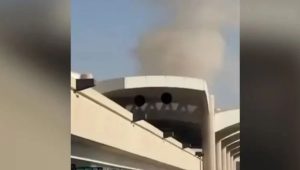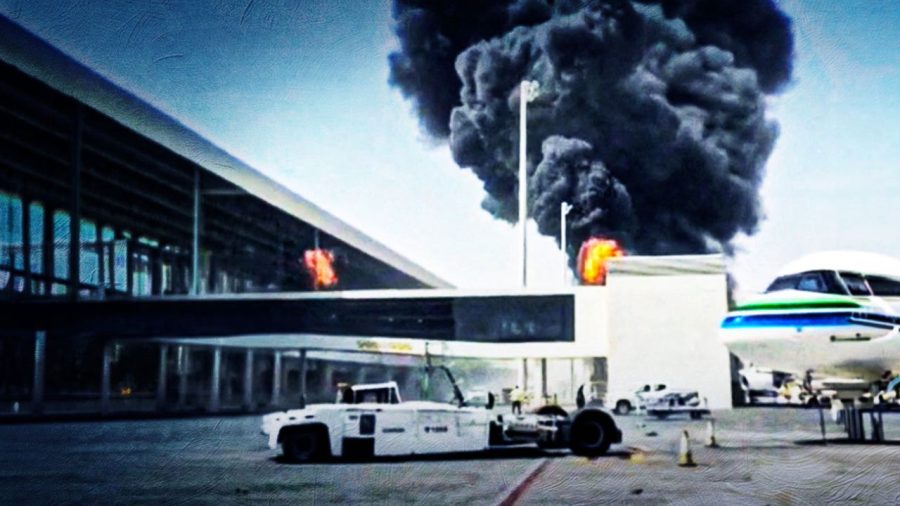



A projectile struck a passenger terminal at King Khalid International Airport in Riyadh on Sunday, a day after a missile attack on the same terminal killed at least 12 people and wounded more than 300 others.
The Saudi-led coalition fighting Iran-backed Houthi rebels in Yemen confirmed the latest strike on domestic terminals 3 and 4, while the Houthis claimed responsibility for the ongoing attacks, reports Al Jazeera.
The airport remained closed on Sunday following Saturday’s attack, which marked the deadliest strike in a Gulf Arab nation since the war with Iran began.
Saudi authorities confirmed that those killed on Saturday included four Saudi citizens, two Bangladeshi nationals, a US citizen, a Palestinian, an Egyptian, a Jordanian, a Syrian, and a Sudanese national.
The victims included Azza Ramzy, an Egyptian flight attendant for Saudi airline Flynas, and Buthaina Ahmad Oweida, a Syrian widowed mother of four whose niece, Nisreen Oweida, said she had fled Syria’s civil war and was returning to Mecca after visiting her sister in Riyadh.

Earlier in the week, Houthi attacks on the airport killed three Saudis, including a pilot, and a Sudanese national. The civilian facility, which contains no military installations, has been targeted daily since at least Wednesday.
On Sunday, the rebels also claimed responsibility for attacks on King Fahd Airport in Dammam, as well as oil and gas facilities in eastern Saudi Arabia.
The Houthis issued a renewed warning to airlines, experts, employees, workers, and travellers against using Saudi airports and airspace, declaring them an active theatre of operations.


Brig Gen Yahya Saree, the group’s military spokesperson, stated on X that airports in the holy cities of Mecca and Medina were exempt, following earlier statements by Riyadh calling Mecca a “red line.”
The latest strike in Riyadh followed Houthi claims that the airport in the rebel-held Yemeni capital of Sanaa had been hit again in a Saudi airstrike.
The Houthi-run health ministry reported that a child was killed and six people were injured in a suspected coalition airstrike on a home in Sanaa, adding that 91 Yemenis – 60 per cent of them women and children – have been killed by the coalition over five weeks. Saudi authorities offered no immediate comment on these claims.
The conflict’s history dates back to 2015 when Saudi Arabia entered Yemen’s civil war on behalf of its internationally recognised government.
A 2022 ceasefire collapsed in July when the Houthis resumed attacks over an incident involving an Iranian aircraft at Sanaa airport, leading the rebels to impose a counter-blockade on Saudi Arabia.
The sharp escalation threatens deeper US military involvement, with President Donald Trump weighing whether to join the campaign against the Houthis.
Trump indicated plans to confer with Saudi Crown Prince Mohammed bin Salman, though the White House provided no immediate comment on Sunday.
Deeper involvement in an unpopular regional conflict could present political risks for Trump’s Republican Party ahead of upcoming midterm elections, though both Trump and Iran insist election timelines do not influence military choices.
Amid heavy engagements, Saudi Arabia is running low on missile interceptors and has requested air defence support from France, Britain, Pakistan, and Egypt, while US interceptor stockpiles have also dwindled.
The attacks took place as Riyadh hosted a major international energy conference, ahead of a planned investment gathering, threatening efforts by Crown Prince Mohammed bin Salman to promote Saudi Arabia as a global business and tourism destination.
The escalating hostilities further jeopardise global oil supplies, energy prices, and commercial maritime routes through the Bab el-Mandeb Strait at the Red Sea, where Houthis seized key positions last month.
Ahmed Nagi, senior analyst for Yemen at the International Crisis Group, cautioned that Houthi pressure tactics could backfire by reinforcing Saudi resolve to pursue the military campaign rather than retreat.