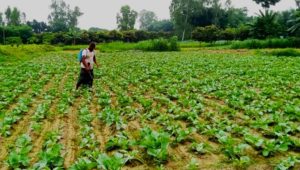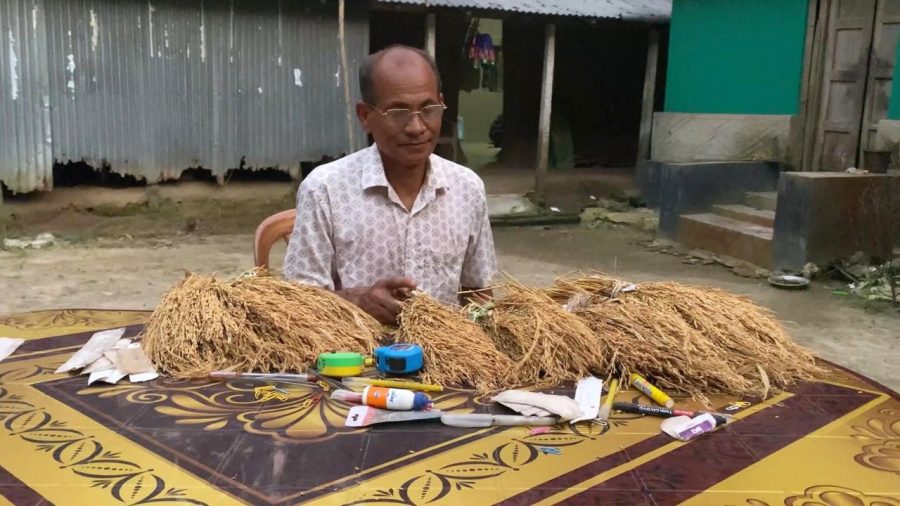



On just 12 kathas of farmland in a remote Sherpur village, farmer Sentu Chandra Hajong has established what effectively amounts to his own open-air rice-breeding laboratory.
There is no brick facility, no modern technical equipment, and no backing from a major research institution. Instead, the 55-year-old farmer has partitioned his modest plot into 440 tiny experimental patches where he has spent 21 years painstakingly crossing, selecting, and testing rice strains.
Sentu says his efforts have so far yielded 25 distinct new rice varieties, whilst more than 200 others remain under ongoing trial.
Some have already spread far beyond his smallholding. Local farmers are cultivating several of his creations, seed vendors actively stock them, and paddy merchants eagerly buy his grain whenever it reaches the market. Yet Sentu’s pioneering work has received no formal government recognition.
Born into an agricultural family, Sentu was forced to abandon his studies after completing his Secondary School Certificate because his family could no longer afford the fees. His formal journey into plant genetics began in 2005 with a short training course run by a local non-governmental organisation.
Armed with basic concepts, he began experimenting with controlled breeding and hybridisation. Developing and stabilising a single viable variety can take up to seven years, meaning a failed trial translates into years of lost labour. Undeterred by setbacks, Sentu simply starts again.

His first major breakthrough was Sentu Shail, which emerged after seven years of continuous trials and quickly gained popularity among neighbouring growers. He has since catalogued his successful creations from Sentu-1 through to Sentu-25, including three variations of Sentu Paijam, three types of Chini Shail, and Tulshimala.
While local agricultural officials have long been aware of his progress, Sentu notes that he has received neither state financial incentives nor targeted technical support, and official accolades have eluded him.
From trial plots to commercial fields
What began on a 12-katha patch in Chatkia of Nalitabari, is now transforming the surrounding agrarian economy.
“I cultivated Sentu Shail on two acres during the last Aman season,” says local farmer Dalim Mia. “Compared to the yields I harvested from standard commercial varieties, output has increased considerably. Virtually every farmer in this area now relies on Sentu’s rice.”


Fellow grower Razzak Mia echoes this sentiment, “We simply don’t cultivate any other rice anymore. During the Aman season, Sentu’s varieties are our default choice.”
This grass-roots movement has swept through local supply chains.
Al-Amin, a seed merchant in Nalitabari, notes that four of Sentu’s strains see overwhelming demand ahead of the planting season, often selling out long before planting begins. Stockist Abdullah Al Mahmud agrees, adding that local growers specifically seek out Sentu’s seeds for their superior productivity.
Grain merchants are equally eager buyers. Paddy trader Helal Uddin highlights parboiled Sentu-Paijam and non-boiled Sentu Atap as prime commodities, with the non-boiled variety fetching between Tk1,700 and Tk2,000 per maund during peak season.
“Sentu’s grain looks exceptional and produces superior cooked rice. Whenever his paddy comes onto the market, we snap it up first,” Helal says.
A refuge for heirloom rice
Developing high-yielding hybrids is only half of Sentu’s mission; he is also using his land to rescue vanishing indigenous rice varieties.
Each year, he experimentally cultivates rare heirloom strains including Bogi, Haloi, Golapi, Malanchi, Maynagiri, Malsira, Anamia, Parijat, Apchi, Kaishabinni, Marakkabinni, Shangbinni, Dudhbinni, Biroi, Chapal, and Khasiabinni. He is currently running active trials on Dhepa, Purabinni, and Nedrabinni.
“Many of our indigenous rice varieties are on the verge of extinction, yet they possess distinct flavours, unique culinary characteristics, and a natural resistance to pests,” Sentu explains. “That is why I am determined to preserve our natural genetic heritage while continuing to breed new strains.”
Sentu avoids chemical inputs, relying instead on self-prepared vermicompost and cow dung. When pests appear, he brews a natural botanical pesticide by boiling neem, gulancha, and basak leaves in water before spraying his fields.
He notes that these organic methods significantly reduce production costs. The natural nutrients also strengthen the plant stalks, helping them withstand seasonal storms without lodging. When cultivated correctly using these traditional techniques, indigenous varieties can yield an impressive 40 to 50 maunds per acre.
No official recognition yet
Despite two decades of success, Sentu still lacks basic research infrastructure.
“I still have not received any government recognition, nor do I have a proper laboratory,” he says. “I have been developing these rice varieties while living in my dilapidated house. If the state were to build me a basic facility, I could preserve far more genetic material and expand my breeding work.”
Formal validation may finally be on the horizon. Mohammad Sakhawat Hossain, deputy director of the district Department of Agricultural Extension, acknowledged that Sentu’s independent initiative has reinvigorated regional farming.
“Steps will be taken to submit his name to the Ministry of Agriculture for official recognition and an innovation award for his contributions to local agriculture,” Sakhawat says.