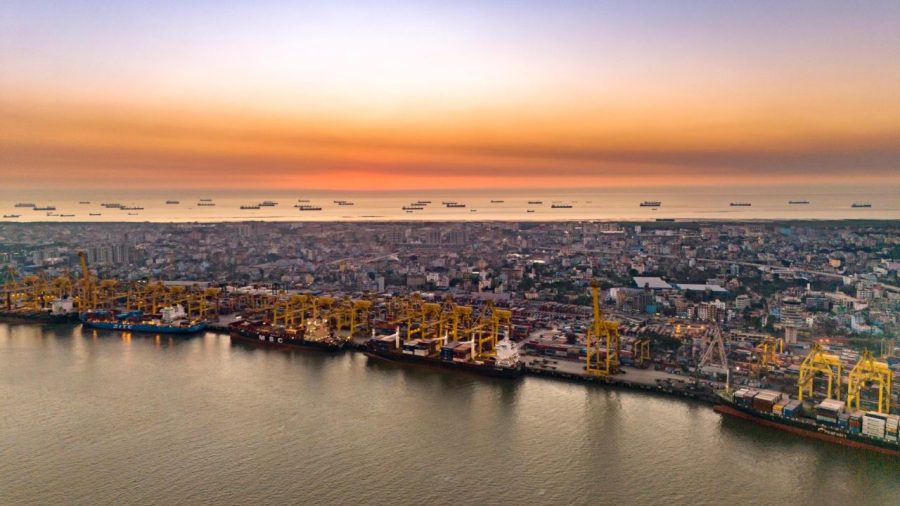



Bangladesh’s debate over private participation in ports is rapidly becoming outdated. The question is no longer whether private or international operators should have a role in the country’s gateways. That transition has already begun. The more important question is whether Bangladesh has built the institutional framework needed to govern the port system that is now emerging.
For decades, Chattogram Port largely followed what is commonly described as a tool-port model: the port authority owns the land, infrastructure and much of the equipment, while private companies undertake selected cargo-handling activities. That arrangement served a particular stage of Bangladesh’s trade development. But the country’s emerging port landscape looks increasingly different. Patenga Container Terminal introduced international terminal operations. A new privately developed terminal has been agreed on CPA land at Patenga. Laldia Container Terminal has now moved from planning and negotiation into construction. Bay Terminal envisages another major expansion involving common marine infrastructure and private participation, while Matarbari Deep Sea Port will introduce an entirely different scale of maritime capability.
Taken together, these are not isolated projects. They indicate the gradual emergence of a multi-operator port system containing increasingly important elements of the ‘landlord-port model’. That makes the next stage of reform institutional rather than simply infrastructural. Under the conventional landlord model, the public authority retains ownership and stewardship of strategic port land and common infrastructure, while terminal development and operations can be undertaken by specialised operators under long-term arrangements. The public sector does not disappear. Its role changes. Indeed, the landlord model can require a stronger port authority, not a weaker one.
The authority must become an effective strategic planner, custodian of scarce waterfront land, coordinator of marine access and common infrastructure, guardian of safety and environmental standards, facilitator of connectivity, and supervisor of a port ecosystem containing different operators and users.
Bangladesh now has a practical example of this transition. On August 31, construction formally began on the Laldia Container Terminal. According to APM Terminals, the approximately $550 million project will be designed, financed, built and operated by the private partner while the port asset remains with Bangladesh. Once operational, currently targeted for 2030, it is expected to add more than 800,000 TEUs of annual capacity and accommodate vessels substantially larger than those normally handled at Chattogram today.

Chittagong Port Authority itself described Laldia at the groundbreaking as Bangladesh’s first green port being developed under the landlord-port model. This is significant beyond Laldia. Once different terminals within the same port system are developed or operated by different entities, CPA’s responsibility can no longer be viewed mainly through the traditional lens of running terminals. It increasingly has to manage the port as a system.
That distinction is crucial. Ships approaching Chattogram do not operate in separate institutional worlds according to which terminal they will eventually call. Navigation channels, vessel traffic, pilotage, towage, hydrographic conditions, safety, emergency response and other marine services form a common environment. Road and rail connectivity outside terminal gates similarly determines whether improvements at the quay translate into improvements across the logistics chain.
Bay Terminal makes this relationship particularly visible. Its success depends not only on individual terminals but also on major common infrastructure, including the navigation channel, breakwater, reclamation and landside connectivity. The public authority therefore has a system-wide responsibility that no individual terminal operator can perform.




The same principle applies to digital infrastructure. A future multi-operator port cannot become a collection of digital islands. Shipping lines, Customs, freight forwarders, terminal operators, inland transport providers and cargo owners should not have to navigate incompatible information environments every time cargo moves between facilities. Port Community Systems, terminal operating systems, Customs platforms, maritime single-window arrangements and other trade platforms must progressively become interoperable.
The landlord-port transition therefore needs a digital architecture for the port community, not merely better software inside individual terminals. There is another reason why institutional reform now deserves attention: competition. Multiple operators can create powerful incentives for efficiency, innovation and service quality. Colombo demonstrates how terminals operated by different entities can coexist within a common port environment. India’s major ports have progressively expanded landlord-style private participation, while Vietnam has combined public stewardship with substantial private investment and terminal development. But international experience also shows that simply introducing private operators does not automatically create an effective landlord port.
The decisive issue is how responsibilities are allocated. Who plans capacity across the port? Who ensures fair access to common infrastructure? Who prevents one development from undermining another? Who coordinates marine services? Who establishes common technical and digital standards? And who ensures that individual commercial decisions remain compatible with national trade and logistics objectives? These questions become more important – not less – as private participation expands.
There is already reason for Bangladesh to consider this institutional gap carefully. A recent UN Trade and Development review observed that private operators are increasingly participating in Bangladesh’s port services while the regulatory framework has not undergone a comparable transformation. It specifically noted the absence of an independent port regulator despite the emergence of competing operators. That observation should not automatically lead Bangladesh to copy another country’s regulatory structure. Institutional models cannot simply be imported.
But it should prompt a serious policy discussion. Bangladesh needs to determine whether existing port authorities can simultaneously participate in commercial activities, administer common infrastructure, oversee multiple operators and act as neutral regulators – or whether some functions should gradually be separated. This is bigger than any single terminal concession. It is about the architecture of the national port system for the next several decades.
The immediate need, therefore, is not another debate framed simply as ‘public versus private.’ Bangladesh needs a coherent port operating-model policy. Such a policy should define which functions remain inherently public; which can be competitively concessioned or privately developed; how common marine and landside infrastructure will be financed and managed; how different terminals will connect digitally and physically; how competition and capacity planning will be coordinated; and how port authorities themselves must develop the skills required to govern increasingly sophisticated commercial operators.
This also matters for future investment. Matarbari, Bay Terminal, Laldia, Patenga and the existing Chattogram facilities should not ultimately function as disconnected infrastructure projects. Together they will form part of Bangladesh’s gateway network. Their development therefore needs to reflect trade flows, shipping economics, inland connectivity and the country’s longer-term logistics strategy.
The transformation has already started. Laldia makes that unmistakable. Bangladesh is therefore moving beyond the question of whether the landlord-port model is relevant. Elements of that model are already appearing on the ground. The real challenge is to ensure that institutional architecture develops as quickly as physical infrastructure.
A landlord port is not created merely by bringing in a private operator. It emerges when public ownership, private operational capability, competition, common infrastructure and regulatory responsibility are organised within a coherent system.
Bangladesh is beginning to build that system. Now it needs the framework to govern it.
The views expressed in this article are solely those of the author
The writer is a Maritime, Logistics and Supply Chain Policy Analyst; Adjunct Faculty, Bangladesh Maritime University