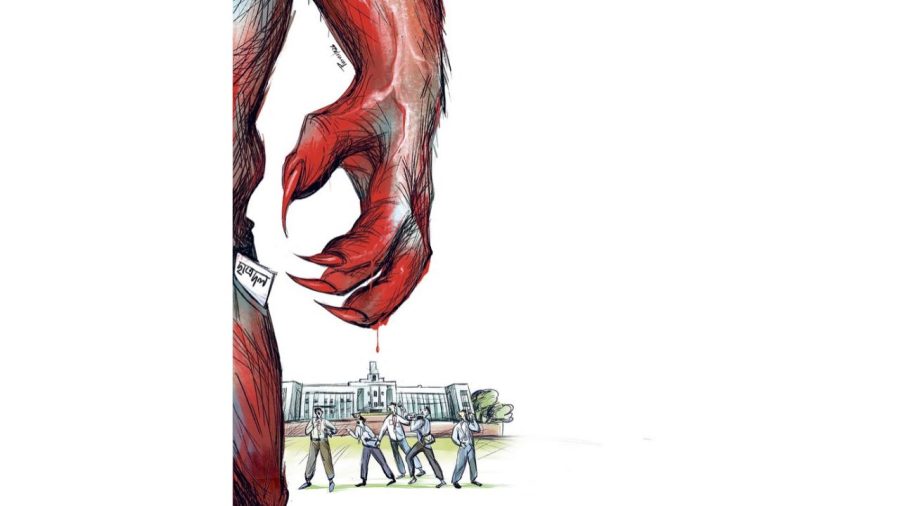



The attack on journalists by Jatiyatabadi Chhatra Dal leaders and activists at Rajshahi University marks another violent showdown by the ruling BNP’s student wing, echoing its gradual return to its old playbook.
Of the 16 to 17 attackers, who were leaders and activists, eight can be clearly identified in photos and videos that have emerged.
The attack on journalists by Jatiyatabadi Chhatra Dal – the student wing of the ruling BNP – at Rajshahi University involved 16 to 17 leaders and activists. Since then, from the photos and videos that have emerged, eight can be clearly identified.
The attackers include university Chhatra Dal vice-presidents M Ahsan Habib, Shariful Islam, Faruk Hossain and Takdir Al Imon; Joint General Secretary Hasibul Islam; Assistant Office Secretary Shahriar Alam; and activists Bishal Chakraborty and Imon.
During Awami League rule, the BNP routinely condemned attacks on journalists. Since 5 August 2024, however, numerous attacks on journalists have involved activists of the BNP, Jamaat and their affiliated organisations, as well as July uprising coordinators. Sunday night’s violence at RU is the latest among these.
The conduct of the university administration and police has also come under scrutiny. Even after Chhatra Dal leaders and activists appeared with weapons, the administration took no action.
Such inaction is not new. On 27 July, when several students were beaten and the library was attacked under the leadership of Rajshahi University Central Students’ Union (Rucsu) General Secretary Salauddin Ammar, the administration similarly “turned a blind eye”. Police instead arrested a student who had been assaulted.
Proctor Mahbubur Rahman acknowledged the failure after Sunday’s incident, stating: “We failed. We could not control the situation.”
He also said police who had arrived while journalists were being beaten left “out of fear” without taking any action.
Fourth-year student Rakibul Hasan criticised the proctor. “If you have failed, then you should have resigned by now,” he told TIMES.
When asked why police would leave the scene in such a manner, Motihar Police Station Officer-in-Charge Md Arjun declined to comment.
SAM Jahan, founding convener of Bangladesh Journalists in International Media, said threats to freedom of expression persist regardless of who holds power.
“Freedom of expression has never lacked enemies,” he said. “The faces change, but the instinct remains the same: to exploit, control, and suppress it once power is secured.”
He further added: “In our country, the culture of impunity endures regardless of who governs. Those who demanded fearless journalism only a year ago have now turned into Frankenstein’s monster, recoiling from scrutiny and resisting the pen. This cycle of hypocrisy and intolerance must be broken. Full stop.”

Professor Saiful Alam Chowdhury of Dhaka University’s journalism noted that the incident reflected a broader breakdown of authority.
“We have moved from autocracy to mobocracy. This incident is a continuation of that,” he said. “The most alarming thing here is that the proctor said the police left out of fear, which means the police are also afraid of mobocracy. If the state cannot ensure the safety of journalists, who ask questions and bring the truth to light, then there is nothing left to say.”
No end to allegations
Several of those identified in the attack have previously faced allegations of extortion, assault and other misconduct.
After the July 2024 mass uprising, Ahsan Habib was joint convener of the university Chhatra Dal and filed a case against over a hundred Chhatra League leaders and activists.
On the night of 17 October, two call recordings were leaked. One, lasting 52 seconds, involved a Chhatra League activist and Ahsan Habib. The other, lasting two minutes and 52 seconds, involved alleged attacker and Joint General Secretary Hasibul Islam.
In the recordings, they were heard demanding money from several Chhatra League activists while threatening them with cases.
Central Chhatra Dal expelled Ahsan Habib and Hasibul from the organisation on 19 October.
On 25 June 2025, student Jasimuddin again accused them of extortion. He alleged that Ahsan Habib, Hasibul, Bishal Chakraborty and 15 to 20 others had taken him to an isolated place, branded him a Chhatra League activist, beaten him and demanded money.
Central Chhatra Dal withdrew the expulsion orders on 16 August that year.
Hasibul was also accused on 22 April this year of stabbing student Abu Hasan with outsiders. He has faced further allegations of detaining people, including female students, on campus and demanding money.


Police arrested Hasibul with narcotics on 15 October.
Ahsan Habib is a student of the Department of Law from the 2013-14 academic session. His studies have continued for more than a decade.
Hasibul, a Department of History student from the 2017-18 session, is now in his eighth academic year.
Vice-President Shariful Islam, who took part in the attack, was admitted to the Department of Anthropology in the 2013-14 session.
Another attacker, Vice-President Takbir Ahmed Imon, enrolled at the Institute of Business Administration in the 2017-18 session.
Assistant Office Secretary Shahriar Alam Othi, who also took part in the attack, was admitted to the Department of Music in the 2019-20 session.
Bishal Chakraborty, a Department of Economics student from the 2021-22 session, was previously a Chhatra League activist. He had joined Chhatra Dal after the 2024 July Uprising.
He has allegedly been involved in the extortion complaints and is known to be close to Vice-President Ahsan Habib.
Branded as ‘gupto’ Shibir
Central Chhatra Dal has formed a two-member committee to investigate the incident, asking vice-presidents ABM Ejazul Kabir Ruel and Manjurul Alam Riyad to report within 24 hours.
RU Chhatra Dal President Sultan Ahmed Rahi, however, wrote on Facebook: “No leader or activist of RU Chhatra Dal would deliberately assault any journalist bhai. We condemn Shibir’s attempt to create distance and misunderstanding between RU Chhatra Dal and journalists.”
Ahsan Habib wrote: “No neutral journalist was attacked. When we went to Zia Hall to catch former Chhatra League leader and Zia Hall GS Ariful, who made derogatory remarks about the honourable prime minister, those so-called journalists who came to attack the aggrieved Chhatra Dal leaders and activists, only those ‘gupto’ Shibir chickens were resisted.”
Hasibul chimed in: “Oh, I see. If Shibir gets beaten, they become journalists!”
Bishal responded: “No journalist was attacked at RU. RU Chhatra Dal Vice-President M Ahsan Habib, together with ordinary students, resisted the ‘gupto’ terrorists.”
However, Chhatra Dal last night removed vice-president Ahsan Habib and joint general secretary Hasib Hasan from their posts, expelled Bishal Chakrabarty and served show-cause notices on six others over the attack on journalists.
Admin ignores warning signs
The tension had begun a day earlier.
Posting in a group called “Rajshahi University Sangsad on Saturday night, Ahsan Habib described Rucsu General Secretary Ammar as a murderer, rapist, extortionist, mob instigator, recruitment trader, embezzler and degenerate.
Rucsu Cultural Affairs Secretary and Chhatra Shibir leader Rakibul Islam replied: “These are Chhatra League narratives.”
Rakib alleged that Ahsan Habib then threatened him.
He said that the two had exchanged messages on Messenger, with Ahsan eventually saying he wanted to meet Rakib.
Rakib replied that he would be alone at the Transport Market until 5pm and challenged anyone to try laying a hand on him.
About an hour after Rakib left, Ahsan Habib arrived at the Transport Market with a group carrying hockey sticks.
Arif Uzzaman Korban, Rajshahi University correspondent for bdnews24.com, said he informed the proctor about the potential conflict, but no action followed.
When journalists were later attacked, the proctor called the police. Korban subsequently told journalists that police had left the scene out of fear.
The proctor could not be reached for comment on whether earlier intervention could have prevented the violence as he did not answer his phone.
Journalists attacked amid Shibir pursuit
While at the Transport Market on Sunday, Ahsan Habib posted on Facebook, in which he challenged Salauddin Ammar to come there if he had the courage.
At around 8:30pm, Zia Hall General Secretary and Shibir leader Ariful Islam replied on Facebook: “If you had guts, you would have come within the specified time.”
After seeing the post, Chhatra Dal leaders and activists vandalised Ariful’s room at Zia Hall.
They were carrying hockey sticks, ramdas, machetes, pipes, baseball bats and other objects.
When Proctor Mahbubur Rahman arrived, the Chhatra Dal leaders and activists hid the weapons.
Samakal correspondent Mainul Islam Raju and Ajker Patrika correspondent Din Islam, however, saw them and moved forward to record video.
Raju was beaten with sticks, while an attempt was made to snatch Din Islam’s phone.
bdnews24.com correspondent Arif Uzzaman Korban was also beaten.
When other journalists arrived, such as The Daily Star correspondent Nur Ahsan Mridul and Agamir Shomoy correspondent Zahidul Islam, they were also assaulted, with the latter suffering a head injury.
Other journalists who stepped forward to protect them were threatened with being buried.
Proctor Mahbubur Rahman later took the journalists inside the hall and locked the door.
No one to blame
Questions have also emerged over CCTV footage from the scene.
Journalists alleged that the footage was deleted after the attack to conceal the identities of those involved and obscure what happened.
Shaheed Ziaur Rahman Hall Provost Mahbubur Rahman said the CCTV connection had been disconnected because renovation work was under way, meaning no footage existed.
Pro-Vice-Chancellor (Administration) Abdul Alim, however, said: “The information is preserved. There is no shortage of documents. The investigation committee is collecting information from wherever it needs to.”
Meanwhile, a case filed by Shaheed Ziaur Rahman Hall Deputy Registrar Md Monir Hossain did not name any accused.
The university administration faced similar criticism after students were beaten under Ammar’s leadership in late July.
A five-member investigation committee was then formed and asked to report “as soon as possible”. More than two months later, the report has yet to be submitted.