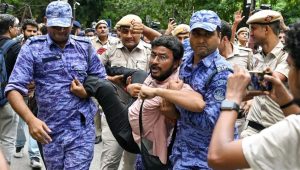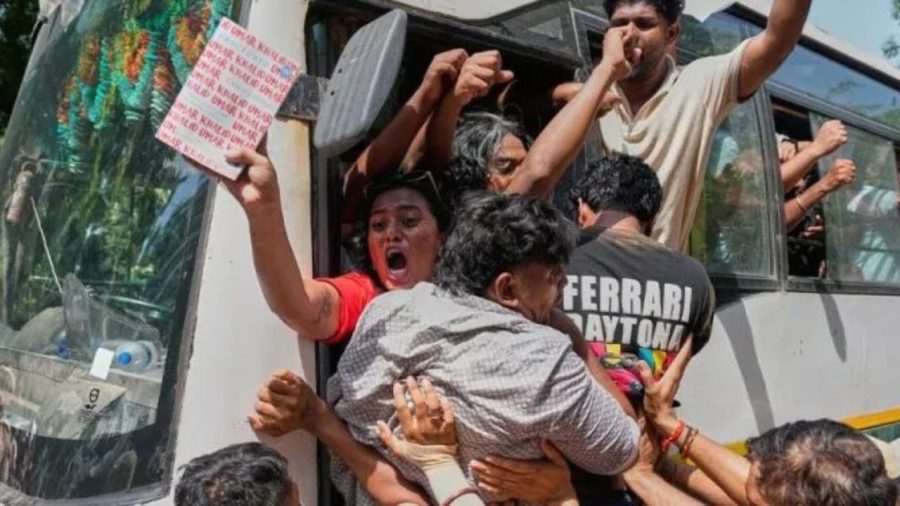



Police in the Indian capital New Delhi detained nearly 700 demonstrators, including senior leaders of the Aam Aadmi Party (AAP) and prominent student activists, during a high-profile protest near Jantar Mantar on Friday.
The agitation, held on Gandhi Jayanti, was staged to demand the immediate resignation of Chief Election Commissioner Gyanesh Kumar over alleged voter roll manipulation and mass voter deletions during the Special Intensive Revision (SIR) exercise, reports NDTV and Hindustan Times.
With law enforcement having refused official authorisation for the gathering, authorities enforced Section 163 of the Bharatiya Nagarik Suraksha Sanhita (BNSS) across the New Delhi district to ban unauthorised assemblies, rallies, and slogan-shouting.
Multi-layered security barriers were erected on key access corridors – including Minto Road, the DND carriageway, and Ashoka Road – manned by officers from the Delhi Police, Central Armed Police Forces (CAPF), and the Border Security Force (BSF).
To impede further mobilisation, authorities ordered a 12-hour suspension of mobile internet services from 9am to 9pm across a 1.5-kilometre zone surrounding Jantar Mantar.

In addition, entry and exit gates were closed at 12 metro stations, including key hubs such as Rajiv Chowk, Central Secretariat, Janpath, Mandi House, and New Delhi.
Vehicular movement around Connaught Place, Parliament Street, and adjoining thoroughfares was heavily restricted, leading to significant traffic congestion.
Security personnel intercepted multiple groups of marchers attempting to converge on the site.




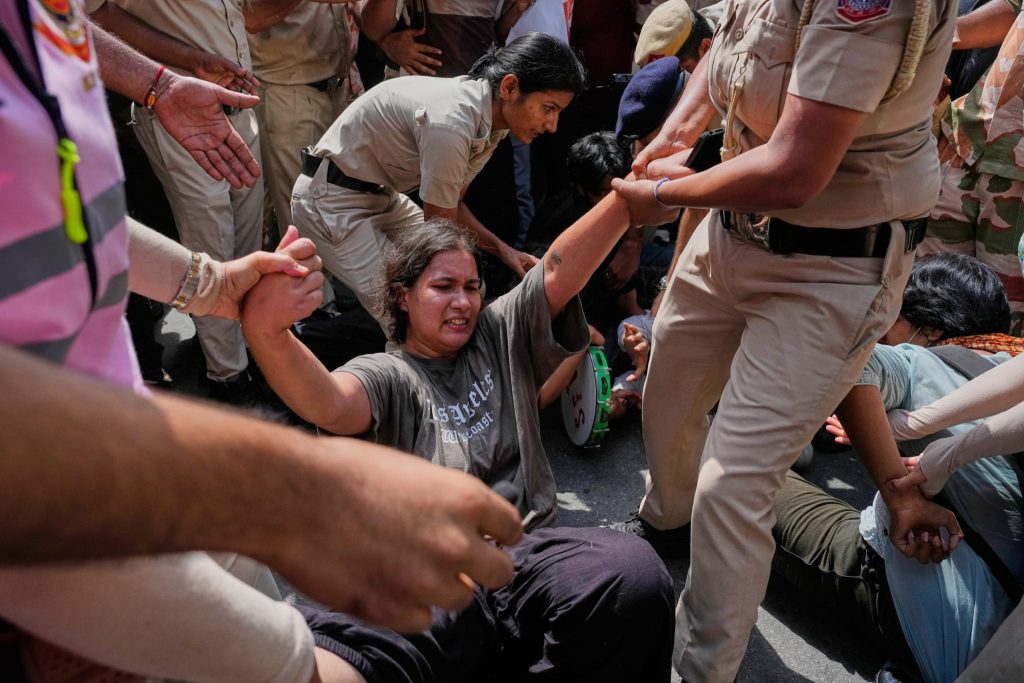
Among those taken into custody were former Delhi Chief Minister and Leader of the Opposition in the Delhi Assembly Atishi, AAP leaders Saurabh Bharadwaj and Sanjeev Jha, All India Students’ Association (AISA) national president Neha Bora, and National Students’ Union of India (NSUI) national president Vinod Jakhar.
Rashtriya Janata Dal (RJD) leader Manoj Jha and political activist Yogendra Yadav were likewise detained, whilst Communist Party of India (Marxist) [CPI(M)] leader Brinda Karat participated in the demonstration.
The rally saw joint participation from various student bodies, including AISA, the Students’ Federation of India (SFI), and the Democratic Youth Federation of India (DYFI), which aimed to assemble around 1,500 demonstrators despite the police ban.
Concurrently, around 200 NSUI members led by Jakhar marched from their headquarters shouting “Gyanesh Kumar Go Back” slogans before being blocked by police, whilst other demonstrators bypassed police barricades at Firoz Shah Road and the Ashoka Road roundabout.

Broadcasting video clips from inside police transport vans, detained leaders condemned the police action. Atishi posted on X that the campaign against “vote theft” would persist and asserted that the nation would not tolerate dictatorial rule.
Bharadwaj pointed out that AAP had submitted permission requests a week prior, questioning why authorisation was required to gather peacefully at a designated protest venue.
Meanwhile, SFI general secretary Aishe Ghosh accused the administration of prioritising the protection of the election chief over public safety, and student representatives from AISA alleged that police resorted to lathi charges and physical force against protesters, including women.
The CPI (ML) Liberation-affiliated student organisation also stated that the police action was aimed at stifling questions surrounding the electoral process.
Public discontent against the Election Commission has escalated following allegations of irregularities in the execution of the SIR voter list updates.
Scrutiny intensified after an investigative report by The Indian Express revealed that Election Commissioners Sukhbir Singh Sandhu and Vivek Joshi had repeatedly raised formal objections regarding decisions taken unilaterally by Chief Election Commissioner Gyanesh Kumar without their knowledge.
The Indian Election Commission has rejected the charges, maintaining that all policy decisions, including the conduct of the SIR process, were finalised through unanimous consensus among its three members.