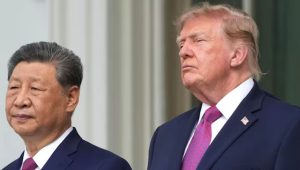
US President Donald Trump hosted Chinese President Xi Jinping in Washington, for a three-day state visit, with artificial intelligence (AI) emerging as a central pillar of bilateral discussions.
Framing the summit around “superintelligence”, Trump declared that dominance in AI is paramount to economic and national power, saying, “Whoever wins AI, WINS!”.
To underscore the high stakes, Trump hosted a lavish state dinner at the White House attended by prominent business leaders, including OpenAI Chief Executive Sam Altman, Amazon founder Jeff Bezos, Tesla and SpaceX Chief Executive Elon Musk, Nvidia Chief Executive Jensen Huang, and LVMH Chief Executive Bernard Arnault.
While Trump rejected potential existential risks from AI as a “hoax” and promised not to “stifle the growth of something that will be bigger than the industrial revolution”, China’s foreign ministry cautioned that “narratives of threat” and confrontation hinder global AI governance.
In his toast, Xi noted that Trump’s pledge to “make America great again” and China’s pursuit of “great national rejuvenation” could prove mutually reinforcing.
Infrastructure, chips, and capital investment
The US currently maintains a commanding lead in foundational computing infrastructure, supported by advanced microchip design.
According to figures from AI research institute Epoch AI, the US accounts for nearly three-quarters of total global AI computing power, whereas China holds just over 14 per cent.

American chip designer Nvidia accounts for more than 60 per cent of global AI computing capacity among major chip designers, while China’s Huawei retains a smaller, albeit growing, share.
Moreover, sweeping US export restrictions continue to limit Chinese access to advanced microchips.
The US also leads in physical infrastructure, housing over 5,400 data centres, roughly ten times more than any other nation, including 84 dedicated AI facilities, exceeding the next eight countries combined.
In capital spending, Goldman Sachs estimates that US hyperscalers, Amazon, Microsoft, Google, Meta, and Oracle, will invest $764 billion in AI infrastructure in 2026, compared to $102 billion by Chinese firms Alibaba, Tencent, Baidu, and ByteDance.



However, market research firm TrendForce projects Chinese hyperscaler capital expenditure to grow by over 80 per cent in 2026, outstripping the projected 76 per cent growth for US tech giants.
Frontier models vs open-weight deployment
While US developers lead in proprietary, subscription-based “frontier models” such as OpenAI’s GPT, Anthropic’s Claude, and Google’s Gemini, Chinese firms have adapted through rapid deployment of accessible “open-weight” systems.
Models from Chinese entities including DeepSeek, Z.ai, Tencent, and Moonshot AI (developer of Kimi K3) offer downloadable, customisable software at significantly lower costs.
On the OpenRouter platform, Chinese models dominate top rankings by tokens processed.


Analysis by the Centre for Strategic and International Studies (CSIS) reveals that top Chinese models trail US frontier systems by “months, not years”.
In May, the US Center for AI Standards and Innovation (CAISI) estimated that DeepSeek V4 Pro was roughly eight months behind leading US models.
While US officials and developers allege that Chinese firms closed the gap using “distillation” to learn from advanced US platforms, Beijing maintains that its progress is driven by open collaboration and resilience.
Research leadership, talent flow, and robotics
Beyond software, China holds significant structural advantages in surrounding technical domains. According to the Center for Security and Emerging Technology, China produced over 27 per cent of global AI scholarly publications in 2024, compared with 12 per cent from the US.
Research by MacroPolo indicates that 47 per cent of the world’s top 20 per cent of AI researchers completed undergraduate studies in China in 2022 (up from 29 per cent in 2019), though 72 per cent of those top researchers subsequently worked in the US.
Additionally, Chinese AI firms benefit from substantially lower electricity costs to power energy-intensive data centres.
In robotics, China has become the world’s largest manufacturer, with over two million industrial robots operating in domestic factories.
It also dominates humanoid robotics, accounting for over nine-tenths of global shipments in the first half of the year.
Diverging governance, risk hotlines, and safety guardrails
The summit highlighted contrasting national philosophies regarding AI safety. Trump has prioritised rapid innovation, asserting that existing rules are sufficient and that the primary guardrail needed is a “high IQ” president.
Conversely, Xi has urged central coordination to keep AI “under human control”.
Despite fierce rivalry, initial steps towards bilateral risk management are emerging. Yun Sun, senior fellow and director of the China program at the Stimson Center, noted that formal US-China dialogue on AI risks remains in its early stages as both nations gauge technical limits and regulatory boundaries.
To prevent operational hazards, US Treasury Secretary Scott Bessent and Chinese Vice Premier He Lifeng discussed pitching a bilateral AI “notification mechanism”, a diplomatic hotline designed to alert either nation when an AI incident poses an immediate threat to national security.