
Rights activists, lawyers, and politicians have expressed deep concern over proposed amendments to the Cyber Security Act under the guise of protecting women and children online.
They alleged that, under the pretext of protection, attempts are being made to suppress dissent and choke citizens’ voices by incorporating vague terms such as defamation, rumours, and misinformation, similar to the previous repressive Digital Security Act (DSA).
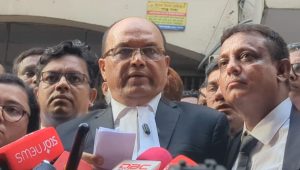
Speaking on Monday at a dialogue titled “How Controversial is the Amended Cyber Law on Freedom of Speech, How Much a Reflection of DSA?” organised by “Voice for Reform” at the BDBL Bhaban in Dhaka, speakers said such laws are completely contradictory to the promise of democratic transformation made following the mass uprising.
Fahim Mashroor, co-coordinator of the organisation, moderated the dialogue, where Nabila Idris, a former member of the Commission of Inquiry on Enforced Disappearances, presented the keynote.
Referring to the prime minister’s statement in parliament regarding the distinction between “freedom of speech and decency of speech,” she said problems arise when the state itself becomes the judge and punisher of indecency.
She added that freedom of speech is a citizen’s right against a powerful state.
Citing the example of cases filed under Section 57 of the ICT Act 2006 at Mirpur and Jatrabari police stations using identical “copy-paste” language, she said the purpose of these laws is not justice, but keeping people quiet through remand and harassment.
Golam Mahfuz, representative of the DSA Victim Network, alleged that the proposed amendment contains no clear provisions to protect citizens from cyber harassment or data leaks on the dark web; instead, defamation clauses have been brought back.

He warned that due to the vague definition of defamation, anyone will be able to file complaints, and phones and servers will be seized in the name of investigation.
Sharing his personal experience, he said that following a telephone call from the DGFI after a 100-day programme protesting enforced disappearances and crossfires, RAB detained him.
After serving 10 months in prison, it took four years for the case to be disposed of. He expressed concern over whether criticism of government policies would be treated as defamation of institutions.
‘1971 syndrome’ and concern over failing to comprehend public expectations
During the dialogue, Abdullah Al Mamun, lawmaker for the Narayanganj-4 constituency, questioned the current political goodwill.
He stated that the “gentlemen’s agreement” reached through the July Charter and the Consensus Commission is not being followed, and the space for expressing dissent is shrinking.



Recalling the tragic fate of writer Mushtaq Ahmed under the Digital Security Act, he warned that the risk of preparing First Information Reports in the same mould as in the past has resurfaced. He remarked that the harassment of facing years of legal battles, even after being proven innocent, can never be compensated.
Comparing the present situation to the post-1971 “syndrome”, the politician observed that during the Liberation War, as Sheikh Mujibur Rahman was in a Pakistani prison, a distance was created between him and wartime realities.
Similarly, due to spending a long time in exile and under persecution, it might be difficult for BNP Acting Chairman Tarique Rahman and Salahuddin Ahmed to fully comprehend the expectations of the people from the time of the mass uprising.
He also questioned what kind of advice Rashed Khan, assistant to the prime minister, is providing.
Drawing past examples of the Magura by-election and raising the retirement age of judges, he cautioned that BNP, the party most persecuted over the past 17 years, also suffers from the fear of losing power upon coming to power.
He added that returning repressive laws would run counter to the spirit of the uprising.
Breach of promises and disparity in punishment
Tajnuva Jabeen, an organiser of ‘Alternative’, noted that item 12 of BNP’s 31-point demand and its election manifesto contained pledges to repeal laws suppressing dissent.
A charge sheet was framed under this law against current Prime Minister Tarique Rahman himself in 2024. Yet within a few months, the government is stepping backwards.
Highlighting the disparity in punishment under the law, she pointed out that the penalty for inciting religious hatred or violence is two years, whereas 10 years has been proposed for rumours or misinformation.
Criticising the arrest of two youths in Meherpur and Sylhet over Facebook posts, she said the government is exploiting the public’s dislike of abusive language. She demanded the withdrawal of the proposed amendments.
Attempt to rush and impose
Barrister Priya Ahsan Chowdhury, Research Advisor of Bangladesh Legal Aid and Services Trust (BLAST), raised questions about the law-making process.
She stated that giving only eight working days, from the 13th to the 23rd, for public consultation is farcical for a sensitive topic concerning fundamental rights.
She noted that internationally, defamation is being shifted from a criminal offence to civil remedy.
Citing past instances of detention over a cartoon drawn by a 14-year-old child or Facebook status updates during the Covid-19 period, she emphasised that according to the UN human rights framework, speech that “insults or annoys” also falls under freedom of expression.
She also cited examples of eight countries failing after enacting criminal laws to curb misinformation.
Moreover, she warned that executive powers granted to the Ministry of Information and Communication Technology and relevant agencies to block content would place freedom of speech under further threat.
Barrister Tajriyaan Akram Hussain said dissent cannot be controlled through repressive black laws; what is needed is good governance.
He warned that if BNP brings back enforced disappearance-related laws, a toothless human rights commission structure, and laws like the DSA from the Awami League era, people will see no difference between the politics of the two parties.
Also present at the dialogue were Didar Bhuiyan, joint general secretary of Rashtra Sangskar Andolon; Engineer Mardia Mamtaz; Faisal Mahmud, Managing Editor of The Daily Waadaa; Sakib Ali, former diplomat; Nayeem Ahammad, Convener of JDP; Zarif Rahman, research director of Sopran; and Zayima Islam, journalist of The Daily Star.