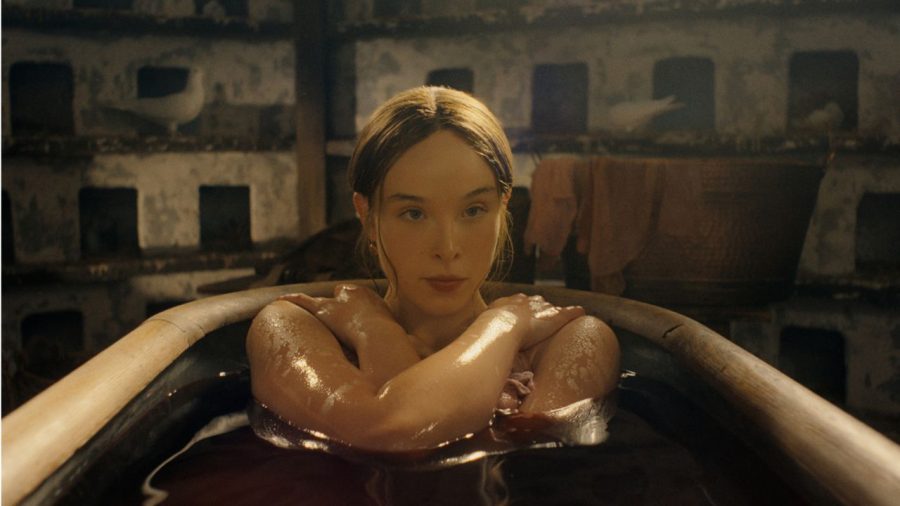

Lizzie Borden walks through her family home in a white nightgown, picks up an axe and changes her life with every swing. Blood stains the walls as Victorian elegance gives way to horror, before Monster: The Lizzie Borden Story rewinds four months.
Ryan Murphy and Ian Brennan’s eight-episode Netflix drama revisits the infamous 1892 murders of Andrew and Abby Borden in Fall River, Massachusetts. Ella Beatty plays Lizzie, with Vicky Krieps as maid Bridget Sullivan, Rebecca Hall as Abby, Charlie Hunnam as Andrew and Sarah Paulson as serial killer Aileen Wuornos.
The real Borden case remains uncertain. Lizzie was accused of killing her father and stepmother, stood trial and was acquitted. The series makes a bold fictional choice: it does not ask whether Lizzie wielded the axe, but why.
Lizzie lives inside a beautiful prison. Her father is cold, her stepmother humiliates her, her sister Emma has escaped and Victorian society offers her little independence. Then Bridget arrives, bringing stories of Paris, herbal remedies and a world beyond the Borden home. Their friendship becomes intimate and eventually leads towards rebellion and murder.

Their relationship is the emotional core. Krieps gives Bridget warmth, confidence and mystery, while Beatty makes Lizzie quietly compelling. Her anger gathers beneath the surface rather than erupting immediately. Rebecca Hall attacks Abby with theatrical ferocity, while Hunnam makes Andrew equally imposing.
The series is strongest as gothic spectacle. The Borden home resembles a haunted fairy-tale mansion, with ornate interiors, dark corridors, blood, birds, axes and elaborate costumes. Max Winkler’s direction contrasts quiet domestic scenes with sudden violence, romance and dark humour.




The soundtrack adds a modern pulse to the period setting. A Kate Bush track provides emotional texture, while Bitter Sweet Symphony accompanies the trial sequences. Lambrini Girls’ Cuntology 101 during a poisoning scene pushes the provocative tone further.
But the story eventually starts running out of road. With eight episodes to fill, exposition is sometimes repeated and promising threads disappear. Lizzie and Bridget’s romance occasionally recalls familiar historical lesbian dramas without developing enough identity of its own.
The series also expands into a meditation on female rage, repression, sexuality and violence. Bridget tells Lizzie about Countess Elizabeth Báthory, played in flashbacks by Krieps. Later, Paulson’s Wuornos becomes fascinated by Lizzie, treating her as a spiritual predecessor and hallucinating encounters with her.
The connection is thematic rather than historical. Borden and Wuornos lived almost a century apart and had different backgrounds, motives and methods. The series wants their stories to form a lineage of women driven towards violence, but the symbolism is sometimes too loudly announced.
That is frustrating because the Borden household provides enough drama on its own. The strongest scenes explore confinement, abuse, desire and resentment through character rather than explanation.
Still, Monster: The Lizzie Borden Story remains stylish, entertaining and wonderfully excessive. Beatty, Krieps and Hall deliver memorable performances, while the production design and gothic atmosphere are striking.
Viewers seeking Ryan Murphy’s glossy, bloody true crime will find plenty to enjoy. Those wanting meticulous history may be disappointed. This is not an investigation into the Borden mystery, but a fictionalised mythology built around it.
The result is a gripping, provocative gothic drama with an axe at its centre — and perhaps too much to say after the blade has already made its point.