
Bangladesh has requested assistance from the International Atomic Energy Agency (IAEA) to facilitate the rapid integration of electricity generated at the Rooppur Nuclear Power Plant into the national power grid.
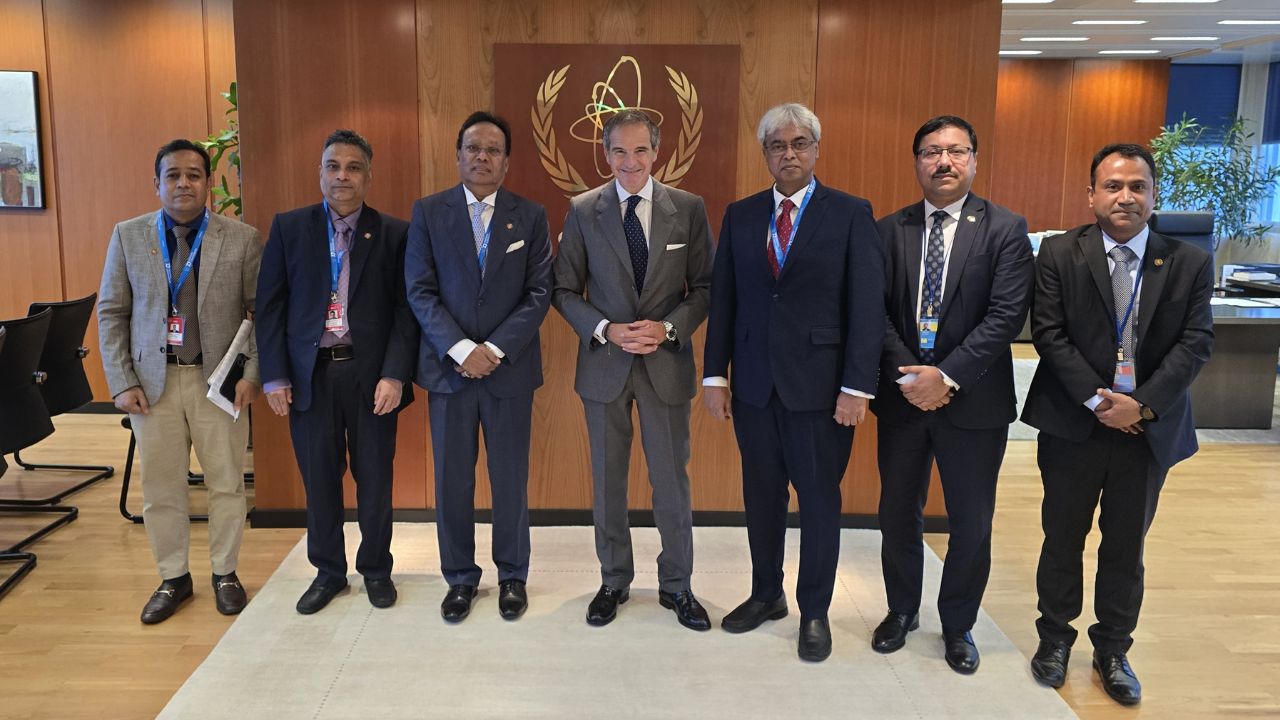
According to a press release, the request was conveyed during a bilateral meeting between Minister for Science and Technology Faqir Mahbub Anam and IAEA Director General Rafael Mariano Grossi at the agency’s headquarters in Vienna, Austria, on Thursday.
The Bangladeshi delegation led by Minister Anam included Secretary of the Ministry of Science and Technology Md Anwar Hossain, Bangladesh Ambassador to Austria and Permanent Representative to Vienna Toufique Hasan, and representatives of the Bangladesh Atomic Energy Commission.
During the meeting, both sides exchanged views on expanding the peaceful applications of nuclear technology, strengthening nuclear safety and security, and enhancing international cooperation.
Anam expressed sincere gratitude to Grossi for his role in advancing peaceful nuclear applications and international partnerships. He also called on the IAEA to deepen international cooperation to promote peaceful nuclear technology, fortify nuclear security, and foster sustainable development.

Describing the Rooppur Nuclear Power Plant as a historic milestone for national energy security, the minister noted that fuel loading in Unit-1 represents a major stride towards carbon-free electricity generation.
He said that this achievement opens new possibilities to meet rising power demand, ensure energy security, and address climate change challenges.



Reaffirming Bangladesh’s commitment to maintaining the highest international standards in nuclear safety, security, and responsible management, Minister Anam highlighted that Bangladesh is the first country in South Asia to join the Joint Convention on the Safety of Spent Fuel Management and on the Safety of Radioactive Waste Management.
The minister pointed out that Bangladesh has derived substantial benefits for over five decades from the IAEA’s Technical Cooperation Programme across vital sectors, including health, agriculture, food, water management, industry, and energy.
He also highlighted the recent signing of the Country Programme Framework (CPF) for the 2026–2032 period, which will unlock new avenues for technological collaboration.
On healthcare, Minister Anam thanked DG Grossi and the IAEA Secretariat for leading the “Rays of Hope: Cancer Care for All” initiative.
Having joined the initiative in 2025, Bangladesh is working closely with the agency to translate this partnership into effective national programmes, with a primary focus on establishing an integrated one-stop cancer care centre to deliver comprehensive, accessible, and patient-centric treatment.
Stressing the vital importance of IAEA technical assistance in capacity building, knowledge exchange, and strengthening sustainable health systems, the minister urged closer cooperation under “Rays of Hope” to expand cancer care access.
He added that Bangladesh looks forward to the IAEA–WHO–IMPACT Review Mission scheduled for November 2026, which will provide an evidence-based assessment of national cancer control capabilities and assist in defining practical priorities.
Underlining the need to deliver the benefits of science directly to the public, the minister emphasised that nuclear technology must be leveraged beyond technical advancement to improve living standards, build climate resilience, boost agricultural productivity, and expand healthcare services.
He urged the IAEA director general to broaden opportunities for international education, training, fellowships, and joint research for Bangladeshi students, scientists, and young researchers.
Reiterating the government’s resolve to establish an equitable, integrated, and sustainable cancer care system, Anam affirmed Bangladesh’s firm commitment to transforming “Rays of Hope” into tangible, lasting benefits for its people.