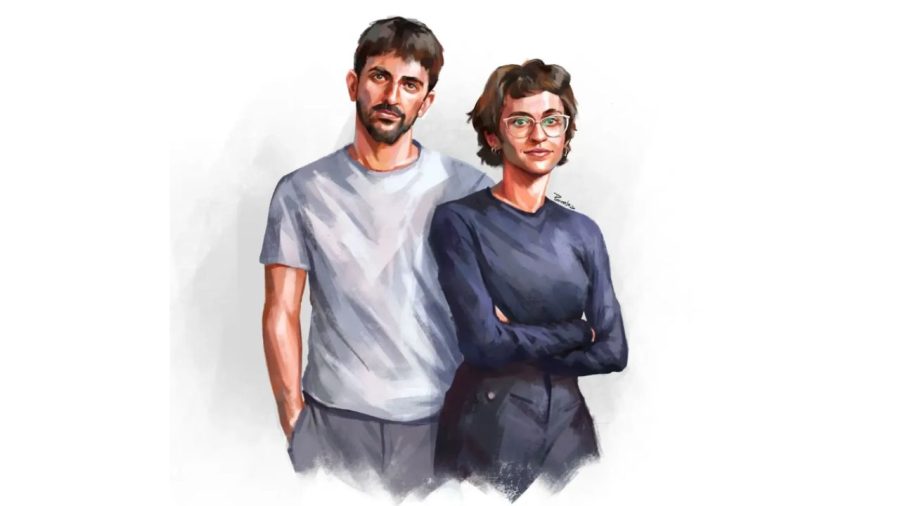

The applause had barely faded at the Venice Film Festival when a political storm erupted around NAZA, an 80-minute documentary about Israel’s military campaign in Gaza. It won the Special Jury Prize after a record-breaking 25-minute standing ovation. The next day, culture minister Miki Zohar threatened to revoke the citizenship of Israeli filmmakers Yuval Abraham and Rachel Szor, accusing them of treason.
The Guardian, which produced NAZA, reported that Zohar would act immediately.
Abraham and Szor interviewed 24 Israeli military and intelligence whistleblowers about intelligence and AI-powered targeting systems allegedly used to identify targets and estimate civilian deaths in Gaza. One source claims the military approved an attack expected to kill 500 civilians to eliminate one Hamas member.
The Israeli military rejected the allegations and questioned the anonymous testimonies.

After the Venice win, Zohar accused the filmmakers of harming Israel, called their work treason and said he would seek to revoke their citizenship. National Security Minister Itamar Ben-Gvir called them a disgrace and suggested Hamas would welcome them. Former defence minister Avigdor Lieberman called them “haters of Israel”, and former prime minister Naftali Bennett called the film a “horrific blood libel against our sons and daughters”.
Zohar’s accusation is not a conviction; neither has lost citizenship.
They also directed No Other Land, which won the 2025 Oscar for best documentary. With Palestinian co-directors Basel Adra and Hamdan Ballal, it examined Israeli settler violence and Palestinian displacement in the occupied West Bank. After its 2024 premiere, a rightwing mob targeted Abraham’s family home.




Israeli law permits citizenship revocation in certain breach-of-loyalty cases, including serious national-security offences. The Supreme Court upheld the framework in 2022; formal legal and judicial procedures are required.
Article 15 of the Universal Declaration of Human Rights protects the right to nationality. The 1961 Convention on the Reduction of Statelessness restricts nationality deprivation causing statelessness, except in limited circumstances. Israel signed but did not ratify it. The Supreme Court says anyone left stateless must receive permanent residence.
There is no verified precedent for revoking a filmmaker’s citizenship over a critical film.
Mordechai Vanunu served 18 years after revealing Israel’s nuclear programme and sought citizenship revocation in 2011. His case involved espionage and treason. Alaa Zayoud, convicted over a 2015 car-ramming attack, became subject to a 2017 court-approved citizenship revocation request. Neither case involves a political film.
Myanmar offers another example. Filmmaker Ko Pauk opposed the 2021 military coup and joined resistance activities; the junta revoked his citizenship in 2022 amid opposition-related charges. It was not shown to be solely because of a particular film.
Governments can also target films. Palestinian actor-filmmaker Mohammad Bakri’s Jenin, Jenin, about Israel’s 2002 West Bank operation, was banned by the Film Board. The Supreme Court overturned the ban in 2003 on freedom-of-expression grounds. After a defamation case by an Israeli military reservist featured in it, a court ordered damages and barred screenings; the Supreme Court upheld the ban in 2022. Bakri faced film restrictions, not citizenship loss.
NAZA has moved beyond cinema. Its directors call it an investigation into Israel’s war in Gaza, while critics see an attack on the state. It has become one of Venice’s most politically charged films, raising a wider question: if governments punish filmmakers for what they reveal, where does artistic freedom end?
The question is not confined to Israel. At Venice, Bangladeshi actress Azmeri Haque Badhan’s festival experience also became entangled in an alleged attack and political fallout in Bangladesh.
From applause to allegations, a festival prize to a citizenship threat, NAZA shows that powerful stories do not always end when the credits roll.