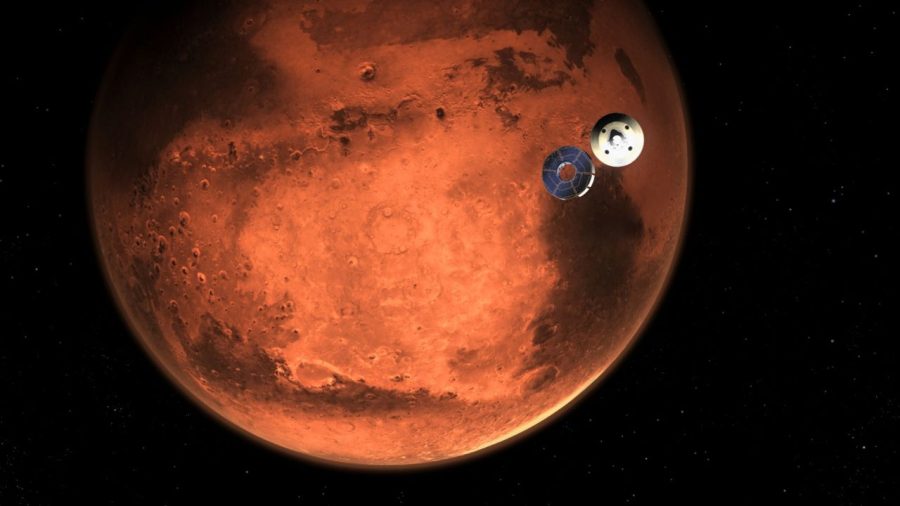

China is aiming to bring 500 grams of Martian soil back to Earth by 2031, a timeline that could see it outpace NASA, which currently lacks a clear plan or funding to match the effort.
The mission, called Tianwen‑3, is being developed by the China National Space Administration (CNSA). It is scheduled to launch around 2028 on two Long March 5 heavy‑lift rockets — the same workhorse that delivered China’s Chang’e lunar sample returns — from the Wenchang Space Launch Site in Hainan province.
The launch window is critical. Mars missions can only depart every 26 months, and Tianwen‑3 is targeting the window from December 2028 into January 2029. Any delay would jeopardize the goal of returning samples by 2031.

Anatomy of China’s Mars Sample Mission
The Tianwen‑3 spacecraft will comprise five components — a lander, an ascender, a service capsule, an orbiter, and an Earth reentry module.
Finding signs of life is the stated priority. Mission chief scientist Hou Zengqian told state media Xinhua that samples will be examined for microbial traces resembling early Earth life, while leaving open the possibility of something more unusual.




He repeated the point at the International Deep Space Exploration Conference in Hefei, organised by China’s Deep Space Exploration Laboratory, which this year drew participants from more than 40 countries.
Hou said even a null result would carry weight. “Regardless of whether signs of life are found, the returned Martian samples will have irreplaceable scientific value,” he noted, citing what microscopic, molecular and isotopic analysis could reveal about Mars’ geology and its potential habitability.
The hardware has reached prototype stage. Hou told state broadcaster CCTV that teams across China are working to overcome technical challenges.
The landing site remains under study. China expects to finalize the choice by the end of 2026, while researchers build a next‑generation geological map of the planet. Candidate sites are being weighed for geological age, evidence of past water, habitability, and their potential to preserve biosignatures.
Containment Challenge in Mars Sample Return
Bringing Martian material back to Earth poses a different challenge: containment. The mission plans to establish a planetary protection laboratory in the first phase of Hefei’s Deep‑Space Science City, the flagship campus of the Tiandu Laboratory now under construction. The facility will handle sterilization, unsealing, processing, and biological risk assessment of returned samples.
Scientists say the lab will operate under protocols set by COSPAR (Committee on Space Research), the international body whose planetary protection rules are standard for spacefaring nations. These protocols work in both directions — preventing Earth microbes from contaminating Mars and ensuring any material brought back remains safely contained.