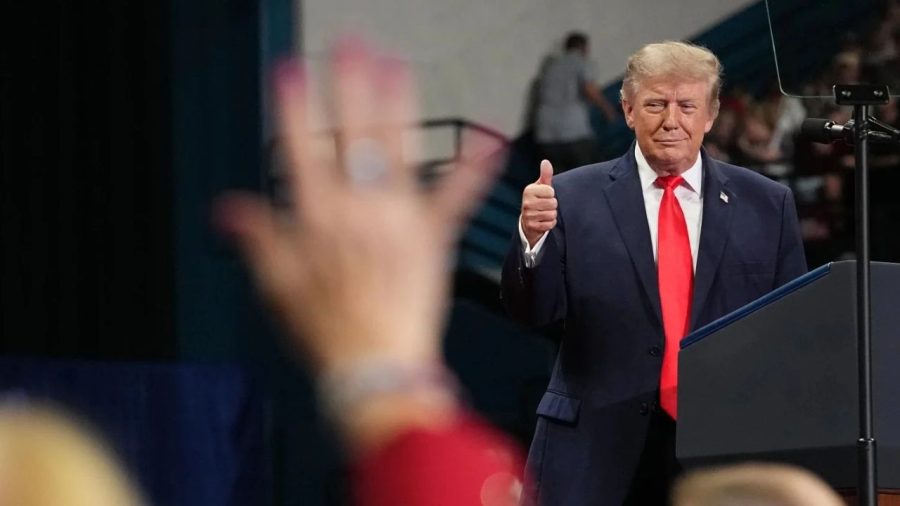



US President Donald Trump wrapped up the final weekend of a turbulent midterm election campaign with rallies in Iowa and Kansas, two states he has comfortably won in previous elections, as Republicans face tough challenges to retain their majorities in the Senate and House of Representatives.
Trump addressed supporters in Salina, Kansas, and Dubuque, Iowa, on Sunday, where Republican candidates are facing strong Democratic challenges that could threaten the party’s control of the Senate, while its majority in the House is also at risk.
During his Iowa rally, Trump expressed confidence that Republicans would secure major victories in Tuesday’s elections.
“We’re going to elect ‘America first’ Republicans up and down the line,” he said during a speech that lasted around two hours.
He later arrived in Kansas, where Air Force One made a dramatic flyover before landing for an outdoor rally at an airport.
However, hundreds of attendees began leaving before the end of his nearly 90-minute address, which continued until almost 10pm local time.
“This is our last stop. We’re closing it down tonight,” Trump told the crowd.
Since 1 October, Trump has travelled across the country, holding more than two dozen rallies in 19 states to support Republican candidates.

He is scheduled to deliver his final campaign message on Monday at the Lincoln Memorial Reflecting Pool in Washington.
With more than 54 million ballots already cast, Trump’s campaign activities highlight the Republican Party’s defensive position as the midterm elections increasingly become a test of public opinion on his second-term presidency.
Unlike the 2024 presidential campaign, when Trump focused on winning states previously carried by Democrat Joe Biden, he has largely concentrated on states where Republicans traditionally perform well. However, concerns over the economic impact of his tariffs and the war in Iran have raised questions among some voters, including his previous supporters.
Democrats face internal divisions in Michigan
Meanwhile, Democrats, who have become increasingly confident about their chances of gaining ground, are dealing with internal disagreements in Michigan.
Haley Stevens, a congresswoman who previously competed against Democratic Senate nominee Abdul El-Sayed in the party’s primary, appeared alongside Republican candidate Mike Rogers at a church service and subsequently endorsed his campaign.
Stevens, who has criticised El-Sayed over his position on Israel, said she decided to support Rogers after an invitation to a Democratic campaign event was withdrawn.




In a video announcing her decision, Stevens said El-Sayed had told her she was no longer welcome in his campaign, prompting her to back the Republican candidate.
The endorsement prompted senior Democrats to reaffirm their support for El-Sayed.
Senate Democratic leader Chuck Schumer said the party remained united behind its nominee, while Sen. Kirsten Gillibrand, who heads the Democratic Senatorial Campaign Committee, pledged to reject attempts to create divisions within the party.
Bernie Sanders, another prominent supporter of El-Sayed, also played down concerns about the internal dispute, saying Democrats across Michigan were prepared to support their nominee.
Michigan is crucial to the Democrats’ efforts to regain control of the Senate. Losing the seat could force the party to win additional contests in traditionally Republican states, including Texas, Kansas, Ohio and Iowa.
Midterm elections test Trump’s influence
The final phase of the campaign has also become a measure of Trump’s continuing influence over the Republican Party, which he has reshaped over the past decade.
Many supporters attending Sunday’s rallies said they wanted Republicans to retain control of both chambers of Congress to ensure Trump’s policies could move forward.
Jon Lutz, a 60-year-old civil engineer from Dubuque, attended his first Trump rally after regularly watching videos of the president.
He said he was satisfied with Trump’s performance during his second term.
Wendy Kuenzler, 44, from Burlington, Iowa, also attended her first Trump rally.
She described the state as being at a critical point because of several competitive elections and said she planned to vote for Republican Senate candidate Ashley Hinson.

She also defended Trump against criticism over rising fuel and grocery prices, saying he was taking steps to address the situation.
In Kansas, restaurant owner Liz Wagner, 59, travelled 165 miles from Atchison to attend the rally in Salina.
She expressed strong support for Trump’s policies and criticised Democrats for their approach to government assistance.
Trump is relying on repeated appearances before his loyal supporters to counter growing political challenges facing Republicans.
However, some of his October rallies attracted attention for lengthy, off-topic remarks and controversial comments about the physical appearance of politicians he supports.
Trump took a break from campaigning on Saturday, attending a jungle-themed Halloween party at his Mar-a-Lago resort in Florida, where he praised the country’s economic condition and dismissed concerns about its direction.
However, some Republicans have expressed worries that Trump’s policies could hurt the party’s electoral prospects.
Outgoing Republican Don Bacon of Nebraska warned that tariffs were unpopular across the Midwest and could become a major political issue.
He also predicted that significant Republican losses in the elections could trigger a debate within the party over its future direction.
Tim Scott of South Carolina, chairman of National Republican Senatorial Committee, remained optimistic, expressing confidence that Republicans would retain control of the Senate.
He also acknowledged Trump’s central role in the election, saying the president’s political agenda was clearly at stake.