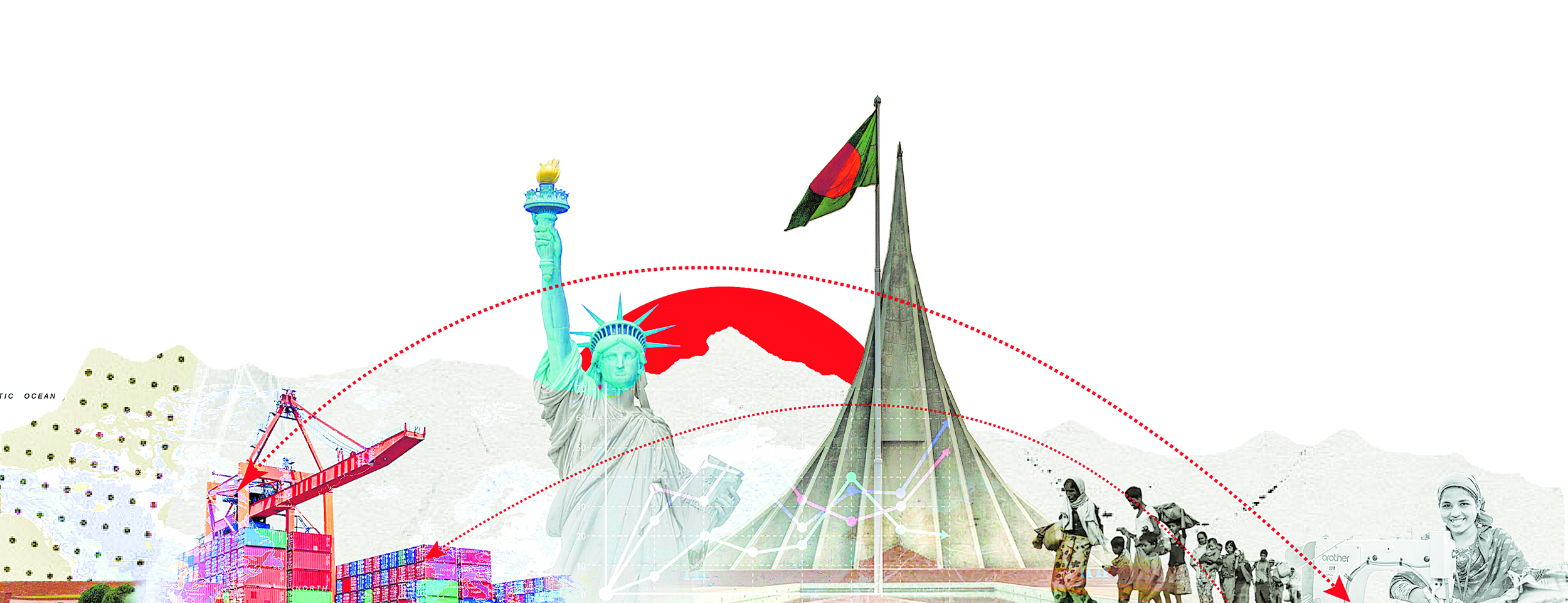
The US-Bangladesh relationship is entering a new era where strategy and opportunity converge amid rapid changes in the international order. As always, the relationship has been assessed from a perspective where humanitarianism, aid, trade, and support for democracy played a leading role.
Now, the US-Bangladesh relationship is occurring within a completely new framework of geopolitics and geo-economics. The Indo-Pacific region has become the centre of great-power rivalry, as China continues to expand economically and politically in South Asia. India, on the other hand, cannot be substituted by any other country.
Nevertheless, global supply chains are changing, and technology and trade are becoming matters of national security, making the Bay of Bengal more strategic than ever. In this regard, Bangladesh, because of its geography and economic potential, will influence future decision-making.
In this context, Bangladesh is no longer just a developing South Asian nation on the fringes ofS foreign policy considerations. Home to an estimated 175 million people, with an important export-based economy, and strategically located between South and Southeast Asia with easy access to the Bay of Bengal, Bangladesh now wields significant geopolitical and geo-economic importance.
Clearly, the main question for both Dhaka and Washington is this: Can the two nations elevate their historical relationship to a mature strategic partnership, while respecting Bangladesh’s sovereignty, national interests, and balanced relations with other powers?
Geography has always mattered in international politics, but Bangladesh’s geography matters more today than perhaps at any time since independence. Bangladesh sits close to India, China and Southeast Asia while overlooking the Bay of Bengal and the wider Indian Ocean.Maritime routes through this region connect major centers of production, energy supply and global commerce.
Consequently, developments in Bangladesh increasingly intersect with broader American interests concerning maritime security, resilient supply chains, regional stability and an open Indo-Pacific.
Still, Bangladesh must not fall into the trap of viewing such geostrategic rivalry as a choice between Washington and Beijing, or any two powers. Its long-term foreign policy strategy lies in strategic autonomy, whereby it can be friendly with all but be subservient to none. China is an important economic and infrastructure partner.
India is Bangladesh’s largest and most consequential neighbour, bound to it by geography, history, security and economic interdependence. The United States remains enormously important for trade, investment, education, technology, development and international diplomacy. Successful Bangladeshi diplomacy must therefore be multidirectional, not exclusive.
Economic relations provide perhaps the strongest practical foundation for a deeper Bangladesh–U.S. partnership. According to the Office of the U.S. Trade Representative, bilateral goods trade reached approximately $11.8 billion in 2025, with the United States importing about $9.5 billion in Bangladeshi goods and exporting approximately $2.3 billion to Bangladesh. However, the most important thing happened on February 9, 2026, as both parties signed an agreement called the United States-Bangladesh Agreement on Reciprocal Trade (USTR).
It is the first such agreement ever signed in South Asia. Moreover, the agreement is not limited to tariffs and non-tariffs. In fact, it also covers agricultural, energy, aviation, digital trade, regulatory, labour, and economic security issues.
It is important because the future of their economic relations cannot depend solely on ready-made garments. The Bangladesh garments industry will remain crucial, but the next level must encompass pharmaceuticals, IT, semiconductors and electronics supply chains, renewable energy, shipbuilding, health care, agriculture, and digital industries. American investment, technology and university-industry partnerships could play transformative roles in this diversification.




At the same time, trade relations reflect a new reality of international affairs: economics and geopolitics can no longer be easily separated. Tariffs, labour standards, supply-chain security, data governance and market access have become instruments of strategic policy. The 2026 trade agreement explicitly connects the commercial relationship with national and regional economic security. Bangladesh must understand and navigate this emerging geo-economic diplomacy skillfully.
One of the greatest strengths of Bangladesh–U.S. relations lies outside traditional diplomacy.
Several thousand Bangladeshi students are enrolled in colleges in America. Bangladeshis residing in America have contributed to areas such as medicine, academics, engineering, technology, business, journalism, and diplomacy. Universities in America and Bangladesh are linked. Social networks, family networks, and business networks between the two countries go way beyond diplomats. This soft power infrastructure is created by these human contacts.
A forward-looking partnership should expand student and faculty exchanges, joint research, professional training, entrepreneurship programs and cooperation in artificial intelligence, cybersecurity, journalism, public health and emerging technologies. In the twenty-first century, strategic partnerships will increasingly be built not simply by diplomats and defence establishments, but also by universities, scientists, entrepreneurs, journalists and young people.
The more mature framework is one based on respectful candour: partners should be capable of disagreement without allowing individual disagreements to define the entire relationship.
For Bangladesh, stronger democratic institutions, accountable governance, an independent judiciary, professional public administration and credible electoral processes are not concessions to Washington. They are ultimately investments in Bangladesh’s own political stability and international standing. Likewise, Washington must appreciate that solid alliances grow stronger when diplomacy respects national honour, history, and politics.
The Rohingya crisis is yet another significant arena where U.S. involvement becomes crucial. The country of Bangladesh has had an immense humanitarian task in protecting refugees from Myanmar. But humanitarian assistance alone cannot provide a permanent solution. The ultimate objective must remain safe, voluntary, dignified, and sustainable repatriation to Myanmar under conditions in which the Rohingya can live with security and fundamental rights.
The United States, working with international and regional partners, can continue diplomatic pressure and humanitarian engagement while helping prevent the crisis from becoming permanently normalised. Bangladesh should not be expected to carry indefinitely a burden created beyond its borders.
Bangladesh and the United States also share interests in counterterrorism, maritime security, transnational crime, disaster response and regional stability. Cooperation in these areas can deepen, particularly as the Bay of Bengal assumes greater strategic significance.
But Bangladesh must avoid becoming an arena for great-power rivalry. Its value to Washington should not be measured by how aggressively it distances itself from Beijing, nor should its relationship with China require estrangement from the United States.
Strategic maturity means developing productive relations with competing powers while ensuring that every partnership serves Bangladesh’s national interest. This is not neutrality through weakness. It is strategic autonomy through confidence.
Thus, the future of Bangladesh-US relations must be built on several intertwined pillars: expanded and diversified trade; increased US investment; cooperation in technology and energy; educational and scientific cooperation; maritime and security cooperation; democratic engagement; continued efforts to solve the Rohingya problem; and closer people-to-people links.
Most importantly, the relationship must evolve from episodic engagement to institutionalised strategic dialogue. Dhaka must articulate clearly what it wants from Washington – not merely what it opposes. Washington, likewise, should increasingly view Bangladesh on its own merits rather than principally through the prism of India, China or broader South Asian competition.
Bangladesh is not simply a geographical space between larger powers. It is a nation with its own interests, aspirations and growing capacity to influence regional affairs.
The global system is evolving towards a fragmented and competitive world order. Power is shifting, alliances are being redefined, technology is reshaping national security considerations, and middle powers and geographically strategic developing nations have increased political space. For Bangladesh, this creates both risk and opportunity.
The United States can become an even more consequential partner in Bangladesh’s journey toward economic diversification, technological modernisation, institutional development and global engagement. Bangladesh, in turn, can become an increasingly valuable American partner in a strategically important part of the Indo-Pacific.
But the relationship will reach its full potential only when both sides move beyond the old vocabulary of donor and recipient, pressure and reaction, or great power and smaller state.
The future should instead be built around mutual interest, sovereign equality, economic opportunity, strategic trust and reciprocal respect.
The author is a Professor and Former Chair at Department of Journalism and Mass Communication, Savannah State University, Georgia, USA.