Power, Energy and Mineral Resources Minister Iqbal Hassan Mahmood has defended the government’s plan to involve private companies in fuel oil imports and marketing, saying the move would increase competition and strengthen supply despite mounting criticism.
“A general policy is being formulated to allow qualified private companies, alongside state-owned entities, to import oil. This initiative is not intended to benefit any particular company, but to increase competition in the market and strengthen the supply system,” he said at a programme on Tuesday.
The government has come under strong criticism over what opponents describe as a hurried move to allow private companies to import and sell refined fuel.
Bashundhara Oil and Gas Company Limited applied directly to the government for permission to import around 33.5 lakh tonnes of refined fuel annually, equivalent to nearly half of national demand.
On 2 July, the Energy and Mineral Resources Division asked Bangladesh Petroleum Corporation (BPC) to review the application. BPC formed an 11-member committee and asked it to submit a report within two working days.

According to media reports, the committee expressed reservations about private-sector imports. Five days later, then BPC chairman Rezanur Rahman was removed from his post and made an officer on special duty.
On 6 August, the division gave BPC four working days to prepare, by 10 August, a draft policy on the private-sector import, storage, transport, distribution and marketing of refined fuel.
The move drew criticism from energy-sector trade unions, the Consumers Association of Bangladesh (CAB), Bangladesh Jamaat-e-Islami and energy experts.
Amid the backlash, the Ministry of Power, Energy and Mineral Resources described media reports as “imaginary and false”. The minister’s remarks, however, indicate that private-sector fuel imports had been under consideration since May.




Referring to panic over fuel supplies during the Middle East conflict, he said, “Despite adequate stocks, there were long queues at petrol pumps, black-market trading and incidents of online fuel sales. Following this situation, discussions were held with the prime minister about allowing the private sector to import oil.”
Mahmood also said low gas pressure affected industrial production and cash flow and increased the risk of loan defaults.
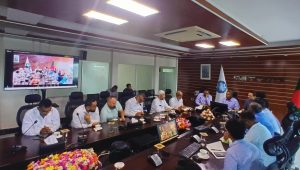
“I do not want any businessperson’s name to end up on a bank’s red list because of us,” he said at a seminar titled ‘Energy Sector Crisis: Prospects and Ways Forward’, organised by the Forum for Energy Reporters Bangladesh (FERB) at Dhaka Club.
State Minister for Power, Energy and Mineral Resources Anindya Islam Amit said the Excelerate Energy-operated floating LNG terminal at Maheshkhali would have to be temporarily shut down for repairs to restore it to full capacity.
“It may take 30 to 36 months to make a new FSRU operational. However, the government wants to make it operational in less than two years,” he said, adding that a land-based LNG terminal was also planned at Matarbari.
Energy expert Ijaz Hossain said FSRUs and LNG imports were necessary to tackle the immediate crisis but were not a long-term solution.
He recommended keeping domestic gas production close to 2,000 mmcfd, expanding solar power and battery storage, and reducing furnace oil-based generation. He estimated that gas demand could reach at least 4,600 mmcfd by 2030.
Independent University, Bangladesh Vice-Chancellor M Tamim said there was no single immediate solution to the energy crisis.
“Alongside increasing gas production, we need to import fuel as required, maximise the use of coal-fired power plants and quickly add 2,000 to 3,000 megawatts of solar power,” he said.
CAB Energy Adviser Shamsul Alam called for “revolutionary change” in the power and energy sector, including rational pricing and clear benchmark prices and investment conditions.
East Coast Group Chairman Azam J Chowdhury said renewable energy, oil, gas and LNG should all be utilised to meet demand, adding that a large land-based LNG terminal at Matarbari could help turn the area into a regional energy hub.
Bangladesh Independent Power Producers’ Association President David Hasanat said around 7,000MW of electricity could not be generated because of gas shortages and called for a third FSRU within two years and a land-based LNG terminal in the longer term.