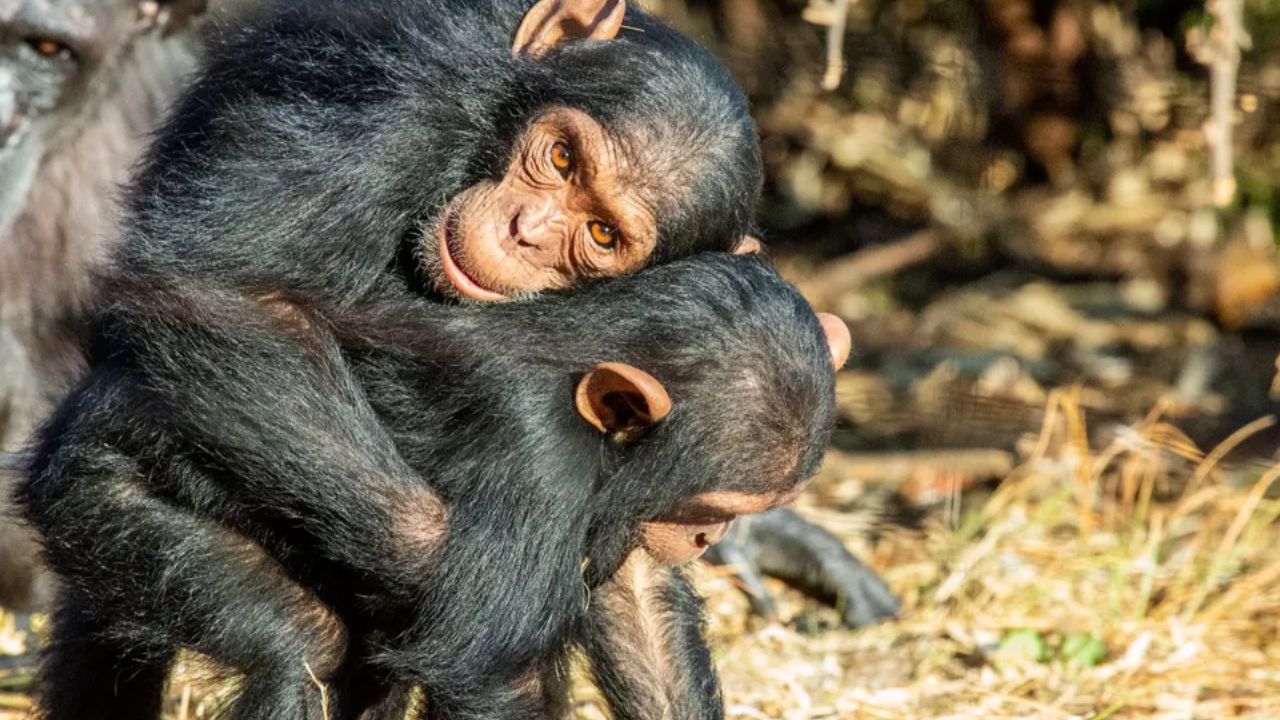



Great apes rely on physical affection such as hugging, kissing and gentle touching to strengthen social bonds before stressful situations, according to a new study by researchers at Durham University.
The research examined how chimpanzees and bonobos use reassuring contact before facing competition over food, reports BBC.
Scientists found that these behaviours helped reduce tension and encouraged peaceful cooperation.
Among the study’s unexpected observations was that chimpanzees, often regarded as more aggressive than bonobos, also displayed intimate gestures, including placing their fingers inside another chimpanzee’s mouth.

“Before stressful events, they come together, they reassure each other, they touch each other, they hug each other,” said Zanna Clay.
She described the behaviour as “a rallying cry” before a stressful event, much like a football huddle before a big match.
“It’s like a ‘we’ rather than a ‘me’,” she said.




The study focused on chimpanzees and bonobos living in two great ape sanctuaries located in the Democratic Republic of Congo and Zambia.
To recreate a natural feeding situation, researchers used peanuts and closely monitored the apes during the five minutes before the food was provided, when the animals anticipated its arrival.
During that period, scientists recorded different forms of comforting physical interaction, including touching, embracing and kissing.
The findings showed that apes engaging in these reassuring behaviours were more likely to share access to food and feed peacefully alongside one another.
Groups with greater social tolerance displayed higher levels of physical reassurance, including what researchers referred to as “reassurance trains”, where several apes embraced each other one after another.
“Comparing bonobos and chimpanzees – our two closest relatives – offers fascinating insight into the evolutionary roots of social behaviour and how they, and we, manage tension, competition and cooperation,” said Jake Brooker.
He said social touch was one of the oldest forms of communication and likely predated language.
According to the researchers, using physical contact to promote trust and cooperation may have originated at least seven million years ago, before humans, chimpanzees and bonobos diverged from a shared ancestor.
The study suggests that modern human behaviours, such as gathering in a football huddle, hugging a teammate or giving someone a reassuring pat on the shoulder before a challenging moment, may reflect a social practice inherited from ancestors millions of years ago.