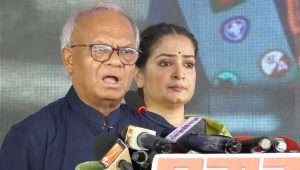
Primary and Mass Education Minister ANM Ehsanul Hoque Milon has expressed concern over what he described as a growing culture of viral attention among young people, saying it is affecting discipline and critical thinking.
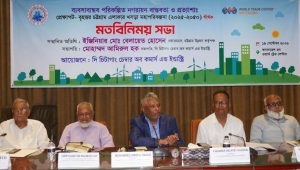
He made the remarks on Sunday while speaking at a workshop organised by the University Grants Commission (UGC) in Dhaka on the occasion of “World Intellectual Property Day 2026”.
The event focused on strengthening research and innovation activities and protecting the interests of innovators.
At the event, the minister said many young people now engage in live social media activity and make comments that are often inappropriate and disconnected.
He said “expressions such as ‘hi’, ‘go ahead’ and ‘do a research’ are frequently used without purpose, creating a trend of instant reactions and viral content.”
He said this behaviour is raising concern about the younger generation.
“Today’s youth, even those in uniform, do not hesitate to make disrespectful remarks against teachers or ministers,” he said.
The misnter described, young people are increasingly driven by a desire to become viral.

“Many students are making inappropriate comments on social media, including against teachers and officials, to become viral,” he said.
“The culture of virality is growing, and it is a matter of concern,” he added, saying such trends are weakening discipline and critical thinking.
He also questioned whether the country was making proper use of its demographic dividend, which he described as a key future strength.
He said “It is important to assess whether the potential of young people is being effectively utilised.”
The minister further said Bangladesh remains behind in the global intellectual property system. He noted “Local innovations and intellectual property are often registered and trademarked abroad, while proper recognition is not ensured within the country due to administrative weaknesses.”




“The government is working to increase investment in education, including a target to raise spending towards 5 percent of GDP, as directed by the Prime Minister” he added.
Milon has said that universities must not be turned into factories of unemployment. He said higher education institutions should not only produce degrees but must be transformed into job-oriented and research-based institutions.
In his keynote speech, the minister said “There are major gaps between planning and implementation in the current higher education system.”
“Simply establishing new universities is not enough, and stressed the need to turn them into centres of research excellence” he added.
He also emphasised maintaining international standards in higher education institutions.
The minister further said it is necessary to clearly decide whether private universities will become centres of quality education or commercial institutions. He questioned whether the country is truly producing educated human resources or only issuing degrees.
The minister said “A large number of graduates are ending up unemployed due to lack of job opportunities. The education system must be redesigned to directly contribute to skilled human resource development.”
He stressed the importance of strengthening industry–academia linkage.
He also said that around 2 million SSC and equivalent students and another 2 million HSC and equivalent students lose valuable time every year due to long admission processes. He said nearly 4 million years are being lost at a national level because of admission delays.
He questioned whether coordination of admission timelines is the responsibility of all concerned stakeholders.
Later, speaking to journalists after the event, Milon reiterated the government’s “zero-tolerance” policy on rumours related to SSC question paper leaks.
He said “Strict legal action would be taken against those spreading misinformation or fraud in the name of question leaks.”
“Social media platforms, including Telegram and Facebook, are under round-the-clock monitoring” he added.
“We request students and parents not to fall into such traps. We are aware and taking action,” Milon farther mentions.
The minister also criticised media reports based on unverified Telegram content, saying information must be checked before publication.
“Facebook spreads instant comments like instant coffee,” he said, adding that media outlets also have responsibility in preventing misinformation.
He noted “Four members of a fraud syndicate have already been arrested by the Counter Terrorism and Transnational Crime (CTTC) unit for cheating SSC candidates by taking money in the name of question papers.”
“The group tried to disrupt the examination system for financial gain and spread rumours that created panic among students and guardians. Police analysis showed the claims were not actual leaks but part of a planned fraud operation” Milon added.
He also said a private television channel later withdrew its report after failing to find evidence, confirming that the allegations were false.
He urged all stakeholders to act responsibly to ensure a fair examination system, adding that the government is working to strengthen cyber surveillance and digital tracking to prevent such incidents.
He said the SSC examinations have been conducted in a satisfactory manner and the government plans to complete exams in December, with the new academic year starting in January. He also said discussions are underway to advance the 2027 SSC and HSC examinations.