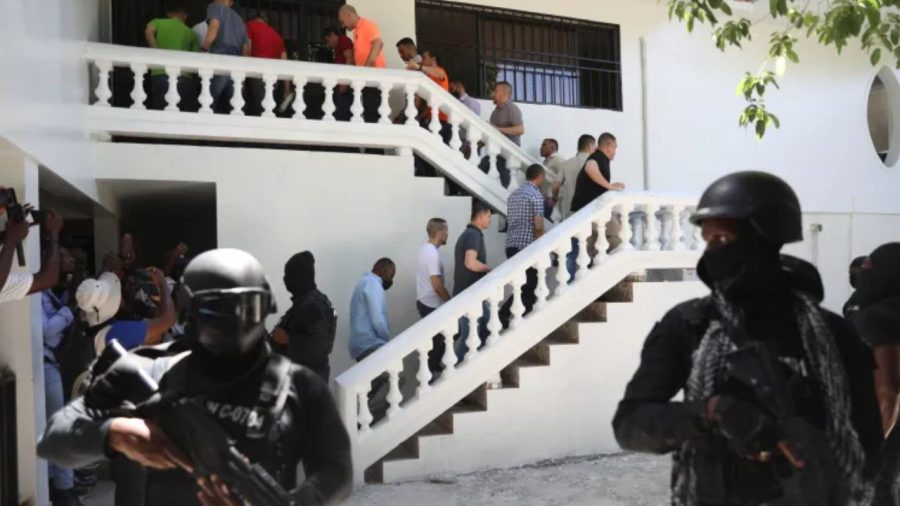

Eighteen individuals facing US federal charges in connection with the 2021 killing of Haitian President Jovenel Moise have been extradited to the United States.
A military aircraft transported the accused on Sunday from the Haitian capital, Port-au-Prince, to the state of Florida, where they are scheduled to stand trial for their alleged participation in an international conspiracy to murder the former head of state, reports Al Jazeera.
The extradition marks a major advancement in the case following the conviction in May of four individuals characterised by federal prosecutors as “gang leaders” and “co-conspirators.”
At least five additional suspects have previously admitted guilt and are currently serving life terms for their roles in the conspiracy.
US Attorney Jason A Reding Quinones, an appointee of US President Donald Trump, is heading the high-profile prosecution.

“Today marks the next major phase in our pursuit of accountability for the assassination of President Jovenel Moise,” Quinones declared on social media.
“We will follow the evidence wherever it leads, to those who financed it, facilitated it, supported it or committed crimes to make it possible. Five years later, we are still bringing defendants before American courts, and we are not finished.”


Although Quinones did not immediately release the identities of the 18 extradited individuals, those still held in Haiti awaiting legal proceedings include more than a dozen Colombian soldiers alongside a former Haitian government official.
Quinones noted that the FBI and partner authorities “remain steadfast in ensuring that all individuals who allegedly sought profit from the assassination of a head of state are held fully accountable.”
FBI Special Agent in Charge Brett Skiles confirmed that several arrests were carried out both within the United States and internationally on Sunday.
US federal courts in Florida, the nearest US state to the Caribbean nation, asserted jurisdiction after prosecutors determined that the plan to kill Moise was principally organised, funded, and coordinated out of southern Florida.
Holding a fair trial within Haiti had become virtually unfeasible because of widespread security breakdown, political chaos, overlapping humanitarian emergencies, and systemic corruption that have severely crippled the Haitian judiciary.
However, the transfer triggered criticism from human rights monitors in Haiti. Pierre Esperance, executive director of the National Human Rights Defense Network in Haiti, labelled the extradition a “disgrace for the Haitian justice system” and called for comprehensive reforms to ensure complex cases can be tried domestically in the future.
Moise, 53, was fatally shot during an overnight raid on his private home in the Pelerin 5 neighbourhood above Port-au-Prince in July 2021, an attack that also left his wife critically wounded.
His death created a deep political vacuum that left Haiti without any elected national leadership, as no national elections have taken place since his murder.
Taking advantage of the institutional collapse, violent gangs rapidly expanded their reach, ultimately seizing control over approximately 90 per cent of Port-au-Prince.
According to the United Nations, gang violence accounted for at least 8,100 killings in 2025 and has forced roughly 1.5 million residents from their homes.