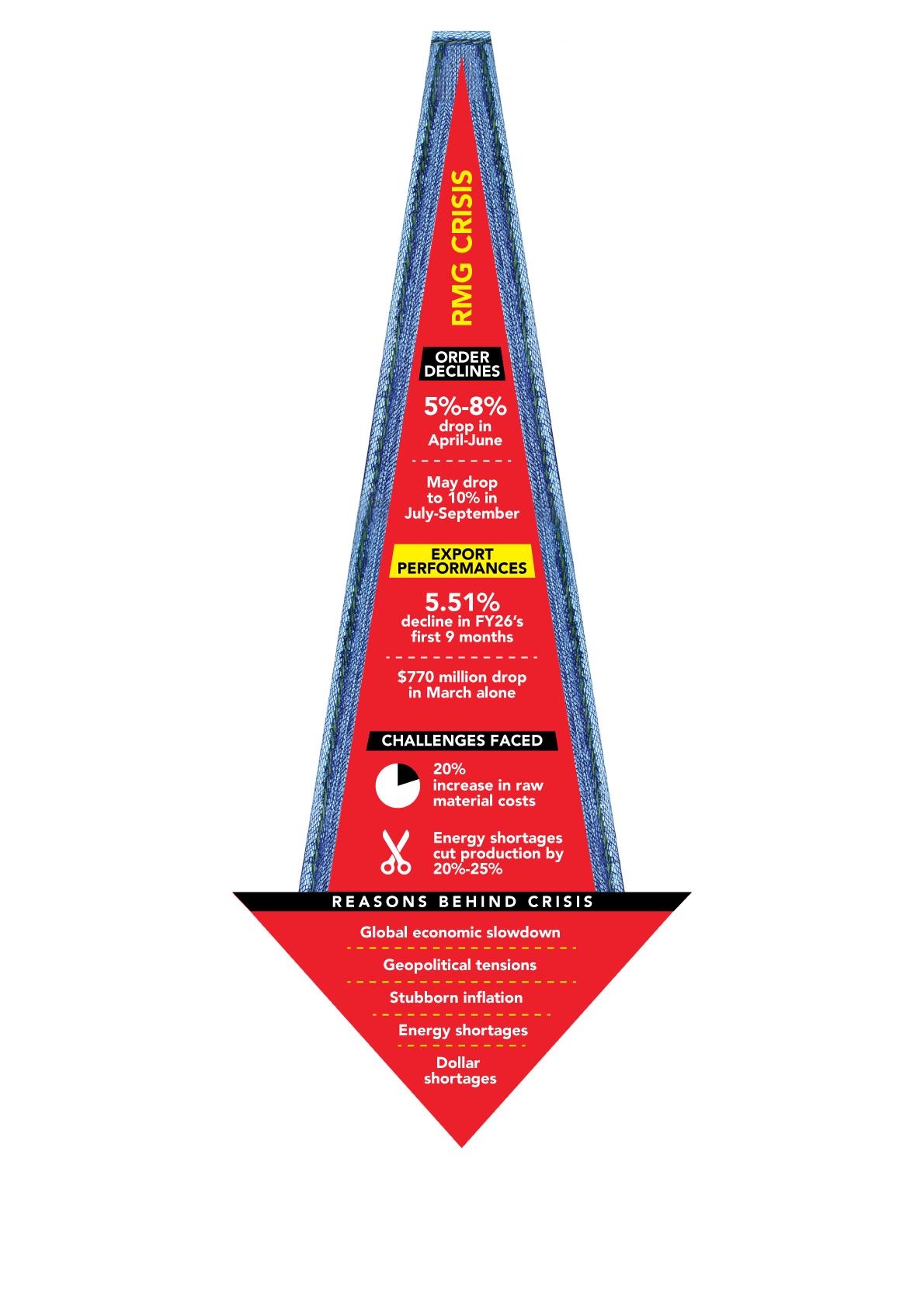
Bangladeshi apparel exporters are facing an intensifying struggle to secure enough orders and maintain fair margins, with export orders for the April-June period – covering the “Fall season” in Western markets – down by 5-8 per cent compared to typical years.
The outlook for the Winter season is equally grim. Industry leaders are bracing for a 10 per cent drop in orders for the July-September period, with negotiations still underway.
Readymade garment (RMG) exporters said they are going through a difficult phase, grappling with a mix of global and domestic constraints.
Amid geopolitical instability and economic slowdowns, foreign buyers are increasingly cautious about stock rollouts and retail margins, opting for more conservative approaches.

At the same time, exporters are seeing a 20 per cent increase in costs of imported raw materials, while their unit prices are barely rising.
Compounding these difficulties, the local energy crisis, rising production and transportation costs, and financial pressures from the high-interest rate environment make it even tougher for exporters.
Entrepreneurs say that the decline in export orders has been more evident in recent months, initially triggered by the Trump tariff shock and exacerbated by the ongoing global economic climate.
April-June period is typically the shipment period for the “Fall season,” in the Western markets, Sparrow Group Managing Director Sovon Islam said.
“However, orders for this period have dropped by around 5-8 per cent compared to normal years,” he said.

The situation looks grim for the upcoming July-September shipments for the “Winter or Holiday season.”
“Winter orders are being negotiated. Due to weakened consumer demand in Europe and the United States, amid high inflation, the orders could ultimately drop by up to 10 per cent,” he added.
Pricing pressure is building to a limited extent.
“International brands are now prioritising business continuity over profit,” Sovon Islam said.
“There is pressure on exporters to reduce prices, but with rising production costs, factories cannot offer discounts.”



Export earnings show concerning signs.
According to the Export Promotion Bureau (EPB), garment exports declined by 5.51 per cent year-on-year in the first nine months of the current fiscal year.
A sharp 19.35 per cent year-on-year drop of nearly $770 million in March has raised alarms about overall economic stability as RMG accounts for around 85 per cent of Bangladesh’s total exports.
Industry insiders point to both global and domestic factors behind the strain.
Geopolitical tensions, including the Iran-Israel standoff and the Russia-Ukraine war, have driven up fuel prices, pushing transportation costs and lead times higher while disrupting supply chains—factors that directly increase production costs.

At the same time, high inflation in key markets like the US and Europe has reduced consumers’ purchasing power, forcing brands to adopt a more cautious stance when placing orders.
BKMEA President Mohammad Hatem said that his factory has secured purchase orders covering 60 per cent of its capacity through June, with only about 30 per cent confirmed beyond that. Similar conditions prevail across most knitwear factories.
Domestically, challenges persist. With many banks going weaker, difficulties in opening letters of credit (LCs) are disrupting raw material imports and slowing production cycles for many factories.
Gas shortages are further hindering factory operations.
Inamul Haque Khan, senior vice-president of the Bangladesh Garment Manufacturers and Exporters Association (BGMEA), said rising fuel prices have increased transport costs and lead times, while declining global demand has made buyers more cautious.
“This slowdown in orders is not unique to Bangladesh—it is affecting nearly all exporting countries,” he said.
BGMEA leaders warn that many factories could face severe difficulties if around Tk4,000 crore in pending incentives are not disbursed swiftly.
Higher bank lending rates, alongside rising energy and transport costs, have compounded cash flow challenges, too.
Fazle Shamim Ehsan, executive president of BKMEA, said that while knitwear orders are generally lower in April, this year’s decline is sharper.
Middle Eastern markets, even though they account for a small part of the exports, are seeing the biggest declines as the war disrupted shipments.
His shipment to a Gulf market was delayed by 28 days amid the war.

“In many cases, even after shipments are made, buyers’ payments are delayed,” he added, noting that his company has around $800,000 in outstanding payments from an Arabian buyer.
Rezwan Selim, vice-president of BGMEA, said raw material import costs have risen by about 20 per cent due to higher fuel prices, while energy shortages at home are reducing production by 20 to 25 per cent.
“As a result, the industry is going through a very challenging time,” he said.
The RMG sector is not only Bangladesh’s largest source of foreign currency earnings but also a cornerstone of employment for millions.
Industry stakeholders argue that addressing the current crisis is vital, not just for economic stability, but also for maintaining the broader socio-economic balance.
According to the EPB, RMG exports stood at $28.58 billion during July–March of FY2025–26, a 5.51 per cent year-on-year decline. Exports to the EU, which accounts for nearly half of Bangladesh’s RMG shipments, fell by 6.99 per cent to $14.02 billion during the period. This indicates subdued consumer demand in European markets amid ongoing economic pressures.
Shipments to the US, the second-largest market with a 20 per cent share, also contracted, though at a slower pace. Exports to the US dropped by 2.54 per cent to $5.59 billion during the period.
“We need a national masterplan to navigate the crisis, where non-traditional markets can help offset the lost orders,” said former BGMEA director Mohiuddin Rubel.