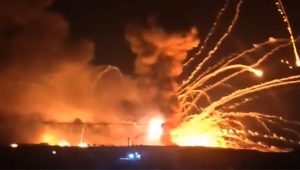
The Israeli military launched a series of intense air raids across Lebanon on Monday, striking the capital and southern regions after Hezbollah fired a barrage of rockets at Israel.
This escalation marks the first time the Tehran-backed group has claimed an assault since the November 2024 ceasefire agreement, effectively shattering the fragile peace, reports The Star.
The exchange began early on Monday when Hezbollah targeted Israel in what it described as a direct response to the killing of the Iranian Supreme Leader, Ali Khamenei. In a formal statement, the group asserted it acted “in retaliation for the pure blood of… Ayatollah Khamenei… and in defence of Lebanon and its people, and in response to the repeated Israeli attacks”.

In immediate retaliation, the Israeli military confirmed it had “begun striking targets of the Hezbollah terrorist organisation across Lebanon” in response to the incoming fire. Israeli officials later verified that their jets hit
Hezbollah operatives in both the Beirut metropolitan area and southern Lebanon. The strikes triggered “major displacement” as terrified residents fled Beirut’s southern suburbs and various towns in the south to escape the bombardment.



An AFP correspondent in the capital reported hearing several massive explosions echoing through the city during the early morning hours. Lebanon’s state-run National News Agency (NNA) noted that the initial waves of the Israeli offensive specifically focused on the southern suburbs of Beirut, where Hezbollah maintains a significant presence.
Responding to the crisis, Lebanese Prime Minister Nawaf Salam condemned the provocations that led to the Israeli strikes, labelling the initial attacks on Israel as “irresponsible and suspicious”. While he did not mention
Hezbollah by name, the Prime Minister vowed that his administration would “take all necessary measures to stop the perpetrators and protect the Lebanese people”.
The latest violence follows a period of heightened regional tension initiated by a US-Israeli strike on Iran. That incident sparked a broader conflict, with the Islamic Republic launching missiles and drones at Israel and various
Gulf nations that house American military installations. Although Lebanese authorities have consistently maintained that they wish to avoid being dragged into the regional theatre of war, the latest collapse of the ceasefire threatens to involve the country more deeply in the ongoing hostilities.