

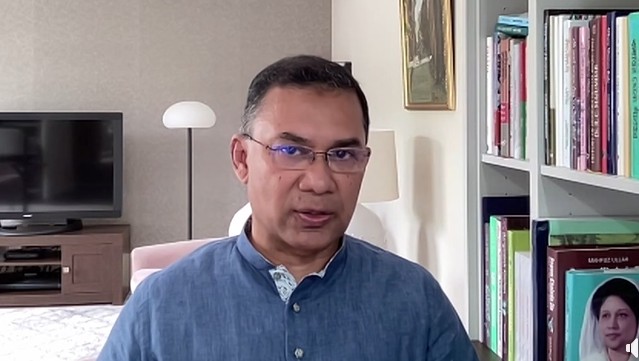



BNP Acting Chairperson Tarique Rahman said that while media in Bangladesh has gained some degree of freedom following the fall of the fascist regime, it is still not entirely free from the grip of fascist forces. He made this remarks in a post on his official Facebook page on Monday.
“I firmly believe that press freedom is a fundamental pillar of multi-party democracy. To ensure the protection and stability of democracy, press freedom must be guaranteed, ” Tarique says.
He alleged “Curtailing press freedom essentially means imprisoning thought and conscience. Like Sheikh Mujibur Rahman, his daughter Sheikh Hasina also followed the same path and reintroduced a one-party system in a new form. By enacting repressive laws, they continuously oppressed journalists and media outlets. In Bangladesh, press freedom was severely curtailed. Anyone speaking the truth faced brutal consequences, forcing journalists and people from all walks of life to live in constant fear.”

Referring to some “draconian laws” he says the Digital Security Act and Cyber Security Act have turned freedom of expression into a “fortress of fear.” “Although the media experienced partial freedom following the fall of the fascist regime on August 5, 2024, it is still not completely free from the control of fascist forces,” he observed.




Pointing towards formation of BAKSAL, Tarique Rahman recalled the events of June 16, 1975, labeling it a “dark day” in Bangladesh’s history. “On this day, the then regime abolished all political parties and imposed an authoritarian one-party system (BAKSAL), allowing only four government-aligned newspapers to operate. This silenced the entire nation. Countless journalists lost their jobs, pushing them and their families into uncertainty and despair.”
He highlighted that the core spirit of Bangladesh’s liberation war was to achieve geographical independence and establish democracy: “In a true democracy, citizens’ freedoms—including freedom of speech, thought, and expression—must be ensured. A free press allows for dissenting voices, which brings both the state and society under accountability and reflects the people’s will in government formation.”He concluded by saying that after independence, the ruling authorities betrayed the spirit of the liberation war by suppressing multi-party democracy and enforcing a one-party rule.
“Later, the proclaimer of Bangladesh’s independence, Shaheed President Ziaur Rahman, reintroduced the long-desired multi-party democracy and reinstated press freedom( in Bangladesh) by abolishing all the undemocratic laws imposed by the BAKSAL regime,” he wrote.
Tarique Rahman concluded his message by reiterating that ensuring press freedom is essential for the protection and sustainability of democracy.