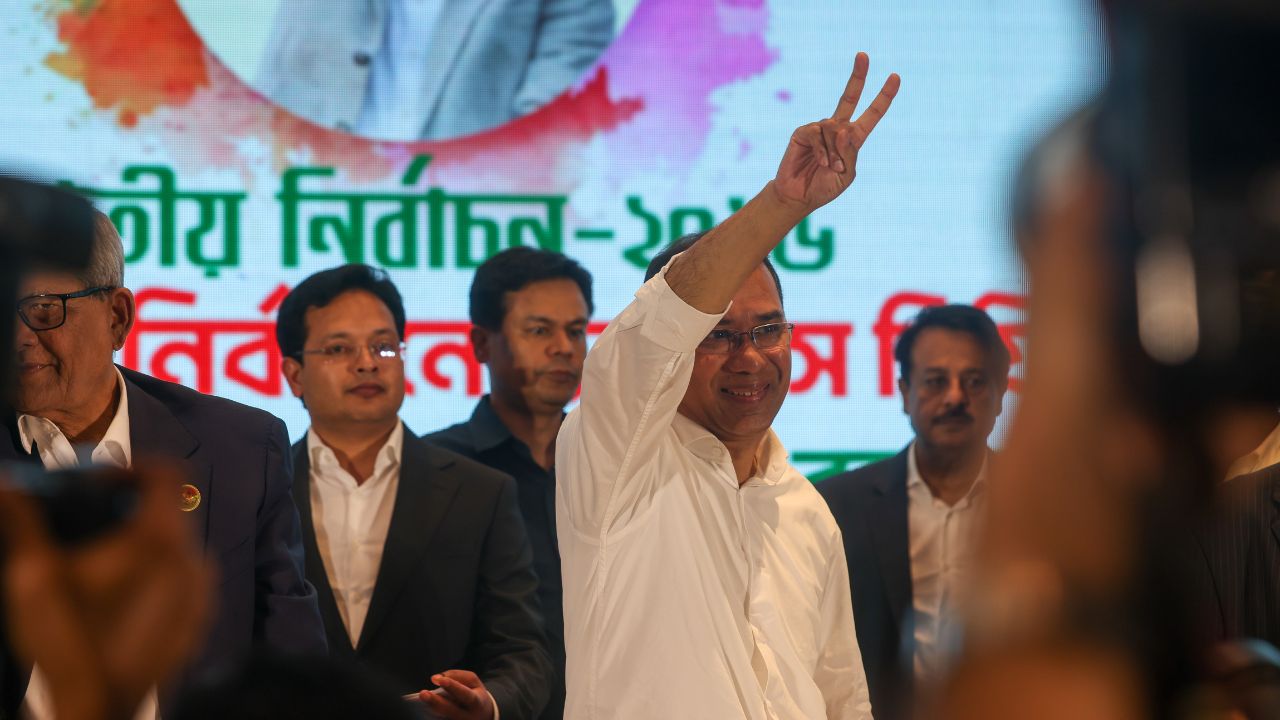

BNP Chairman and Prime Minister-in-waiting Tarique Rahman has called for national unity, democratic consolidation and a foreign policy driven by national interest after his party’s sweeping victory in the 12 February parliamentary election.
Addressing a packed hall of domestic and international journalists at a five-star hotel in the capital on Saturday, Tarique framed the election result not merely as a partisan triumph but as a turning point for democracy, sovereignty and state reform in Bangladesh.
“Stay united to build a humane and democratic country,” he urged, describing the moment as both historic and heavy with responsibility.
‘This victory belongs to the people’
In his first public appearance following unofficial results that showed a landslide mandate for BNP in the 13th parliamentary election, Tarique repeatedly stressed that the victory did not belong to a single party.
“The freedom-loving and democracy-loving people of the country have made BNP victorious today,” he said. “This victory is not of a single party; it is the victory of the common people. From today, we are truly free.”
He congratulated citizens for overcoming what he described as years of political hardship and paving the way for what he called the restoration of democracy after more than 15 years.
Tarique extended special gratitude to the 51 political parties that participated in the election, including Jamaat-e-Islami, National Citizen Party (NCP), Islami Andolan Bangladesh and Gono Odhikar Parishad.
“With your spontaneous participation, a parliament and government accountable to the people are now being established,” he said, describing political parties as the “true beacons of democracy.”

He added that democracy would only take institutional form if both government and opposition played responsible roles. “If both the government and the opposition act responsibly from their respective positions, democracy will surely become institutionalised in the country,” he said.
A fragile inheritance
Tarique acknowledged that his party was assuming office at a difficult time.
“We are assuming responsibility at a time when we must begin our journey amid a fragile economy left behind by fascism, ineffective constitutional and statutory institutions, and a weakened law-and-order situation,” he said. “But with the strength of the people beside us, no obstacle can stop us.”
He pledged that the new government would be fully answerable to the public, with state and constitutional institutions restored as a primary goal. Emphasising accountability and reform, he said the administration would focus on rebuilding institutions he claimed had been weakened under authoritarian rule.
Reaffirming BNP’s 31-point agenda and July Charter, Tarique assured voters that manifesto commitments would be implemented gradually. “Justice will be our guiding principle. If the rule of law is not established, all our efforts will be in vain,” he said, adding that the law would apply equally to all citizens, regardless of party, religion or opinion.


He also thanked the interim government and Election Commission for what he described as a credible and peaceful election, and praised the roles of judicial officials, public administration, armed forces, law enforcement agencies, as well as domestic and international observers and the media.
Tribute and restraint
Tarique paid tribute to those who had sacrificed their lives or were injured in pro-democracy movements — from the 1971 War of Independence to the 2024 mass uprising — saying their contributions would never be forgotten.
“Throughout this long journey, those brave individuals whose blood and sacrifices paved the difficult path toward today’s democratic Bangladesh, I express my deepest respect,” he said.
He also acknowledged the absence of BNP’s former leader, the late Khaleda Zia, describing her steadfast struggle against what he termed fascism as an enduring inspiration.
Despite the scale of the victory, Tarique instructed party activists to refrain from holding celebratory processions.
“We have celebrated this victory by offering thanks to Almighty Allah,” he said, urging calm and vigilance. He warned that no unlawful activity or retaliation would be tolerated in the post-election period and called on supporters to move beyond electoral rivalries.
‘Bangladesh First’ foreign policy
Beyond domestic reform, Tarique used the press conference to outline what he described as a fundamental shift in foreign policy, anchored in sovereignty and national interest.
“Regarding foreign policy, the interest of Bangladesh and the interest of Bangladeshi people comes first,” he said.
Describing the approach as “Bangladesh First”, he rejected what he termed “country-centric” diplomacy that favours one neighbour over another. When asked by international journalists about relations with India, Pakistan and China, Tarique was unequivocal.
“This is the foreign policy for all countries. No country-centric policy,” he said, outlining a framework based on “mutual respect, mutual interest, non-interference and strategic autonomy.”
He emphasised that Bangladesh would never return to being a “subservient state”, saying the electorate’s mandate was not only for domestic change but also to ensure that “no evil force” could turn the country into a puppet of external powers.
On major global initiatives, including Chinese-backed infrastructure projects, Tarique said all international partnerships would be evaluated on whether they truly benefited the Bangladeshi people. “Something which will not be in the interest of Bangladesh, we will not [do],” he said.
When asked about the trial of Sheikh Hasina and the possible revival of South Asian Association for Regional Cooperation (SAARC), Tarique noted that the original initiative to establish SAARC had come from Bangladesh, and said his government was keen to see the regional body reactivated. He added that the matter would be discussed further once the new administration formally assumes office.
Asked specifically about the prospect of Sheikh Hasina’s trial, Rahman said the issue would depend on due legal process. “It will depend on the legal system,” he said.
The BNP leadership signalled that foreign policy would also be closely tied to economic recovery and job creation. Tarique expressed hope that the international community would see Bangladesh as a “friend” and increase investment and business cooperation to stabilise what he described as a fragile economy.
Supporting his remarks, BNP Secretary General Mirza Fakhrul Islam Alamgir said the result marked a victory for an “independent and democratic Bangladesh” and affirmed party unity on safeguarding national sovereignty.
A call for unity
Closing his address, Tarique appealed for cooperation from all citizens, regardless of political affiliation, in building what he described as a safe, humane and democratic Bangladesh.
He extended thanks to expatriate Bangladeshis and democratic forces around the world, reiterating that unity — not division — must define the next chapter.
“With congratulations and thanks once again to all democratic forces around the world, to all expatriate Bangladeshis, and to the freedom-loving people of our country on this victory, I conclude my speech,” he said.