

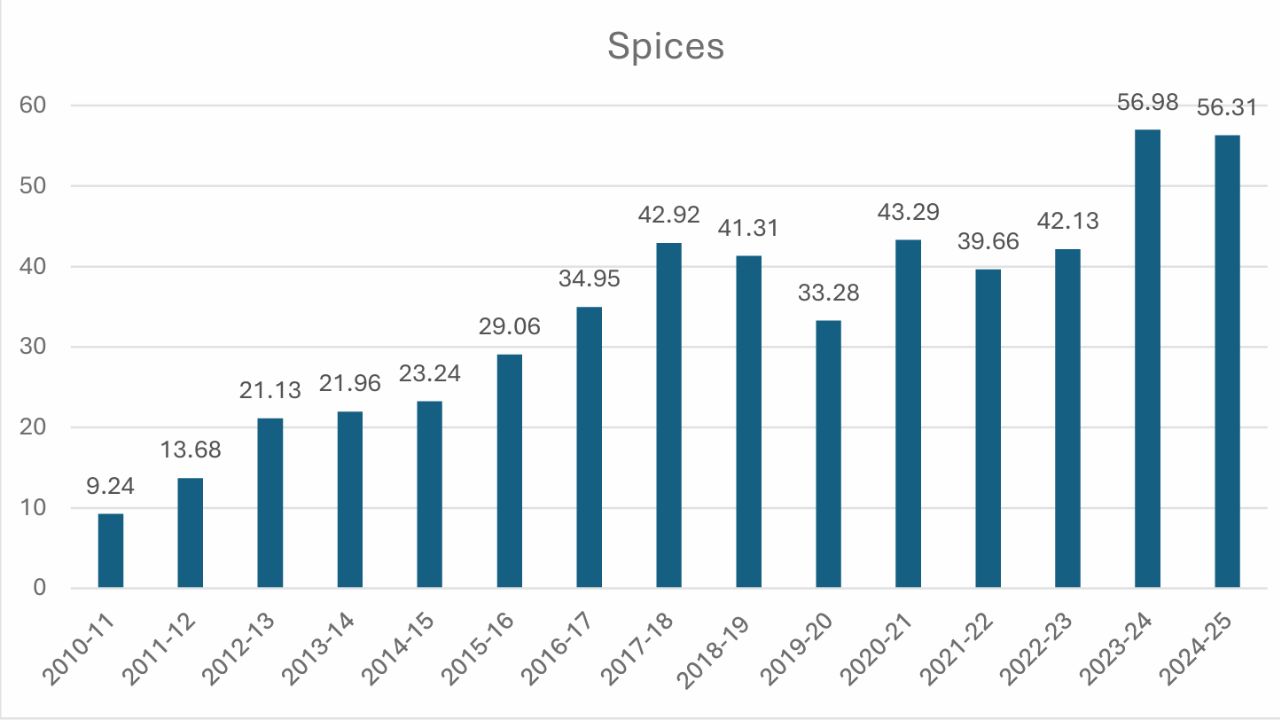
Bangladesh’s spice exports have surged more than five times in 15 years to reach a record $56.31 million, driven by a growing diaspora and rising global demand for Bangladeshi flavours.
According to the Export Promotion Bureau, the country earned around $9.24 million from spice exports in the fiscal year 2010-11. With more items entering new markets and reaching a wider consumer base, exports have climbed sharply, making spices one of the fastest-growing segments in the agricultural export basket.
Exporters say the growth could accelerate if the country expands its sterilisation capacity, which remains the biggest barrier to entering stringent markets such as the United States and Europe.
Spice exports could double within the next two to three years if sterilisation facilities improve, said PRAN Marketing Director Kamruzzaman Kamal and Square Food and Beverage Director Parvez Saiful Islam.
A large base of more than one crore Bangladeshis living abroad is a key driver behind the steady rise in demand. Islam said the diaspora continues to enjoy home-cooked meals year-round, fuelling sales of local spices in the Gulf, North America, Europe and parts of Asia.
He said young non-resident Bangladeshis prefer ready-mixed spices for biriyani, meat curries and kabab, similar to young homemakers and students in the domestic market.

Kamal added that the sector has transitioned from informal exports to structured, high-quality production with modern testing and packaging. This shift has strengthened the competitiveness of Bangladeshi spices across continents.
Bangladesh now exports spices in whole, powdered and mixed forms. Popular items include red chilli powder, cinnamon, clove, coriander seed, cumin, ginger and turmeric. Many spices — such as cinnamon, clove and coriander — are imported, processed locally and then exported.




Major destinations include Saudi Arabia, Bahrain, Iraq, Oman, Qatar and the United Arab Emirates, while shipments to the United States, Canada and European Union countries are increasing. Australia, Malaysia and several ASEAN markets are expanding rapidly.
Kamal said consumers from other South Asian countries, including India and Pakistan, are increasingly buying Bangladeshi branded spices for their quality. Arab consumers, especially those preparing biriyani, kebab and meat dishes, are also opting for Bangladeshi spices as their experience improves.
Malaysia, with a large non-resident Bangladeshi population, is emerging as a fast-growing market.
But exporters warn that access to Western markets is being constrained by the lack of sterilisation facilities.
After the Covid-19 pandemic, developed countries tightened food-safety rules, making gamma-radiation sterilisation mandatory for many spice products. For years, the Institute of Radiation and Polymer Technology (IRPT) in Savar provided the service, but it remained closed from November 2023 to July 2025 for renovation.
As an interim solution, the Institute of Food and Radiation Biology has been offering sterilisation, though with much lower capacity. Exporters say shipments to the United States and Europe have more than halved due to delays. Without timely sterilisation, consignments cannot be cleared for export, disrupting supply chains and weakening exporter reliability.
Many fear prolonged bottlenecks could allow rivals such as India and Pakistan to capture Bangladesh’s market share, especially in North America.
Kamal said PRAN maintains internal systems to control bacteria and ensure product safety but still relies heavily on IRPT for radiation treatment. He said exports could increase significantly if the government fully reopens IRPT or sets up new sterilisation centres.
Square’s Islam said destinations like the Gulf and Malaysia accept heat-treated products, but high-value Western markets require radiation facilities.
In good news for exporters, IRPT is set to boost its sterilisation capacity tenfold. A Tk63 crore renovation project, undertaken under an agreement with Russia, was scheduled for completion in June, but machinery installation is still pending.
IRPT Director Ruhul Amin Khan told the TIMES of Bangladesh that the centre reopened in July using its old system and the new machines have yet to be installed due to payment complexities delaying the Russian team’s arrival.
“Once the new machinery is operational, the sterilisation capacity will increase tenfold,” he said, expecting it to be ready by the end of this year.
PRAN and Square aim to expand their customer base beyond non-resident Bangladeshis in the long run. They see strong potential among large South Asian communities abroad and hope to capture even 10% to 20% of that wider ethnic market.
Kamal said competition has turned into a quality battle with multiple exporting countries vying for the same consumers.