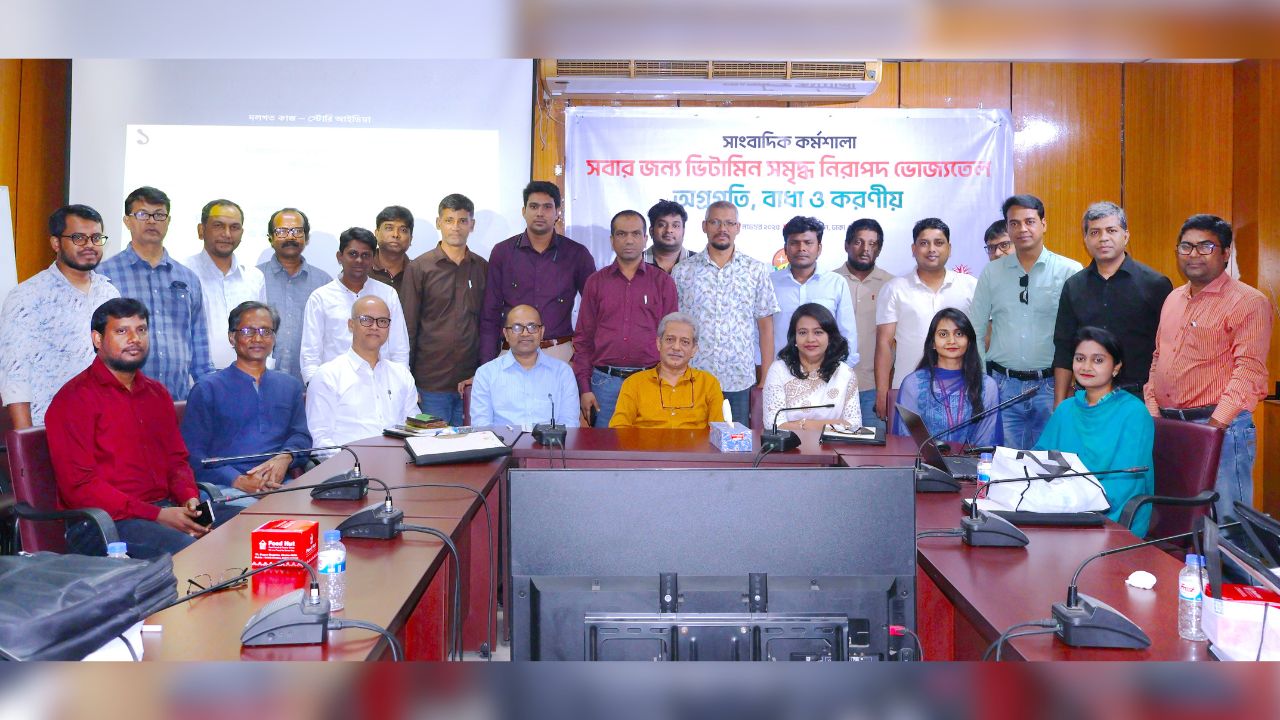

Experts at a journalists’ workshop today emphasized the urgent need for vitamin-fortified, safe edible oil to protect public health and promote a healthy generation.
Held at BMA Bhaban in Dhaka on Tuesday, the workshop titled “Vitamin-Fortified Safe Edible Oil for All: Progress, Challenges, and Way Forward” was organized by PROGGA (Knowledge for Progress) and the National Heart Foundation of Bangladesh.
The event brought together 23 journalists from various print, television, and online media outlets.
The workshop underscored the risks posed by the sale of loose edible oil in open drums and the absence of opaque packaging, which violates government regulations and undermine public health.

According to the National Micronutrient Survey (2011–12), one in five children in Bangladesh suffers from vitamin A deficiency, while two in five are lacking sufficient vitamin D. Despite the existence of the Vitamin ‘A’ Enrichment in Edible Oils Act, 2013, a significant portion of the oils in the market contain insufficient or no vitamins.
A study by ICDDR,B found that 65 pe cent of edible oil sold in the market is in open drums, with 59 per cent containing no vitamin A and only 7 per cent meeting the required legal standards for vitamin content.




Experts at the workshop highlighted that the open sale of edible oils in non-food grade drums — often previously used to store chemicals, engine oils, or industrial products — is a major issue.
These drums do not provide any information on the oil’s source or quality, making it easy for adulterated or substandard oils to enter the market. The Ministry of Industries had issued directives to ban the sale of soybean oil in open drums from July 2022 and palm oil from December 2022, but such practices continue to persist.
Speakers at the event called for stronger coordinated monitoring by the Ministry of Industries, the Bangladesh Standards and Testing Institution (BSTI), the Directorate of National Consumer Rights Protection (DNCRP), and the Food Safety Authority to ensure safe, vitamin-fortified edible oil reaches consumers.
The workshop also discussed the health implications of vitamin A and D deficiencies.
Vitamin A deficiency increases the risk of childhood blindness and maternal mortality, while vitamin D deficiency is linked to rickets, bone density loss, cardiovascular disease, and other non-communicable diseases. Experts highlighted that fortifying edible oil with both vitamins A and D is an affordable and effective public health solution, providing essential nutrients through everyday meals.
The event further emphasized the importance of storing edible oil in light-resistant, opaque bottles, as exposure to sunlight can degrade vitamin A and compromise the oil’s quality.
The speakers concluded that ensuring the safe packaging and fortification of edible oil is essential for safeguarding public health and providing necessary nutrition to the population.
The workshop featured presentations by Dr Aliva Haque, Program Officer at PROGGA, and Md. Hasan Shahriar, Head of Programs at PROGGA. The discussion panel included Fakir Muhammad Munawar Hossain, Former Director (Deputy Secretary), Operations and Laboratories Department, DNCRP; Mustak Hassan Md. Iftekhar, Consultant at the National Heart Foundation Hospital & Research Institute; Dr Ashek Mahfuz, Portfolio Lead for Large Scale Food Fortification and Value Chain at the Global Alliance for Improved Nutrition (GAIN); Doulot Akter Mala, President of the Economic Reporters Forum (ERF) and Special Correspondent at The Financial Express; and ABM Zubair, Executive Director of PROGGA.